Long COVID and the Damaged Vagus: A Three-Reflex Model of Recovery
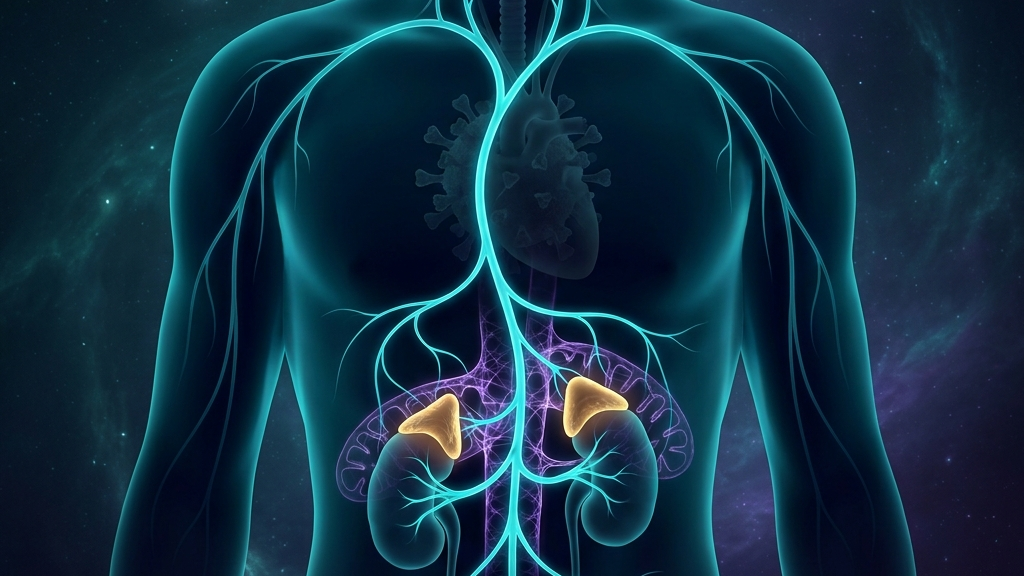
Long COVID has resisted clean explanation for years. The most coherent framework to emerge in 2024 proposes a three-reflex model: SARS-CoV-2 inflicts chronic functional damage on three of the body's primary anti-inflammatory systems — the vagus nerve reflexes, the HPA hormonal axis, and the mitochondrial redox network — and Long COVID is the phenomenology of all three failing at once (Frontiers in Cellular and Infection Microbiology, 2024).
What's Actually Broken
Reflex 1: The Vagal Anti-Inflammatory Loop
The cholinergic anti-inflammatory pathway is one of the most powerful endogenous brakes on systemic inflammation. SARS-CoV-2 directly infects vagal ganglia and brainstem nuclei in autopsy tissue, and surviving patients show reduced HRV that persists for months. Without that brake, baseline cytokine tone stays elevated.
Reflex 2: HPA Axis Dysregulation
Cortisol is required for resolution of inflammation. In Long COVID populations, morning cortisol is persistently lower than expected, and circadian cortisol curves flatten. Recovery from any acute stressor is therefore prolonged.
Reflex 3: Mitochondrial Failure
Peripheral blood mononuclear cells from Long COVID patients show altered ATP synthase behavior and increased baseline oxygen consumption — the cells are working harder for less ATP (PMC 12344680, 2025). This is not metaphorical exhaustion. It is a measurable bioenergetic deficit.
Why Patients Look So Different From Each Other
The three-reflex model explains the wild heterogeneity. A patient whose dominant lesion is vagal will present with POTS, GI dysmotility, and orthostatic intolerance. A patient whose dominant lesion is mitochondrial will present with post-exertional malaise that looks like ME/CFS. A patient whose dominant lesion is HPA will present with cortisol-pattern fatigue, low stress tolerance, and brain fog. Most patients have all three — in different ratios.
POTS as the Vagal Subtype
Long COVID-POTS deserves special attention because it is so common and so treatable when recognized. Proposed mechanisms include autoimmunity against autonomic ganglia, viral persistence in vagal tissue, persistent inflammation, mitochondrial dysfunction, and brainstem swelling — all converging on autonomic instability (Annals of Medicine, 2025).
A Recovery Framework That Treats All Three Reflexes
- Vagal restoration: daily slow breathing, cold-water face immersion, auricular taVNS where available, gentle vagal exercises, consistent sleep schedule.
- HPA support: circadian light exposure (morning sun, dark evenings), adequate salt and fluid intake for orthostatic patients, careful adrenal-axis-aware exercise pacing.
- Mitochondrial support: CoQ10 (ubiquinol form), magnesium glycinate, B-complex, attention to sleep architecture, time-restricted eating where tolerated, and — critically — energy envelope discipline. Pushing through post-exertional malaise damages mitochondrial recovery and slows everything else.
- Pacing as a clinical intervention. The single most underrated treatment in Long COVID is the deliberate refusal to do too much. The autonomic system needs unambiguous safety signals to begin rebuilding the vagal brake.
Clinical takeaway: Long COVID recovery rarely happens through a single intervention because the underlying pathology is rarely single. Treat the vagus, the HPA axis, and the mitochondria together — and pace ruthlessly while you do it.
References & Further Reading
- Connecting dots of Long COVID-19 pathogenesis: vagus–HPA–mitochondrial axis. Frontiers in Cellular and Infection Microbiology, 2024. Read
- Mitochondrial function is impaired in Long COVID patients. Annals of Medicine, 2025. Read
- Mitochondrial dysfunction in Long COVID: mechanisms and therapeutic approaches. PMC 11336094. Read
- Lingering echoes of SARS-CoV-2: management of Long COVID. Inflammopharmacology, 2025. Read
Have a question?
Have a question about something specific? Send us a message.
Visit VagusSkool.com/contact — we'll try to get back to you within 24 hours.