The Baroreflex: The Blood-Pressure Thermostat the Vagus Runs — and What Breaks in POTS
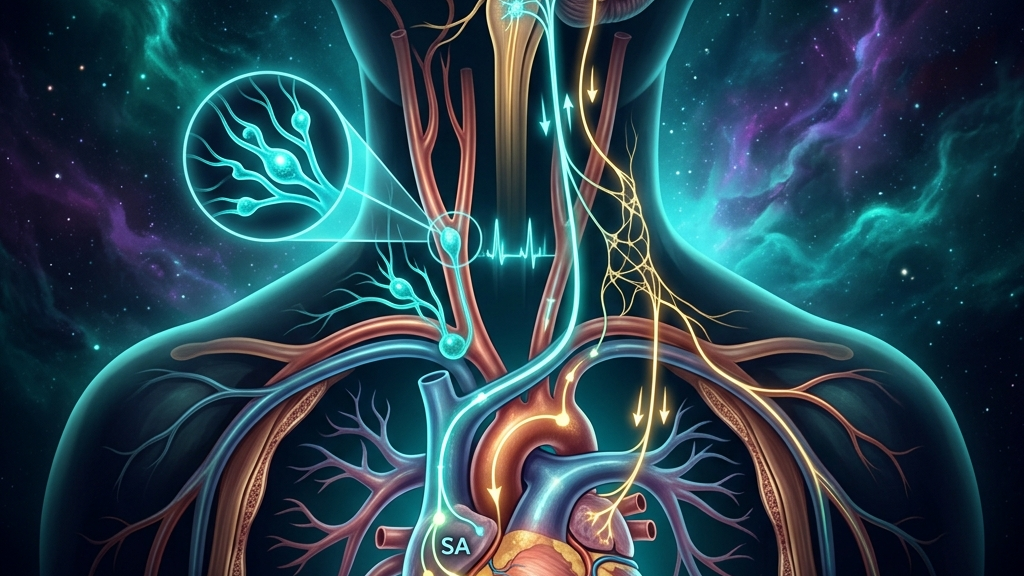
Stand up quickly and gravity pulls roughly half a liter of blood down into your legs and belly within seconds. By all rights your blood pressure should crash and you should faint every single time you rise from a chair. You don't — because a reflex loop measures the pressure drop and corrects it before you even notice, often within a single heartbeat. When that loop works, standing is invisible. When it doesn't, standing becomes the central problem of your day. Understanding the loop is the first step to understanding conditions like POTS.
The Pressure Thermostat
Think of a thermostat. It senses temperature, compares it to a target, and adjusts the heating to close the gap. Your body runs the same design for blood pressure, and it is called the baroreflex (the automatic feedback loop that keeps blood pressure stable by adjusting heart rate and vessel tension). The sensors are baroreceptors (stretch-detecting nerve endings embedded in artery walls that fire faster when the vessel is stretched harder by higher pressure).
The most important cluster sits in the carotid sinus (a small widening of the carotid artery in your neck, densely packed with baroreceptors), with a second set in the aortic arch. These are the thermometers of the system, constantly reporting how hard your blood is pushing on the vessel walls.
The Loop, Beat by Beat
Here is the sequence when you stand. Pressure drops, so the baroreceptors stretch less and fire less. That drop in firing travels up sensory fibers to the nucleus tractus solitarius (the NTS — the brainstem relay where visceral sensory signals first arrive). The NTS reads "pressure falling" and responds two ways at once: it pulls back the vagal brake so the heart speeds up, and it tightens the blood vessels to raise pressure.
The vagus is the fast lane here. Because vagal control of the heart acts almost instantly, the baroreflex can adjust heart rate within a single beat. That is the smooth "catch" that keeps you upright — a correction so quick you never feel the drop it just fixed (StatPearls: Physiology, Baroreceptors).
What Breaks in POTS
In orthostatic intolerance (the general term for symptoms brought on by being upright — dizziness, racing heart, brain fog, weakness), and specifically in POTS, the loop does not fail outright. Its gain is off. Gain is how strongly the system responds to a given error. When you stand:
- The pressure drop is met with an oversized heart-rate response. Instead of a small, smooth speed-up, the heart overshoots and races — the defining feature of POTS is a large jump in heart rate on standing.
- The vessel-tightening half often underperforms. If blood vessels don't clamp down adequately, blood pools in the legs, the pressure error persists, and the heart is left to compensate by beating even faster.
- The correction never fully lands. A well-tuned loop fixes the error and quiets down. A poorly tuned one keeps chasing it, which is why upright time feels like relentless effort rather than a solved problem.
The racing heart in POTS is often not the disease itself — it is the loop overworking to cover for a correction that isn't happening elsewhere. Reframing tachycardia as "compensation" rather than "malfunction" changes how you interpret your own body.
Measuring the Loop's Health
Because the baroreflex is a measurable loop, we can quantify how well it works. That measure is baroreflex sensitivity (how much the heart rate changes per unit of blood-pressure change — essentially, the gain of the loop). High baroreflex sensitivity means a responsive, well-damped system: pressure moves, the heart answers proportionately, the error closes. Low sensitivity means a sluggish or erratic loop.
Because the vagus supplies the fast, beat-to-beat arm of the reflex, baroreflex sensitivity doubles as a window into vagal health. A loop that catches pressure smoothly is a vagus doing its job well. Training slow breathing, improving hydration and blood volume, and gradually reconditioning upright tolerance all aim at the same target: nudging the loop's gain back toward a smooth catch.
References & Further Reading
- Armstrong M, Kerndt CC, Moore RA. Physiology, Baroreceptors. StatPearls, NCBI Bookshelf. NCBI Bookshelf
- Fedorowski A. Postural orthostatic tachycardia syndrome: clinical presentation, aetiology and management. Journal of Internal Medicine, 2019. PubMed
- Lanfranchi PA, Somers VK. Arterial baroreflex function and cardiovascular variability. Overview at Baroreflex
Have a question?
Have a question about something specific? Send us a message.
Visit VagusSkool.com/contact — we'll try to get back to you within 24 hours.