Chronic Pain Is a Vagal Problem: How the Cholinergic Brake Counters Central Sensitization
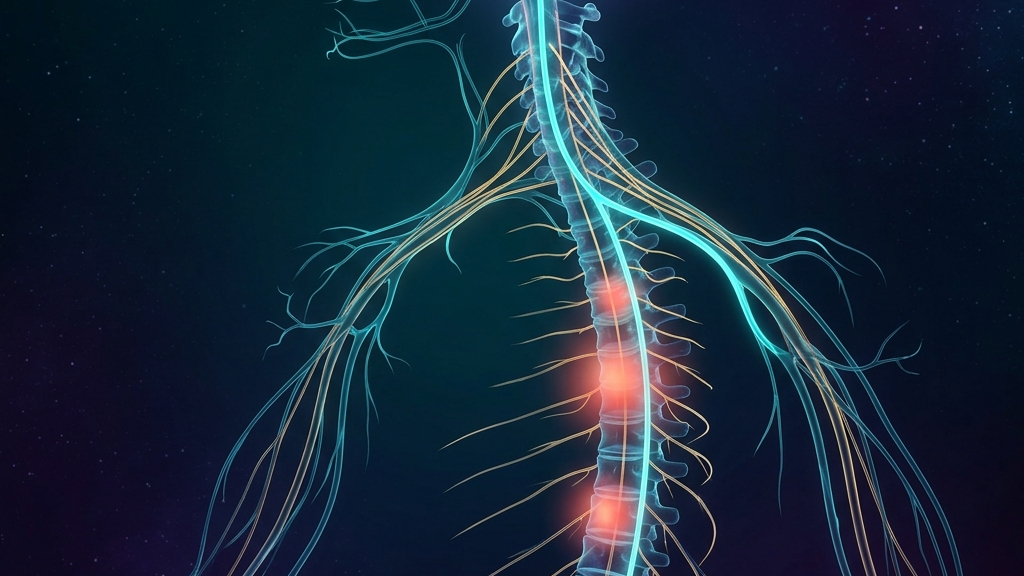
Chronic pain has long been treated as an input problem — a damaged tissue producing too much pain signal. That model accounts for some pain. It does not account for most chronic pain. The deeper picture is that chronic pain reflects central sensitization: the nervous system itself has become hyperexcitable, amplifying signals that were never meant to be painful, driven by neuroinflammation that has nowhere to resolve. The vagus nerve has direct biological access to that loop, and the chronic pain field is increasingly building treatment around that fact.
What Central Sensitization Actually Is
Central sensitization is the adaptive response of the central nervous system to overactivity, inflammation, or nerve injury, resulting in increased excitability of injury-sensing pathways (PubMed 37011956). It is a phenomenon of synaptic plasticity in central pain pathways — the nervous system literally rewires to make pain signals louder. Once established, it self-maintains through neuroinflammation in the peripheral and central nervous system (PMC 6051899).
This is why chronic pain so often outlives its initial cause. The original injury heals; the central amplification stays. And it is why many chronic pain patients have widespread symptoms — fibromyalgia phenotypes, irritable bowel, headaches, sensitivity to light, sound, and touch — that look unrelated until you recognize them as the same underlying loop.
The Vagus Nerve's Role in the Pain Loop
Three vagal mechanisms converge on the central sensitization picture:
1. The Cholinergic Anti-Inflammatory Pathway
Vagal efferents release acetylcholine that binds α7 nicotinic acetylcholine receptors on macrophages and microglia, suppressing pro-inflammatory cytokine production (PMC 1430829). Neuroinflammation drives central sensitization; the vagus is one of the most direct endogenous brakes on it.
2. Descending Pain Modulation
VNS modulates descending serotonergic and noradrenergic pathways, which in turn dampen nociceptive transmission at the spinal level. The result: less signal reaches the conscious pain centers (Frontiers in Pain Research, 2026).
3. Autonomic Balance
Sympathetic dominance amplifies pain perception. Restoring vagal tone shifts the autonomic balance, lowering the substrate from which pain is read.
What the Clinical Evidence Shows
Recent trials of transcutaneous vagus nerve stimulation in chronic pain populations have produced meaningful results:
- A 2025 randomized controlled trial of transcutaneous VNS in knee osteoarthritis showed measurable pain modulation versus sham (BMC Musculoskeletal Disorders, 2025).
- A 2023 review documented VNS efficacy across chronic headache, fibromyalgia, abdominal pain, and pelvic pain populations (PMC 10614462).
- A 2024 editorial in Frontiers in Pain Research summarized the emerging consensus that non-invasive VNS is a viable adjunct in chronic pain care (Frontiers).
The Patient Profile
The chronic pain patient most likely to benefit from a vagal approach is the one whose pain spans multiple regions, fluctuates with stress and sleep, comes with low HRV, sympathetic dominance signs, and frequently overlaps with anxiety, GI symptoms, and fatigue. This is the central sensitization phenotype. Localized post-traumatic pain with no widespread features is a different problem with different solutions.
A Vagus-First Chronic Pain Framework
Foundational
- Daily six-per-minute breathing — 20 minutes minimum, ideally split morning and evening
- Cold-water face immersion or cold shower exposure
- Sleep prioritization — central sensitization worsens with poor sleep, full stop
- Movement that lowers sympathetic tone — walking, swimming, yoga, gentle resistance work
Layered Interventions
- HRV biofeedback for measurable progress
- Auricular taVNS where available and tolerated
- Pain neuroscience education — patients who understand central sensitization often see meaningful reduction in pain catastrophizing, which in turn lowers the loop
- Body-based therapy — Somatic Experiencing, Feldenkrais, gentle myofascial work to restore non-painful interoception
- Address comorbidities — MCAS, gut dysbiosis, sleep apnea, mood disorders — each treated lowers the substrate
Pharmacology in Context
SNRIs, gabapentinoids, and low-dose naltrexone all have evidence in central sensitization populations. Opioids generally do not, and often worsen the loop through opioid-induced hyperalgesia. The medications work better as part of a vagal-restoration program than as standalone treatment.
Clinical takeaway: Most chronic pain is not an input problem — it is a central amplification problem. The cholinergic anti-inflammatory pathway is one of the most powerful endogenous tools we have to quiet that amplification. Restoring vagal tone is one of the few interventions that addresses pain at its source rather than masking the signal.
References & Further Reading
- Neuroinflammation and central sensitization. PMC 6051899. Read
- taVNS in chronic pain — mechanisms and applications. Frontiers in Pain Research, 2026. Read
- Role of VNS in chronic pain. PMC 10614462. Read
- Transcutaneous VNS in knee OA — RCT. BMC Musculoskeletal Disorders, 2025. Read
- Central sensitization, chronic pain, and other symptoms. PubMed 37011956. Read
Have a question?
Have a question about something specific? Send us a message.
Visit VagusSkool.com/contact — we'll try to get back to you within 24 hours.