Vagus Nerve and Social Connection — The Neurobiology of Co-Regulation
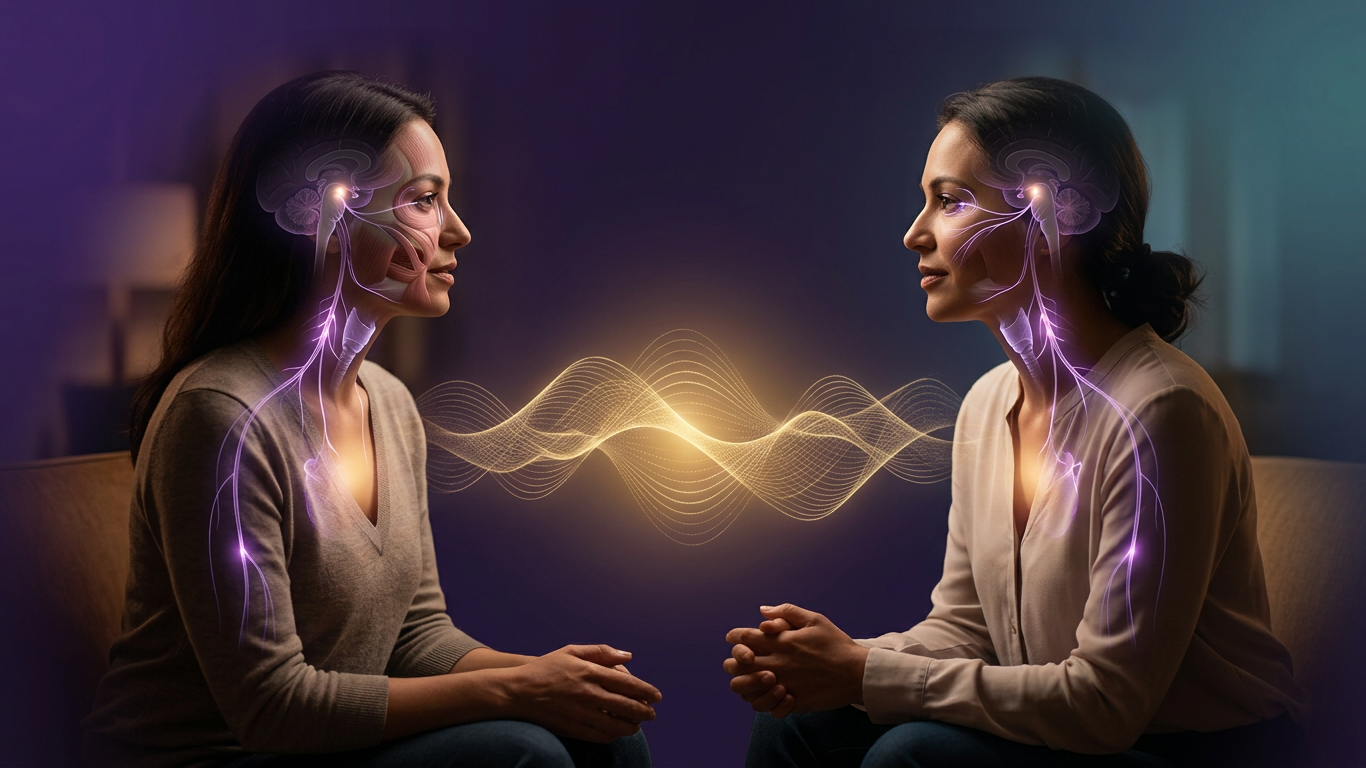
Vagus Nerve and Social Connection — The Neurobiology of Co-Regulation
Thesis
Social connection isn't a psychological luxury — it's a biological necessity mediated by the vagus nerve. The ventral vagal complex evolved specifically for mammalian social engagement: facial expression, vocal prosody, listening, and eye contact. When we connect with others, our vagal systems synchronize — heart rates align, breathing entrains, and autonomic states co-regulate. Positive social experiences build vagal tone; isolation degrades it. This creates a direct causal pathway from loneliness to cardiovascular disease, immune dysfunction, and premature death.
Key Questions
- How does the vagus nerve mediate social connection at a mechanistic level?
- What is co-regulation, and how do two nervous systems synchronize?
- Does positive social experience literally build vagal tone?
- Why is loneliness as dangerous as smoking 15 cigarettes per day?
Supporting Research
Porges, S.W. (2007). The polyvagal perspective. Biological Psychology, 74(2), 116–143. PMID: 17049418
Kok, B.E. et al. (2013). How positive emotions build physical health: Perceived positive social connections account for the upward spiral between positive emotions and vagal tone. Psychological Science, 24(7), 1123–1132.
The Social Engagement System
Porges' Polyvagal Theory describes the "social engagement system" — an integrated neural platform connecting brainstem nuclei to cranial nerves V (face), VII (expression), IX (gulping), X (vagus — heart/lungs), and XI (head turning). When the ventral vagal complex is active, these circuits enable:
- Facial expressivity and genuine smiling
- Vocal prosody (warm, melodic speech)
- Attentive listening and head turning toward speakers
- Gentle eye contact that signals safety
- Social referencing — reading emotional cues from others
This system operates via neuroception — the unconscious scanning for safety cues. When neuroception detects safety (warm voice, gentle eyes, open posture), the ventral vagal system activates, inhibiting defensive sympathetic and dorsal vagal circuits.
Co-Regulation: Synchronized Nervous Systems
Co-regulation is the bidirectional process where two individuals attune to each other's autonomic states through social cues. It works through the vagus nerve:
- Mother-infant bonding: maternal vocal prosody and touch synchronize infant HRV
- Romantic partners: synchronized heart rates and breathing during intimate conversation
- Therapist-client: the therapist's regulated nervous system provides a "vagal anchor" for dysregulated clients
- Group singing/chanting: unison vocalization synchronizes HRV across participants
Co-regulation is the foundation of self-regulation development — children learn to regulate their own nervous systems by internalizing patterns from co-regulating caregivers.
The Upward Spiral: Positive Emotions Build Vagal Tone
Kok et al. (2013) demonstrated a remarkable feedback loop: positive emotions increase vagal tone, and higher vagal tone facilitates more positive emotions. In a longitudinal study:
- Participants with increasing vagal tone over 9 weeks also showed increasing positive emotions
- This relationship was mediated by perceived positive social connections
- The effect was bidirectional — each reinforced the other in an "upward spiral"
In other words: social connection → positive emotions → higher vagal tone → better emotional regulation → more social connection. The reverse (loneliness → negative emotions → lower vagal tone → worse regulation → more isolation) is the "downward spiral" that characterizes depression and social anxiety.
Why Loneliness Is Dangerous
Without co-regulation, the autonomic nervous system loses its external support structure. Chronic loneliness produces:
- Reduced baseline vagal tone (measurably lower HRV)
- Chronic sympathetic activation (elevated cortisol, blood pressure)
- Elevated inflammatory markers (CRP, IL-6)
- Impaired sleep quality
- Accelerated biological aging
Holt-Lunstad's meta-analyses showed social isolation increases mortality risk by 29% — equivalent to smoking 15 cigarettes per day, and greater than obesity or physical inactivity.
Why This Matters
The vagus nerve transforms social connection from a "nice to have" to a biological imperative. We evolved as social mammals — our nervous systems literally require input from other nervous systems to function optimally. This reframes public health: social isolation isn't just sad, it's physically dangerous. It also explains why community, belonging, and relationships are consistently the strongest predictors of longevity across cultures.
Experimental Predictions
- Socially connected individuals should show higher resting vagal tone than isolated individuals
- Therapeutic co-regulation (safe relationships) should measurably increase vagal tone in trauma survivors
- Loneliness interventions that build social connection should improve HRV and reduce inflammatory markers
- Group practices (choir, martial arts, partner dance) should synchronize HRV across participants and improve individual vagal tone
Have a question?
Have a question about something specific? Send us a message.
Visit VagusSkool.com/contact — we'll try to get back to you within 24 hours.