The Vagus Nerve and Immune Regulation — Neuroimmunology of Healing
The Vagus Nerve and Immune Regulation — Neuroimmunology of Healing
Thesis
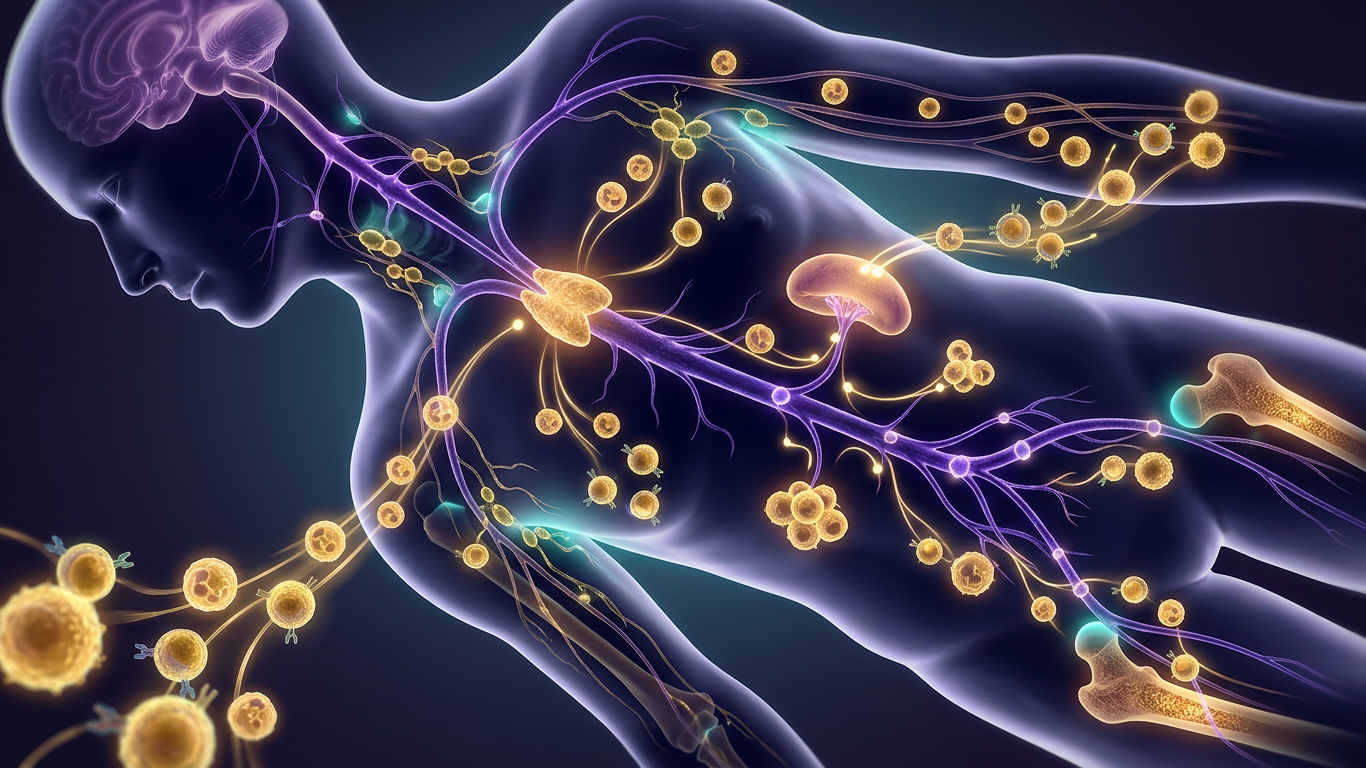
The immune system is not autonomous — it's under direct neural control. The vagus nerve regulates inflammation through a circuit involving an unexpected player: memory T cells that produce acetylcholine. Rosas-Ballina's 2011 Science paper solved a critical puzzle in the cholinergic anti-inflammatory pathway — how vagus nerve signals reach splenic macrophages when the spleen lacks cholinergic nerve fibers. The answer: T cells act as a relay, receiving neural signals and converting them into immune-modulating acetylcholine.
Key Questions
- How does the vagus nerve control immune function without direct innervation of immune organs?
- What role do T cells play as a cholinergic relay in the inflammatory reflex?
- How was this circuit experimentally verified?
- What are the therapeutic implications for autoimmune and inflammatory diseases?
Supporting Research
Rosas-Ballina, M. et al. (2011). Acetylcholine-Synthesizing T Cells Relay Neural Signals in a Vagus Nerve Circuit. Science, 334(6052), 98–101.
DOI: 10.1126/science.1209985 | PMC
Koopman, F.A. et al. (2016). Vagus nerve stimulation inhibits cytokine production and attenuates disease severity in rheumatoid arthritis. PNAS, 113(29), 8284–8289.
The Missing Cholinergic Link
Tracey's earlier work established that vagus nerve stimulation suppresses TNF-α production in the spleen via the α7 nicotinic acetylcholine receptor (α7nAChR) on macrophages. But there was a problem: the spleen doesn't contain cholinergic nerve fibers. Splenic nerve fibers lack choline acetyltransferase (ChAT), the enzyme needed to synthesize acetylcholine. So how does the vagus nerve signal reach splenic macrophages?
The T Cell Relay
Rosas-Ballina discovered a population of CD4+ memory T cells (CD44hi, CD62Llo) in the spleen that express ChAT and produce acetylcholine. The circuit works in three steps:
- Vagus nerve stimulation activates splenic sympathetic nerves (noradrenergic fibers)
- Sympathetic signals activate ChAT+ T cells in the spleen's marginal zone and white pulp
- T cells release acetylcholine, which binds α7nAChR on macrophages, inhibiting TNF-α and other pro-inflammatory cytokines
T cells are not just immune cells — they're functional components of a neural circuit, converting electrical nerve signals into chemical immune modulation.
Experimental Evidence
- Splenectomy or splenic nerve transection: VNS fails to suppress TNF-α — the spleen and its neural connection are required
- Rag1−/− mice (no mature T/B cells): VNS anti-inflammatory effects are lost. Adoptive transfer of ChAT+ (but not ChAT−) T cells restores them
- CD4+ T cell depletion: Abolishes VNS protection against lethal endotoxemia
The specificity is remarkable: only ChAT+ T cells rescue the function. ChAT− T cells from the same animals do not. This proves acetylcholine production by T cells is the critical relay mechanism.
Clinical Translation
Koopman et al. (2016) demonstrated clinical relevance by testing VNS in rheumatoid arthritis patients:
- Invasive VNS for 84 days reduced TNF-α, IL-6, and IL-1β levels
- Disease activity scores (DAS28-CRP) improved significantly
- Effects were sustained — suggesting the cholinergic anti-inflammatory pathway can be therapeutically engaged in humans
Why This Matters
This discovery bridges neuroscience and immunology in a way that was previously unimaginable. The nervous system directly controls immune function through a hard-wired circuit involving T cells as neural relays. This has profound implications:
- Autoimmune diseases may involve dysfunction in this neural-immune circuit
- VNS could be an alternative to immunosuppressive drugs for inflammatory conditions
- Vagal tone (measured by HRV) might predict inflammatory disease risk
- The "psychosomatic" connection between stress and immune function now has a molecular mechanism
Experimental Predictions
- Patients with autoimmune diseases should show reduced ChAT+ T cell populations
- Vagal tone should correlate with ChAT+ T cell abundance and anti-inflammatory capacity
- Pharmacological enhancement of T cell cholinergic signaling should reduce inflammation
- Combining VNS with T cell immunotherapy should show synergistic anti-inflammatory effects
Have a question?
Have a question about something specific? Send us a message.
Visit VagusSkool.com/contact — we'll try to get back to you within 24 hours.