Vagal Tone and Trauma — How PTSD Rewires the Autonomic Nervous System
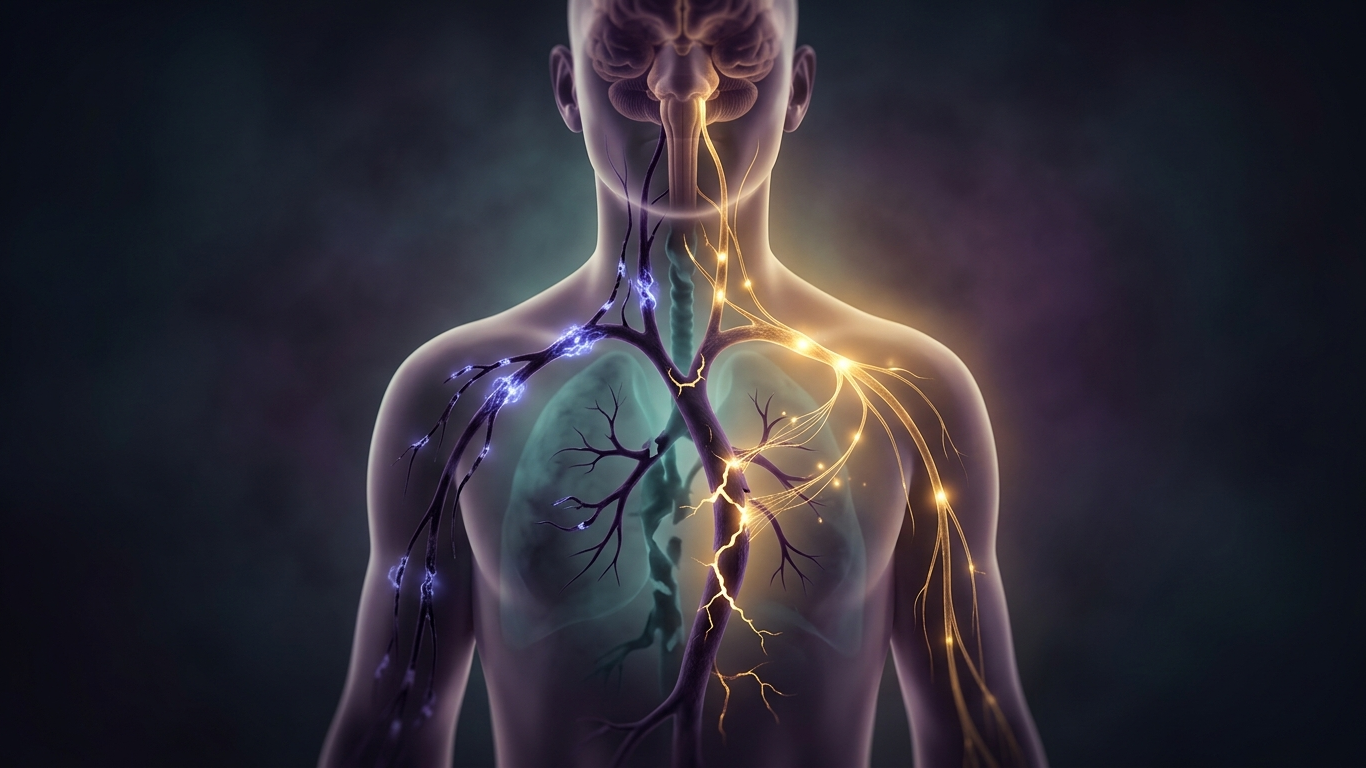
Vagal Tone and Trauma — How PTSD Rewires the Autonomic Nervous System
Thesis
Trauma doesn't just live in memories — it rewires the autonomic nervous system. PTSD shows measurable reductions in vagal tone (HRV/RSA), reflecting a nervous system that has lost its ability to return to safety after threat. Trauma exposure produces either hyperreactivity (acute/single-event trauma) or hyporeactivity (chronic maltreatment) in autonomic stress responses, with the type depending on developmental timing and severity. Understanding this autonomic signature transforms PTSD from a "psychological disorder" to a measurable dysregulation of the body's safety detection system.
Key Questions
- How does trauma measurably alter vagal tone and autonomic function?
- Why do different types of trauma produce different autonomic signatures?
- Does vagal tone predict PTSD risk or resilience?
- Can restoring vagal tone be a treatment strategy for trauma?
Supporting Research
Siciliano, R.E., Anderson, A.S., & Compas, B.E. (2022). Autonomic Nervous System Correlates of Posttraumatic Stress Symptoms in Youth: Meta-Analysis and Qualitative Review. Clinical Psychology Review, 92, 102125.
DOI: 10.1016/j.cpr.2022.102125 | PMC
Autonomic Dysregulation in Trauma
The autonomic nervous system normally operates in a flexible balance: sympathetic activation during stress, parasympathetic (vagal) recovery after stress. Trauma disrupts this balance in two distinct patterns:
- Hyperreactivity: Common after acute or single-event trauma. The sympathetic system becomes hypersensitive — exaggerated startle, elevated heart rate, hypervigilance. The nervous system is stuck in "threat detected" mode.
- Hyporeactivity: Common after chronic maltreatment or repeated trauma. The system shuts down — emotional numbing, dissociation, flat affect. The dorsal vagal complex takes over, producing immobilization and disconnection.
Both patterns reflect impaired vagal brake function — the inability to flexibly shift between activation and recovery.
Measuring Vagal Tone in Trauma
Vagal tone is measured noninvasively via respiratory sinus arrhythmia (RSA) — the fluctuation of heart rate synchronized with breathing. High resting RSA indicates strong parasympathetic (vagal) control, associated with:
- Effective social engagement and perception of safety
- Flexible emotional regulation
- Rapid recovery from stress
- Better cognitive flexibility
The Siciliano et al. meta-analysis found that in youth, posttraumatic stress symptoms showed modest autonomic hyperreactivity during stress tasks (r = .07) and longitudinally (r = .15), with sympathetic reduction at rest (r = -.09). Notably, no significant parasympathetic (HRV) relations with PTSS were found in youth — unlike adults, where reduced HRV consistently correlates with PTSD severity.
Developmental Considerations
The absence of strong HRV-PTSD correlations in youth suggests developmental differences:
- Autonomic regulation matures throughout childhood and adolescence
- Youth may show more heterogeneity — hyperaroused vs. dissociative subtypes coexist
- The vagal brake develops alongside social engagement capacity — trauma during critical periods may prevent full development
- Shahrestani et al. (2014) showed HRV is stable during social engagement in healthy children but drops during disengagement — at-risk children lack this flexibility
Why This Matters
If trauma lives in the autonomic nervous system, then healing must address the body — not just the mind. Polyvagal-informed therapies focus on restoring vagal tone through:
- Safe relationships that provide co-regulation (external vagal regulation)
- Body-based practices: breathing, movement, cold exposure
- VNS to directly restore vagal tone
- Trauma-sensitive environments that reduce neuroception of threat
This explains why talk therapy alone often fails for severe trauma — the social engagement system (ventral vagal) is offline, making cognitive processing impossible. Safety must be established somatically first.
Experimental Predictions
- Baseline vagal tone should predict PTSD resilience after trauma exposure
- Polyvagal-informed therapy should show greater HRV improvements than traditional CBT for trauma
- Vagal tone restoration should precede symptom improvement in successful trauma treatment
- Developmental timing of trauma should predict whether hyperreactive vs. hyporeactive autonomic patterns emerge
Have a question?
Have a question about something specific? Send us a message.
Visit VagusSkool.com/contact — we'll try to get back to you within 24 hours.