Ringing That Won't Stop: Tinnitus, the Vagus Nerve, and the Ear–Brain Connection
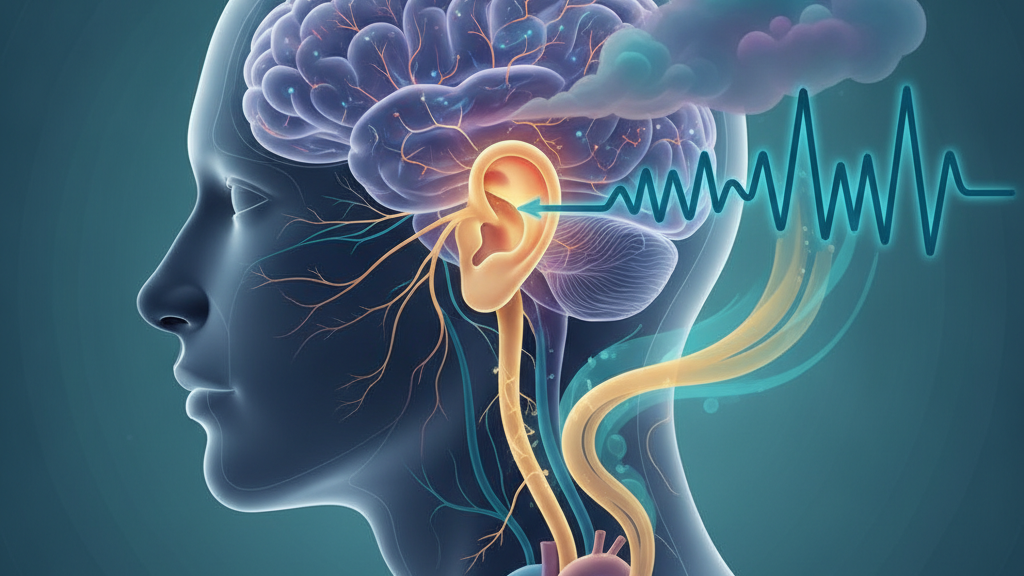
A high-pitched ring, a hiss, a buzz that no one else can hear — tinnitus affects an enormous number of people, and for many it worsens exactly when stress and poor sleep are worst. That timing is a clue. Tinnitus is less an ear problem than a brain-and-nervous-system problem, and one branch of the vagus nerve runs directly to the ear, which is why it has become a serious target for treatment.
Tinnitus Is Generated by the Brain
In most cases the ringing does not come from a sound source in the ear. It usually begins with some loss of input — often subtle hearing loss — after which the brain's auditory pathways turn up their own gain to compensate and start generating phantom signals (NIDCD: Tinnitus). This is a form of maladaptive neuroplasticity: the brain rewires around missing input and produces a sound that is not there. That is why tinnitus is so tied to attention, stress, and sleep — all of which change how much the brain amplifies the signal.
Why Stress Makes It Louder
Almost everyone with tinnitus notices it spikes during stressful, exhausted periods. The autonomic nervous system is the link. Sympathetic overdrive heightens sensory gain across the board — sound, touch, pain — so a nervous system stuck in fight-or-flight literally turns up the volume on the ringing. Calming the autonomic state does not always erase tinnitus, but it very often reduces its intrusiveness and the distress it causes.
The Vagus Connection: A Nerve That Reaches the Ear
Here is the anatomical hook. A branch of the vagus nerve — the auricular branch, sometimes called Arnold's nerve — supplies sensation to part of the outer ear, especially the concha and tragus. This is the only place on the body surface where you can reach the vagus through the skin, and it is the basis of transcutaneous auricular vagus nerve stimulation (taVNS) (taVNS review — mechanisms and applications).
The Research Angle
Because tinnitus is a problem of maladaptive brain plasticity, researchers have tested whether stimulating the vagus can help the brain re-tune. A landmark approach paired vagus nerve stimulation with tones, aiming to drive plasticity that pushes the auditory map away from the tinnitus frequency (Tyler et al., paired VNS-tone therapy for tinnitus). Non-invasive taVNS has since been studied on its own and in combination with sound therapy. Results are mixed and this is not a settled cure — but the direction of the science is clear: the vagus is a credible route into the networks that generate and sustain tinnitus.
Practical Steps That Help Most People
- Turn down the autonomic gain. Daily slow breathing and other vagal practices reduce the sympathetic amplification that makes ringing louder and more intrusive.
- Protect and support sleep. Tinnitus and insomnia feed each other; a low, steady background sound at night keeps the brain from fixating on the ring.
- Use sound enrichment. Gentle background sound reduces the contrast between the tinnitus and silence, which lowers how much the brain highlights it.
- Consider sound-based therapy. Structured approaches like tinnitus retraining therapy and cognitive behavioral therapy have the strongest evidence for reducing distress and habituating the brain to the signal.
- Protect your hearing going forward, since further input loss can worsen the compensatory ringing.
When to Get It Checked
See a clinician promptly if tinnitus is one-sided, pulsating in time with your heartbeat, sudden, or accompanied by hearing loss, dizziness, or ear pain. These features can point to causes that need specific evaluation rather than general nervous-system care.
The takeaway: Tinnitus is largely a brain-plasticity and nervous-system phenomenon, not just an ear one — which is why stress and sleep move the needle so much. The vagus nerve reaches the outer ear, giving both a mechanism for why calming the autonomic system quiets the ringing and a genuine research target in taVNS. Managing distress and sensory gain helps nearly everyone; the stimulation science is promising but still developing.
Have a question?
Have a question about something specific? Send us a message.
Visit VagusSkool.com/contact — we'll try to get back to you within 24 hours.