Sound Frequencies and Vagus Nerve Resonance — Acoustic Stimulation Pathways
Sound Frequencies and Vagus Nerve Resonance — Acoustic Stimulation Pathways
Thesis
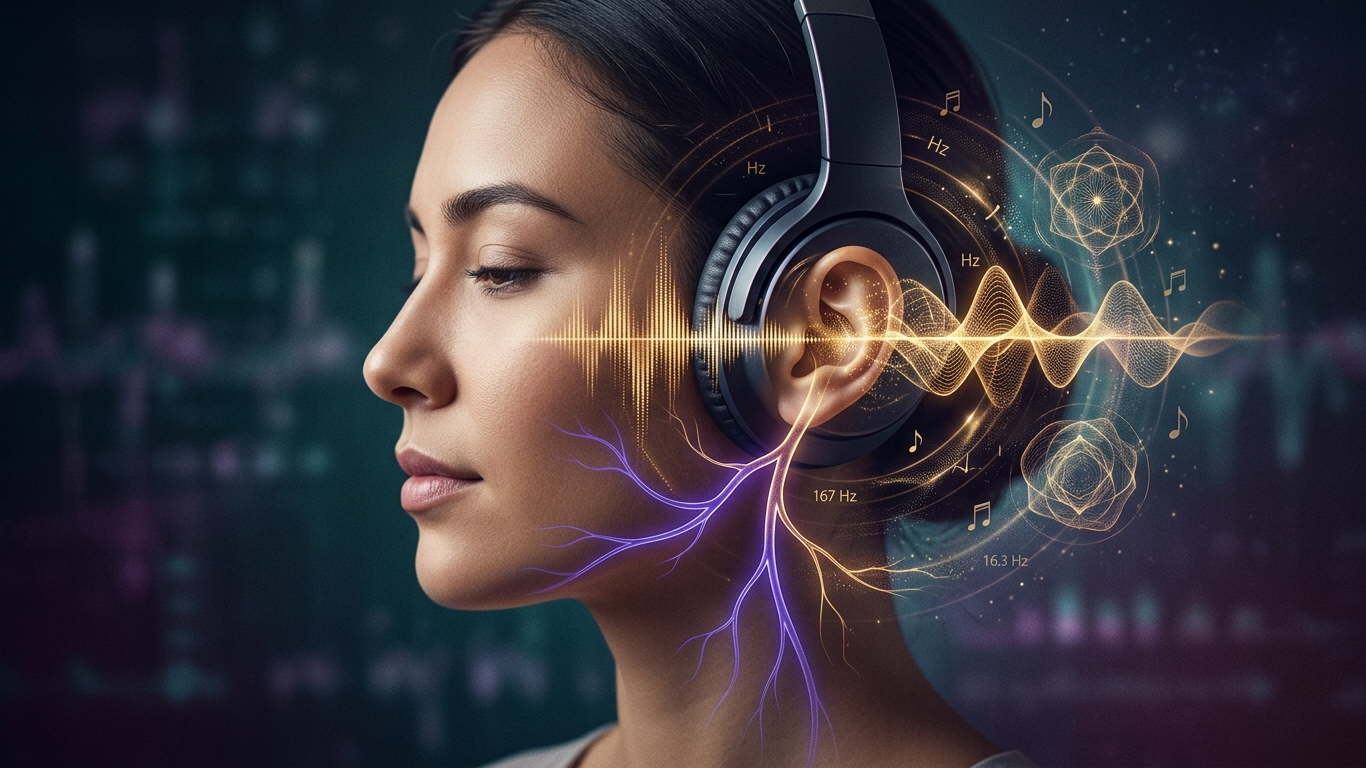
Sound is a mechanical vibration, and the vagus nerve is exquisitely sensitive to mechanical stimulation. Choral singing, mantra chanting, and structured vocalization synchronize heart rate variability across participants, entrain respiratory sinus arrhythmia, and produce measurable vagal activation — effects that individual meditation or silence cannot replicate. The music structure itself (phrase length, breathing patterns) determines the degree of vagal resonance, suggesting that specific acoustic patterns could be designed to maximize autonomic benefit.
Key Questions
- How does sound/vibration activate the vagus nerve?
- Why does group singing synchronize heart rates across participants?
- What musical structures maximize vagal activation?
- Can specific sound frequencies be used therapeutically for vagal stimulation?
Supporting Research
Vickhoff, B. et al. (2013). Music structure determines heart rate variability of singers. Frontiers in Psychology, 4, 334.
DOI: 10.3389/fpsyg.2013.00334 | PMC
Bernardi, L. et al. (2001). Effect of rosary prayer and yoga mantras on autonomic cardiovascular rhythms: comparative study. BMJ, 323(7327), 1446–1449.
Singing as Guided Breathing
Choral singing is, at its core, structured breathing with sound. Vickhoff et al. measured HRV in singers performing three tasks:
- Humming: Free breathing, continuous tone
- Singing a hymn: Unguided breathing between musical phrases
- Singing a slow mantra: Breathing only between 10-second phrases (~0.1 Hz respiration)
Results were striking: the mantra — with its forced 0.1 Hz breathing — produced the highest HRV and strongest respiratory sinus arrhythmia. The hymn was intermediate. Humming showed individual regulation but no group synchronization.
Interpersonal Heart Synchronization
The most remarkable finding: during unison choral singing, participants' heart rates synchronized. Their hearts accelerated and decelerated simultaneously. This wasn't subtle — it was statistically significant (p<0.01 for mantra vs. baseline).
Coherence analysis showed phase-locking of cardiac rhythms across participants during structured singing. The more structured the musical phrases, the stronger the synchronization. This is the first study documenting singing-induced interpersonal heart rate sync.
The 0.1 Hz Resonance Connection
The mantra's 10-second phrase structure forced breathing at ~0.1 Hz — the exact resonant frequency of the cardiovascular system. This connects to the deep breathing research (Russo et al., 2017): breathing at 0.1 Hz maximizes vagal output by entraining the baroreflex and respiratory sinus arrhythmia at their natural resonance. The mantra doesn't just sound spiritual — it mechanically locks breathing into the optimal vagal frequency.
Bernardi: Rosary Prayer and Yoga Mantras
Bernardi et al. (2001) found similar effects with rosary prayer and "Om" chanting:
- Both reduced respiratory rate to ~6 breaths/min (0.1 Hz)
- Both increased baroreflex sensitivity
- Both enhanced cardiovascular rhythms at the resonant frequency
- Effects were comparable between Christian rosary and Hindu/Buddhist mantras — the structure matters, not the religious content
Why Group Singing Works
Three mechanisms converge in choral singing:
- Respiratory entrainment: Musical phrases force structured breathing at vagal-optimal frequencies
- Vagal pumping: Sustained vocalization during phrases creates intrathoracic pressure changes that mechanically stimulate vagal afferents
- Social co-regulation: Group unison creates neuroception of safety, activating the ventral vagal social engagement system
Individual meditation achieves the first two. Group singing adds the third — social co-regulation — creating a triple activation of vagal circuits that individual practice cannot match.
Why This Matters
This research validates what every culture has known intuitively: chanting, singing, and communal vocalization are profoundly regulating. The mechanism isn't mystical — it's the vagus nerve responding to structured sound and guided breathing at its resonant frequency. This has practical applications:
- Therapeutic choir programs for PTSD, depression, anxiety
- Structured breathing apps using mantra-like phrase timing
- Sound therapy designed around 0.1 Hz entrainment
- Community singing as public health intervention for loneliness and cardiovascular health
Experimental Predictions
- Music with phrase structures near 0.1 Hz should produce greater vagal activation than faster or slower tempos
- Group singing should produce greater HRV increases than individual singing
- Chronic choir participation should show higher baseline vagal tone than matched non-singers
- Acoustic frequencies near the vagal resonant range should measurably alter autonomic function
Have a question?
Have a question about something specific? Send us a message.
Visit VagusSkool.com/contact — we'll try to get back to you within 24 hours.