The Recurrent Laryngeal Nerve: The Vagus Branch That Dives Into Your Chest and Loops Back
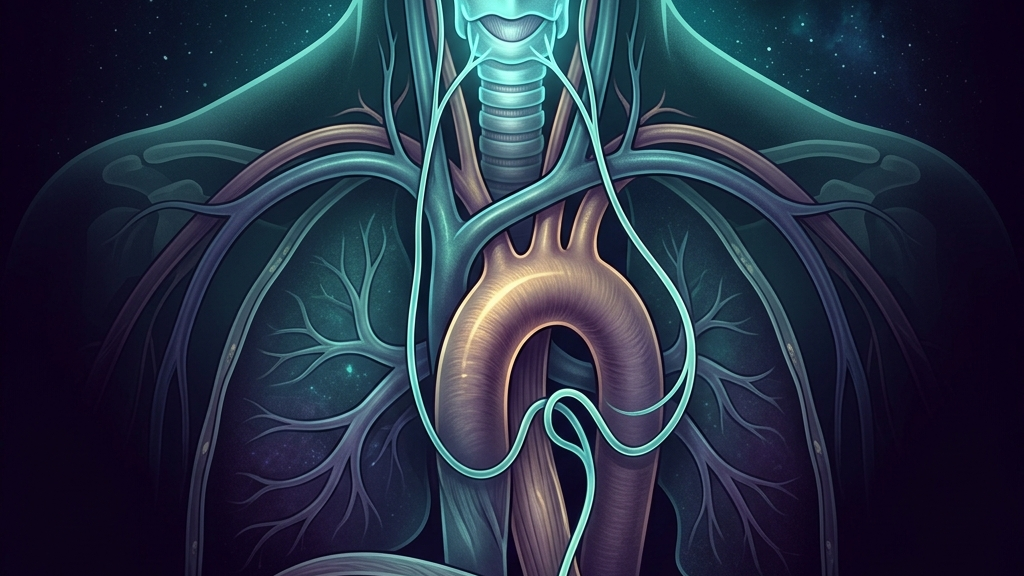
If you were designing a nerve to reach the voice box, you would run it a short, straight distance from the brainstem down the neck to the throat. A few inches, done. Your body does the opposite. A branch of the vagus called the recurrent laryngeal nerve (the vagal branch that supplies most of the muscles of the voice box) refuses the short route. Instead it plunges down past the larynx into the chest, hooks underneath a major blood vessel, and then climbs all the way back up to end at the very organ it passed on the way down. It is one of the strangest detours in human anatomy — and it is not a mistake. It is a fossil.
The Detour, Traced Step by Step
Follow the nerve from the top. The vagus descends through the neck inside the carotid sheath. Somewhere around the base of the neck, the recurrent laryngeal branch peels off and heads downward, away from its target. On the left side, it dives into the chest and loops under the aortic arch (the great curved artery leaving the top of the heart). On the right side, it loops under the subclavian artery, higher up. Then, on both sides, it reverses course and ascends back up the neck, running in the groove between the trachea and the esophagus, until it finally reaches the larynx (the voice box, the cartilage structure housing the vocal cords). The word "recurrent" means exactly this: running back the way it came.
Why On Earth Would a Nerve Do This?
The answer is embryology (how the body's structures form during development in the womb). Early in development, the nerves and the great vessels are neatly stacked in the neck region, and this nerve passes cleanly beneath a set of vessels called the aortic arches. As the embryo grows, the heart and its great vessels descend down into the chest, dragging the loop of the nerve down with them. The nerve is caught, like a strap hooked under a moving object. It cannot unhook, so it simply stretches. What began as a short, sensible path becomes a long detour that no engineer would ever choose — kept only because development builds on what came before rather than starting clean.
The most famous illustration is the giraffe. A giraffe's recurrent laryngeal nerve makes the same loop under the aorta near the heart, then climbs the entire neck to reach the larynx — a detour that can run several meters to serve an organ inches from the brain. Same fossil, dramatically magnified.
The Clinical Payoff: Why This Detour Matters to You
A nerve that takes a long, exposed journey through the chest is a nerve with many chances to get injured along the way. Because the left recurrent laryngeal nerve wraps around the aortic arch, anything that enlarges or invades that region can press on it. This is why voice change can be an early warning sign of problems far from the throat:
- Aortic aneurysm: a bulging, weakened aortic arch can stretch or compress the looping nerve, producing hoarseness — a phenomenon well known enough to have its own name in the older literature.
- Chest tumors and enlarged lymph nodes: a mass in the chest, including certain lung tumors, can trap the nerve along its route, changing the voice before anything else declares itself.
- Thyroid and neck surgery: the nerve's final climb runs right beside the thyroid gland in the groove next to the windpipe, so it is at risk during thyroid operations — which is why surgeons deliberately hunt for and protect it.
When the nerve is compromised, the vocal cord it powers can go slack or paralyzed, causing dysphonia (impaired or abnormal voice production — hoarseness, breathiness, or a weakened voice). A symptom that feels purely local to the throat is, anatomically, a report from deep inside the chest.
The Reframe
Hoarseness is easy to shrug off as strain or a lingering cold. But the recurrent laryngeal nerve's bizarre routing means the voice is quietly wired to the interior of the chest. A persistent, unexplained voice change is worth taking seriously precisely because of where this nerve has to travel. The detour that seems like a quirk of trivia is the reason your voice can act as a distant early-warning system.
Have a question?
Have a question about something specific? Send us a message.
Visit VagusSkool.com/contact — we'll try to get back to you within 24 hours.