The Nucleus Tractus Solitarius: The Brainstem Inbox Where Your Whole Body Checks In
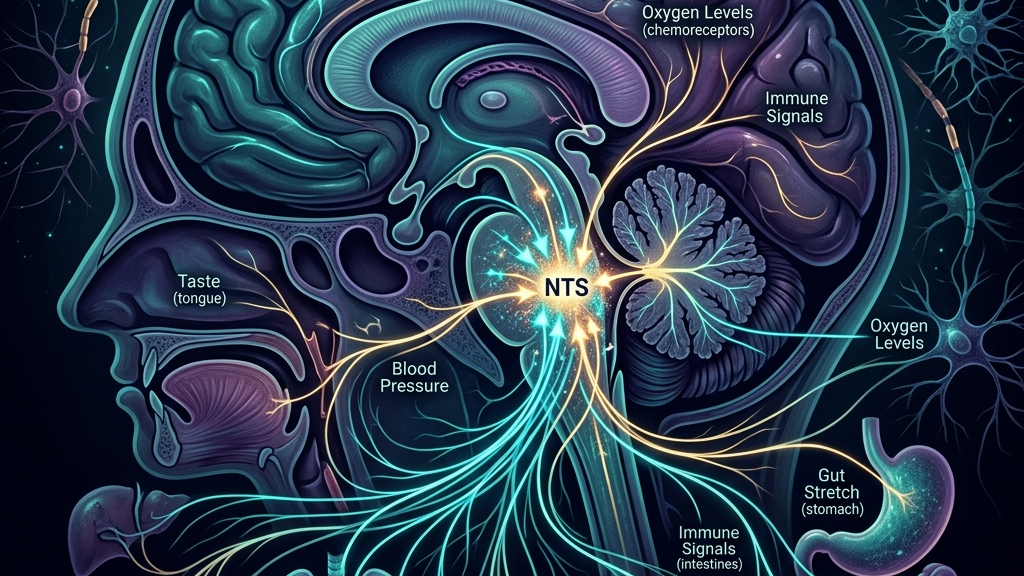
Imagine every sensor in your body — the ones reading your blood pressure, your oxygen level, the stretch of your stomach, the chemistry of your gut, even the state of your immune system — all emailing their reports to a single inbox. Not a metaphorical inbox. An actual, physical structure in your brainstem, roughly the size of a grain of rice, running down each side of the medulla. Its name is the nucleus tractus solitarius (the primary brainstem region where incoming sensory information from the internal organs first arrives), usually shortened to the NTS. Nearly everything your body senses about itself checks in here first. And when this one inbox gets overloaded, the fallout can spread across every organ it touches.
What Actually Arrives at the NTS
The NTS is the landing zone for the vagus nerve's afferent fibers (sensory fibers carrying information toward the brain, as opposed to motor fibers carrying commands outward). But it is not only the vagus. The NTS is a shared receiving dock for several streams of internal information, and the breadth of what converges there is the whole point:
- Taste from the tongue and throat enters the upper portion of the NTS — this is the gustatory front desk.
- Blood pressure signals from baroreceptors (stretch sensors in the walls of your major arteries that detect blood pressure) arrive continuously, letting the brainstem know, beat by beat, how hard the blood is pushing.
- Oxygen and carbon dioxide readings from chemoreceptors report whether your blood gases are in range.
- Gut stretch and chemistry from the stomach and intestines tell the NTS how full, how distended, and how irritated the digestive tract is.
- Immune signals — chemical messengers released during inflammation — are also detected here, which is how the brain learns the body is fighting something.
Sitting right beside the NTS is the area postrema (a small brainstem region lacking the usual blood-brain barrier, letting it sample toxins and hormones directly from the bloodstream) — the so-called vomiting center, which is why nausea and the NTS are close neighbors both anatomically and functionally.
From Inbox to Action: Where the Reports Go Next
An inbox is only useful if it forwards mail. The NTS does two things with every report. First, it triggers immediate, local reflexes — an autonomic reflex (an automatic, unconscious adjustment of heart rate, blood pressure, breathing, or digestion made without involving conscious thought). If blood pressure spikes, the NTS relays that to nearby motor centers that slow the heart, all within a heartbeat or two, no conscious involvement required. Second, it forwards the summarized report upward — to the hypothalamus (which sets hormonal and stress responses), the amygdala (which sets threat and fear levels), and the insular cortex (which builds your felt sense of your body's internal state). So a single visceral signal both fires a fast local reflex and shapes your mood and threat perception higher up.
Why One Sensitized Hub Spreads Symptoms Everywhere
Here is the reframe that reorganizes a confusing chart. If dozens of different bodily inputs all converge on one small structure, then a problem at that structure — an NTS that is overloaded, inflamed, or sensitized so that it over-reacts to normal input — will not produce one tidy symptom. It will produce a scattered mess: blood-pressure instability, unpredictable heart rate, nausea, gut sensitivity, air hunger, and a pervasive sense that something is wrong, all at once. Not because five organs failed, but because the one hub reading all five is running hot.
This is a genuinely different way to understand multi-system illness. Conditions where symptoms leap between organs with no single failing part — the kind that get a patient bounced between specialists who each find their own organ "normal" — make more sense when you realize those organs report to a shared address. A convergence point can be the source of divergent symptoms. The problem is not everywhere; it is at the one place that listens to everywhere.
It also points toward why bottom-up, body-calming inputs can help so broadly. Change the quality of the signals arriving at the NTS — through slow breathing, blood-pressure stability, a calmer gut — and you are turning down the volume at the hub, not just at one organ.
References & Further Reading
- StatPearls. Neuroanatomy, Nucleus Solitarius. NCBI Bookshelf. Source
- Berthoud HR, Neuhuber WL. Functional and chemical anatomy of the afferent vagal system. Autonomic Neuroscience, 2000. Source
- Craig AD. How do you feel? Interoception: the sense of the physiological condition of the body. Nature Reviews Neuroscience, 2002. Source
Have a question?
Have a question about something specific? Send us a message.
Visit VagusSkool.com/contact — we'll try to get back to you within 24 hours.