Two Vagal Engines: Nucleus Ambiguus vs. the Dorsal Motor Nucleus
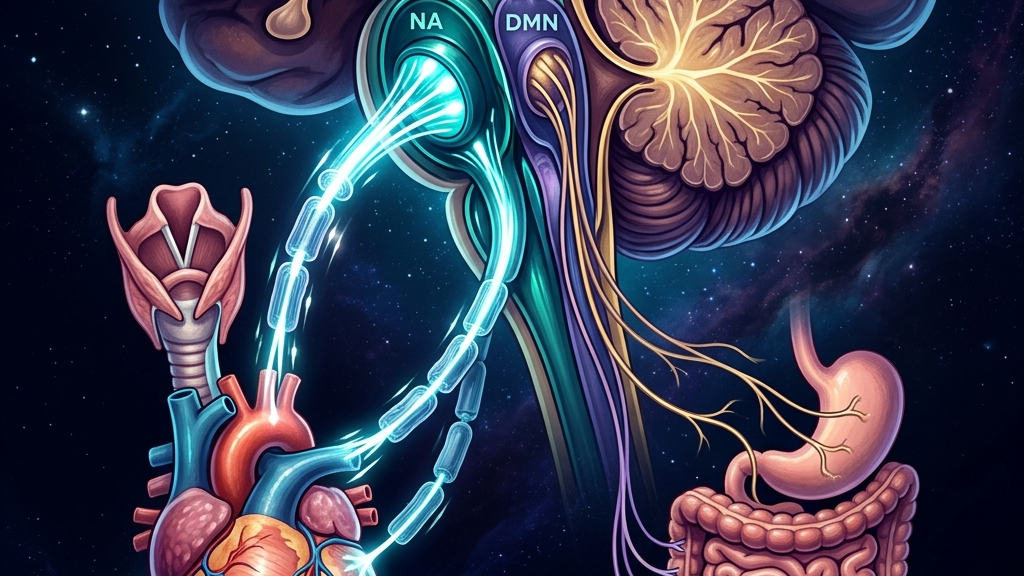
People talk about "the vagus" as if it were one thing with one job. On the motor side — the outgoing commands — it is really two things. The vagus's efferent fibers (motor fibers carrying commands away from the brain toward the organs) come from two separate control rooms in the brainstem, built at different points in our evolutionary history, wired differently, and serving different jobs. Learn to tell these two engines apart and one of the most popular frameworks in the trauma and nervous-system world — Polyvagal Theory — suddenly has real neuroanatomy underneath it, instead of vibes.
Engine One: The Nucleus Ambiguus — Fast, Smart, Ventral
The first engine is the nucleus ambiguus (a motor nucleus in the medulla that controls the heart, larynx, and pharynx through fast-conducting vagal fibers). It sits toward the front, or ventral, side of the medulla. Its defining feature is speed. Its fibers are myelinated (wrapped in a fatty insulating sheath that dramatically speeds up nerve signal conduction), which means they fire fast and with fine control.
This is the engine that runs the moment-to-moment. It controls the muscles of the larynx and pharynx — your voice and swallowing — and, most importantly for how you feel day to day, it puts a fast, flexible brake on the heart. That flexibility has a visible signature: respiratory sinus arrhythmia (the natural quickening of the heart on inhalation and slowing on exhalation, driven by rapid vagal control). When you breathe in, this engine briefly eases off the heart and it speeds up; when you breathe out, it re-applies the brake and the heart slows. That beat-to-beat variability is not noise — it is the signature of a healthy, responsive nucleus ambiguus, and it is much of what people are actually measuring when they talk about "vagal tone" or heart-rate variability.
Engine Two: The Dorsal Motor Nucleus — Old, Slow, Deep
The second engine is the dorsal motor nucleus (the older vagal motor nucleus in the back of the medulla that supplies the digestive organs below the diaphragm through slow-conducting fibers). It sits toward the back, or dorsal, side of the brainstem — hence the name. It is the evolutionarily older system, shared with far more primitive vertebrates, and it is built for a different tempo. Its fibers are largely unmyelinated, so they conduct slowly, without the fine beat-to-beat finesse of the nucleus ambiguus.
This engine handles the unglamorous, sub-diaphragmatic work: the slow, sustained regulation of the stomach and intestines. Under ordinary conditions it quietly runs digestion. But it is also implicated in something more dramatic — the deep "freeze" or shutdown response, a passive collapse into immobility and slowed function seen in overwhelming threat. Where the fast engine gives you flexible engagement, the old engine, pushed hard, can pull the body toward conservation and stillness.
The Real Anatomy Under Polyvagal Theory
This two-engine structure is what Polyvagal Theory — the popular framework introduced by Stephen Porges — is built on. The framework's two vagal circuits map onto these two nuclei:
- The ventral, myelinated vagus (nucleus ambiguus) is the framework's "social engagement" and safety circuit — fast, flexible, tied to the heart, voice, and face, and active when you feel safe and connected.
- The dorsal, unmyelinated vagus (dorsal motor nucleus) is the framework's "shutdown" or immobilization circuit — old, slow, tied to the gut, and associated with collapse under inescapable threat.
It is worth being precise here: Polyvagal Theory is a popular and clinically influential model, and some of its specific claims remain debated among researchers. But the underlying anatomy — two distinct vagal motor nuclei, one fast and myelinated toward the front, one slow and unmyelinated toward the back — is standard, uncontroversial neuroanatomy. You do not have to accept every layer of the theory to benefit from knowing that your vagus has two engines with genuinely different speeds and jobs.
Why This Matters When You Are Trying to Regulate
The distinction changes what "activating the vagus" even means. There is no single vagal switch. When breathing practices, humming, or a long slow exhale help you feel calmer and more present, you are largely engaging the fast, ventral engine — which is exactly why they show up as improved heart-rate variability. That is a different state from the heavy, shut-down, can't-move exhaustion that leans on the old dorsal engine. "My vagus is off" is too blunt. The better question is which engine is running, and whether the fast, flexible one has enough tone to keep you in engaged calm rather than dropping into collapse.
References & Further Reading
Have a question?
Have a question about something specific? Send us a message.
Visit VagusSkool.com/contact — we'll try to get back to you within 24 hours.