Brain on Fire: How Neuroinflammation Drives Fog, Fatigue, and Low Mood — and the Vagal Off-Switch
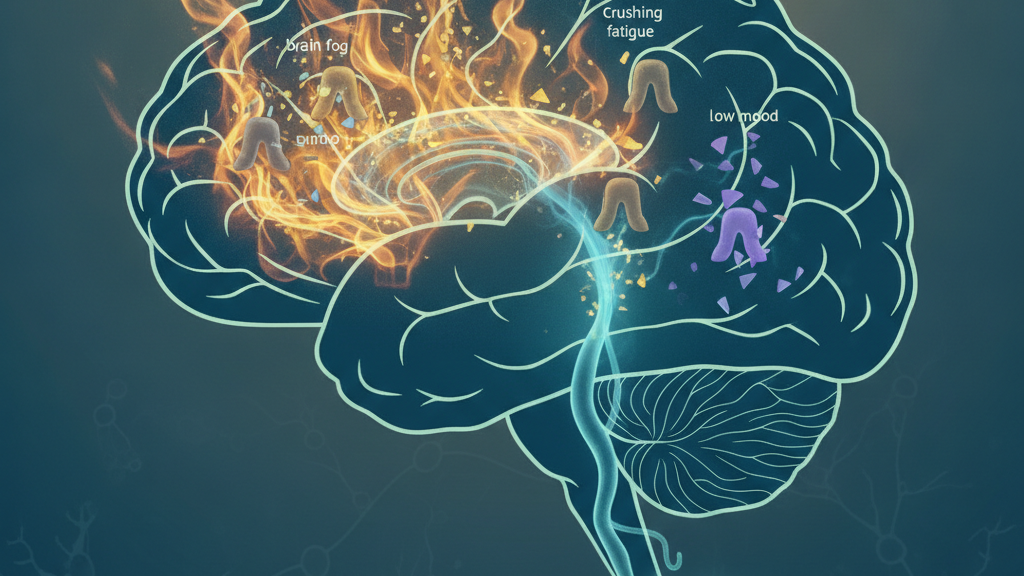
Brain fog, crushing fatigue, and a flat, low mood are three of the most common concerns we hear — and they are often treated as three separate problems in three separate appointments. But they frequently share one underlying driver: inflammation inside the brain itself. And the body's most powerful tool for switching that inflammation off is the vagus nerve.
What Neuroinflammation Actually Is
Your brain has its own immune cells, called microglia. In their resting state they maintain and repair neural tissue. When they sense threat — infection, injury, chronic stress, or inflammatory signals arriving from the body — they switch to an activated state and release inflammatory molecules called cytokines (DiSabato et al., Neuroinflammation: the devil is in the details). Short-term, this is protective. Sustained, it degrades how neurons communicate — and that degradation is what you feel as fog, fatigue, and low mood.
Why It Feels the Way It Does
Activated microglia and elevated cytokines produce a recognizable cluster of symptoms often called "sickness behavior" — the same heavy, foggy, withdrawn, unmotivated state you feel during a bad flu (Dantzer et al., From inflammation to sickness and depression). When that state becomes chronic rather than lasting a few days, it stops looking like illness and starts looking like depression, ADHD-like inattention, or unexplained fatigue. Inflammatory cytokines also disrupt the metabolism of serotonin and dopamine, which is part of why inflammation-driven low mood often does not respond well to standard antidepressants alone.
The Body-to-Brain Pipeline
Much neuroinflammation does not start in the brain. It starts in the body — a leaky, dysbiotic gut, chronic infection, visceral fat, poor sleep, or unrelenting stress — and the inflammatory signals travel upward. The vagus nerve is a key part of this two-way pipeline: its sensory fibers detect inflammation in the body and report it to the brain, which is how a gut problem becomes a brain symptom (Breit et al., brain–gut axis review).
The Vagal Off-Switch
Here is the hopeful part. The same nerve that reports inflammation can also shut it down. The cholinergic anti-inflammatory pathway, described by Kevin Tracey, shows that vagus nerve activity releases acetylcholine that directly tells immune cells to stop pumping out inflammatory cytokines (Tracey, The inflammatory reflex, Nature 2002). Cutting the vagus makes inflammation worse; stimulating it calms inflammation down. This is a hard-wired reflex, not a metaphor — and it applies to the microglia-driven inflammation behind brain fog as well as to inflammation in the body.
Turning the Switch On
You cannot flip a nerve reflex by willpower, but you can raise the vagal tone that drives it, and you can lower the inflammatory load feeding the fire from below:
- Raise vagal tone. Daily slow, long-exhale breathing, humming, and cold-water face exposure all increase parasympathetic activity that supports the anti-inflammatory reflex.
- Fix sleep. Deep sleep is when the brain's glymphatic system clears metabolic waste. Fragmented sleep is directly pro-inflammatory in the brain.
- Calm the gut. Because so much inflammatory signal originates in the gut, supporting the microbiome and the gut lining reduces the load arriving at the brain.
- Move — carefully. Moderate exercise is anti-inflammatory; overtraining is pro-inflammatory. In fatigue-dominant states, gentle movement wins.
- Consider taVNS. Non-invasive auricular vagus nerve stimulation is being actively studied as a way to engage the anti-inflammatory pathway directly.
When to Get Evaluated
Persistent brain fog, fatigue, and low mood can also reflect thyroid disease, anemia, B12 deficiency, sleep apnea, autoimmune disease, or clinical depression that needs treatment. A neuroinflammatory framing is a lens, not a substitute for a workup — pursue both.
The takeaway: Fog, fatigue, and low mood are often not three problems but one — chronic inflammation inside the brain, frequently fueled from the body below. The vagus nerve sits on both sides of that loop: it carries the alarm up, and it carries the shut-off signal back. Raising vagal tone and lowering the inflammatory load work on the same mechanism from two directions.
References & Further Reading
- Tracey KJ. The inflammatory reflex. Nature 2002;420:853–859. Read
- DiSabato DJ, et al. Neuroinflammation: the devil is in the details. J Neurochem. Read
- Dantzer R, et al. From inflammation to sickness and depression. Nat Rev Neurosci. Read
- Breit S, et al. Vagus Nerve as Modulator of the Brain–Gut Axis. Read
Have a question?
Have a question about something specific? Send us a message.
Visit VagusSkool.com/contact — we'll try to get back to you within 24 hours.