Neck and Jaw Tension: Why the Vagus Nerve Runs Right Through Your Pain
You stretch. You roll your shoulders. You schedule the massage. The neck and jaw tension comes back. It’s an old conversation, and one most people end up just learning to live with.
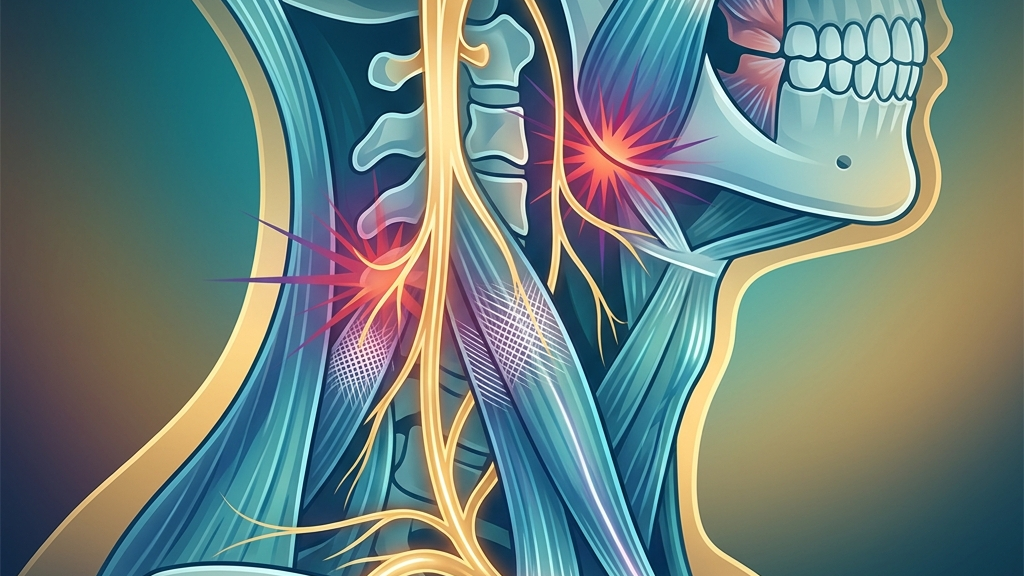
What rarely gets explained is that the place where your neck and jaw meet — the side of the throat and the back of the upper jaw — is exactly where the vagus nerve passes on its long journey from your brainstem to your gut. When this region is chronically tight, you’re not just dealing with sore muscles. You’re dealing with compromised nervous system function.
The Anatomy: A Crash Course
The vagus nerve exits the skull through a small opening at the base of the skull called the jugular foramen. From there, it travels down the side of the neck inside a sheath called the carotid sheath — sharing space with the carotid artery and the internal jugular vein. It runs alongside the upper cervical spine, behind the angle of the jaw, and continues down into the chest.
This means several layers of muscle and connective tissue are wrapped around the nerve’s path:
- Sternocleidomastoid (the big diagonal neck muscle)
- Scalenes (the muscles you feel tighten when you can’t turn your head)
- Suboccipitals (small muscles at the base of the skull)
- Jaw muscles — masseter, temporalis, pterygoids
- Hyoid muscles in the front of the throat
When any of these are chronically tight, the vagus nerve’s function in that region can be measurably affected. People often describe a heavy, "thick" feeling in the throat that comes with their jaw tension — that’s vagal compression, not imagination.
Why Your Neck and Jaw Hold So Much
The neck-jaw region is a stress concentration zone for several reasons:
- Many muscles in this area are postural — they fire constantly to hold your head up
- Phone and laptop posture pulls the head forward, dramatically increasing load
- The jaw muscles are involuntarily activated during stress, sleep, and concentration
- Emotional holding patterns — unsaid words, suppressed anger, swallowed grief — are physically expressed in the throat region
- Untreated sleep apnea or open-mouth breathing keeps these muscles in continuous use through the night
Most people clench or grind without knowing it. Most people have forward head posture. Most people breathe through their mouth more than they realize. The cumulative cost shows up here.
The vagus nerve runs right behind your jaw and down the side of your throat. Chronic tension there isn’t just sore muscles — it’s a compressed cable.
Symptoms That Connect Back to This
When neck and jaw tension is suppressing vagal function, people often notice a constellation of symptoms that don’t obviously look like neck pain:
- Difficulty taking a full breath
- Tightness or "lump" sensation in the throat
- Digestive sluggishness, especially after meals
- Tinnitus or ear fullness
- Chronic low-grade anxiety with no clear trigger
- Voice fatigue or hoarseness
- Disrupted sleep — the autonomic system can’t settle
If you’ve had any of these alongside your neck or jaw tension, you’ve been experiencing the integrated picture all along.
What Actually Releases This Region
Stretching alone usually isn’t enough — the vagal region responds best to a combination of mechanical release and parasympathetic activation. The fastest tools:
Self-Massage Along the Sternocleidomastoid
The big diagonal muscle running from behind your ear to your collarbone. Use gentle pressure with your fingertips, working slowly down its length. Two minutes per side, daily. Many people feel an immediate softening of throat tightness afterward.
Suboccipital Release
Lie on your back. Place two tennis balls in a sock at the base of your skull. Rest your head on them for two to three minutes. The pressure releases the tiny muscles that connect your skull to your spine — a region notorious for pinching nervous output.
Jaw Release
Place your fingertips on the muscles just in front of your ears. Open your jaw slowly while applying gentle pressure. Massage in small circles. One to two minutes per side. Most people are shocked by how much tension shows up here.
Humming and Vocal Toning
The vagus nerve is mechanically stimulated by vibration in the throat. Three to five minutes of humming, "om," or low-pitched singing daily reduces tension and reactivates the nerve. This sounds odd until you try it.
Gargling
Vigorous gargling for 30 seconds activates the muscles surrounding the vagus nerve and stimulates the nerve directly. Sounds silly. Works.
Daily Posture Changes That Help
- Raise your screen so the top is at eye level (most people’s screens are too low)
- Anchor your shoulders down by gently squeezing the shoulder blades back several times an hour
- Keep your tongue resting on the roof of your mouth, lips closed, breathing through the nose — this passively trains better jaw alignment
- Avoid holding the phone between your shoulder and ear; never sleep with your phone on your chest
- If you wake with jaw soreness, talk to a dentist about a night guard — nighttime clenching is one of the fastest ways to wreck this region
Why This Matters Beyond the Pain
When you release chronic neck and jaw tension, you don’t just feel better in the muscles. You restore the integrity of the vagal pathway running through them. People who consistently work this area often notice their digestion settling, their breathing deepening, their sleep improving — changes that look unrelated until you understand the anatomy.
Start With Two Minutes
Pick one technique above and do it once today. The most efficient starting place is two minutes of slow self-massage along the sternocleidomastoid. Then try one slow exhale through pursed lips. Most people notice a real shift in the first session. The vagus nerve responds quickly when given even a little space.
Have a question?
Have a question about something specific? Send us a message.
Visit VagusSkool.com/contact — we'll try to get back to you within 24 hours.