The Jugular Foramen: The Crowded Skull Doorway Where Your Vagus Exits
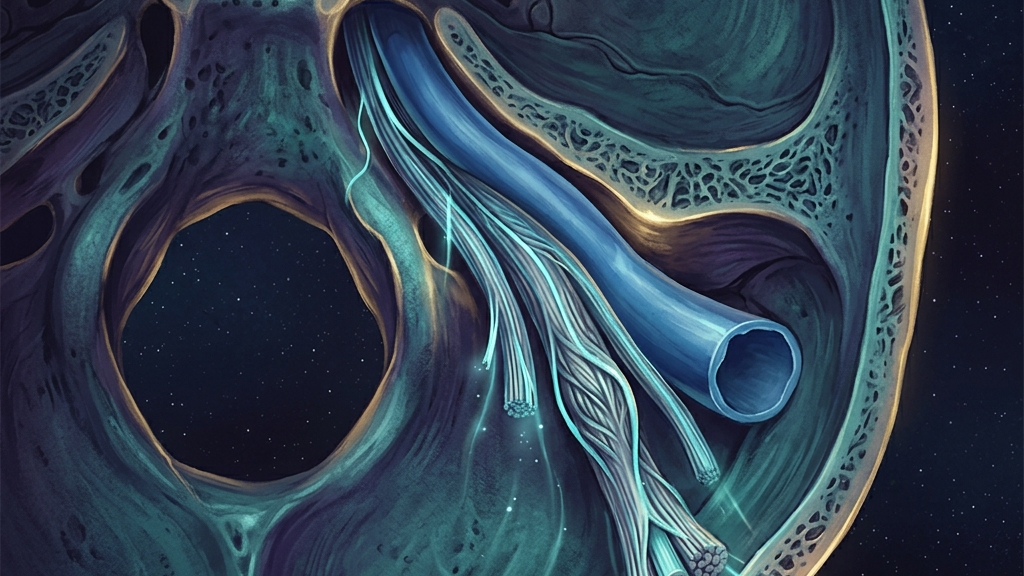
Press your fingertip just below your earlobe, in the soft hollow behind the angle of your jaw. A centimeter or two deep to that spot, inside the base of your skull, is a doorway. Not a metaphor — an actual hole in bone called the jugular foramen (the opening in the skull base through which the vagus nerve exits the head). And your vagus does not get this doorway to itself. It squeezes through shoulder-to-shoulder with two other cranial nerves and the largest vein draining your brain. Once you know how crowded this passage is, a whole cluster of "unrelated" symptoms starts to look like one traffic jam.
One Doorway, Three Nerves, One Big Vein
The vagus is cranial nerve X (CN X), and it is the middle passenger in the jugular foramen. Ahead of it runs the glossopharyngeal nerve (CN IX — the nerve serving the back of the throat, part of the tongue, and taste). Behind it runs the accessory nerve (CN XI — the nerve that powers the sternocleidomastoid and trapezius muscles of the neck and shoulder). Packed alongside all three is the internal jugular vein, the main drainage pipe for blood leaving your skull.
Anatomy this tight has a consequence people rarely appreciate: whatever irritates one occupant of the foramen can easily irritate its neighbors. There is simply nowhere for a swollen, compressed, or crowded structure to go. The bone does not flex.
Why Symptoms Cluster Instead of Standing Alone
Think about what these three nerves do, and then imagine all three being nudged at once. The result is not a single clean symptom — it is a set:
- Vagus (CN X): hoarseness or voice changes, a sensitive gag, swallowing difficulty, and — because the vagus carries autonomic traffic — heart-rate and blood-pressure oddities, nausea, or that vague "something is wrong inside" feeling.
- Glossopharyngeal (CN IX): throat pain, ear pain, a persistent lump-in-the-throat sensation, and pain triggered by swallowing.
- Accessory (CN XI): aching or weakness in the neck and the top of the shoulder, and difficulty shrugging or turning the head.
Notice how that list reads like a scattered, confusing chart — throat plus voice plus shoulder plus palpitations — the kind of chart that gets a patient told "there is nothing structurally wrong." But structurally, there may be a great deal wrong: it is just wrong in one small shared space rather than in any single organ.
What Actually Crowds the Passage
The jugular foramen sits at a busy structural crossroads, and several ordinary things can reduce its clearance or irritate its occupants. A rotated or shifted C1 (the topmost neck vertebra, which sits directly beneath the skull base) can change the geometry just below the foramen. An elongated styloid process — a slender bone spike projecting down from the skull — can encroach on the nerves as they emerge. Local inflammation from infection or injury can swell the soft tissue. And impaired jugular vein outflow can raise pressure in the very space the nerves share. Any of these produces foraminal compression (mechanical pressure on the nerves passing through a bony opening), and because the opening is shared, the compression rarely stays polite and stays with one nerve.
Reframing an "Anxiety" Diagnosis as a Bottleneck
Here is the reframe worth sitting with. A person arrives with palpitations, a tight throat, difficulty swallowing, neck tension, and a background hum of feeling unwell. Each symptom, examined alone, looks psychological, and the whole picture gets labeled anxiety or dysautonomia (dysfunction of the autonomic nervous system that regulates heart rate, digestion, and other automatic processes). But dysautonomia is a description of the output, not an explanation of the cause. If the vagus is being mechanically irritated at the skull base — alongside its two neighbors — then the autonomic chaos, the throat symptoms, and the shoulder ache are not three problems and a mood. They are one bottleneck, expressing itself through everything that passes through it.
This does not mean everyone with these symptoms has foraminal compression — most will not. But it means the clustering itself is information. Symptoms that share an anatomical address deserve to be investigated at that address before they are dismissed.
References & Further Reading
- StatPearls. Anatomy, Head and Neck, Jugular Foramen. NCBI Bookshelf. Source
- StatPearls. Neuroanatomy, Cranial Nerve 10 (Vagus Nerve). NCBI Bookshelf. Source
- StatPearls. Anatomy, Head and Neck, Glossopharyngeal Nerve (CN IX). NCBI Bookshelf. Source
- Berthoud HR, Neuhuber WL. Functional and chemical anatomy of the afferent vagal system. Autonomic Neuroscience, 2000. Source
Have a question?
Have a question about something specific? Send us a message.
Visit VagusSkool.com/contact — we'll try to get back to you within 24 hours.