Interoception: How Your Brain Builds a Sense of Self Out of Vagal Signals
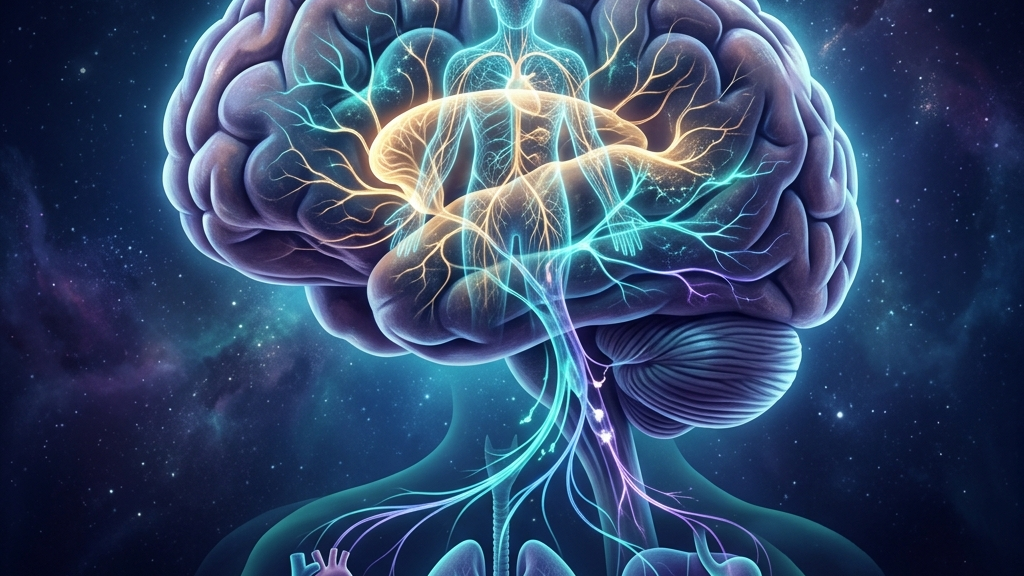
Here is a claim that sounds like philosophy but is actually neuroscience: your sense of being a self — here, now, in this body — is not simply given to you. Your brain builds it, continuously, out of signals streaming up from your organs. Your heartbeat, your breath, the state of your gut, the tension in your blood vessels — all of it feeds a running internal map, and your felt sense of "how I am" is read off that map. Change the signals, or change how the brain reads them, and you change the self they produce. That is not a metaphor. It is how the machinery works.
The Sense You Were Never Taught You Had
You learned five senses in school. There is a sixth that matters more for how you feel: interoception (the perception of the body's internal state — heartbeat, breathing, hunger, gut sensation, temperature, the felt condition of the organs). Most interoceptive traffic rides the vagus and related nerves upward as afferent signals (sensory fibers carrying information toward the brain rather than commands away from it).
This is the perception side of the vagus. The nerve doesn't just carry raw data up; that data becomes an experience — a feeling of your own interior. Interoception is the sense that tells you whether you feel settled or on edge, full or empty, safe in your body or under threat from within it.
Where the Self Gets Assembled: The Insula
Those rising signals converge, after a brainstem relay, on the insular cortex (the insula — a fold of cortex buried in the side of the brain that integrates internal bodily signals into a coherent felt sense of the body's condition). The insula is where a scatter of organ reports becomes a unified feeling of embodiment — the difference between a list of numbers and the sensation of simply being in your body.
Damage or dysregulate the insula's reading and the felt self distorts: people can feel unreal, detached, or strangely disconnected from their own body. The self, it turns out, has an address, and much of its raw material arrives from below.
Accuracy vs. Sensitivity: Two Very Different Things
Two people can both say "I'm very aware of my body" and mean opposite things. The research splits this into distinct dimensions:
- Interoceptive accuracy — how correct your internal readings are. Can you actually detect your true heartbeat, or are you guessing? This is objective precision.
- Interoceptive sensitivity — how much attention and confidence you place on internal signals, whether or not they are accurate. This is subjective weighting.
The trouble comes when sensitivity is high but accuracy is low: you attend intensely to a body signal that is actually noisy or misleading. You are turning up the volume on a channel full of static — and the brain, forced to interpret a loud, unreliable interior report, often interprets it as danger.
Why This Is the Real Engine of a Lot of Anxiety
The modern framework here is predictive processing (the theory that the brain constantly predicts what its incoming signals should be and reacts to the mismatch between prediction and reality). Your brain predicts a calm interior. If the vagal afferent stream reports something jittery — a pounding heart, a churning gut, an irritated organ — there is a mismatch, and the brain must explain it. A common explanation the brain reaches for is fear.
This is why so many people told they are "just anxious" are in fact accurately perceiving a genuinely noisy body — or over-weighting an ordinary one. It also updates a century-old idea. The James–Lange view held that we feel afraid because we notice our heart pounding, rather than the other way round. Interoception refines it: emotion is partly read off the organs, assembled in the insula from vagal signals, then labeled. Your "gut feeling" is not poetic. It is an interoceptive signal from an actual gut, reaching an actual cortex.
The hopeful part: if the self is assembled from signals you can influence — through breath, through calming the body, through learning to read your interior more accurately — then the assembled self is not fixed either.
References & Further Reading
- Craig AD. How do you feel? Interoception: the sense of the physiological condition of the body. Nature Reviews Neuroscience, 2002. PubMed
- Critchley HD, Garfinkel SN. Interoception and emotion. Current Opinion in Psychology, 2017. PubMed
- Barrett LF, Simmons WK. Interoceptive predictions in the brain. Nature Reviews Neuroscience, 2015. PubMed
Have a question?
Have a question about something specific? Send us a message.
Visit VagusSkool.com/contact — we'll try to get back to you within 24 hours.