IBS, Bloating, and the Stuck Gut: When Your Vagus Won’t Tell Your Belly to Calm Down
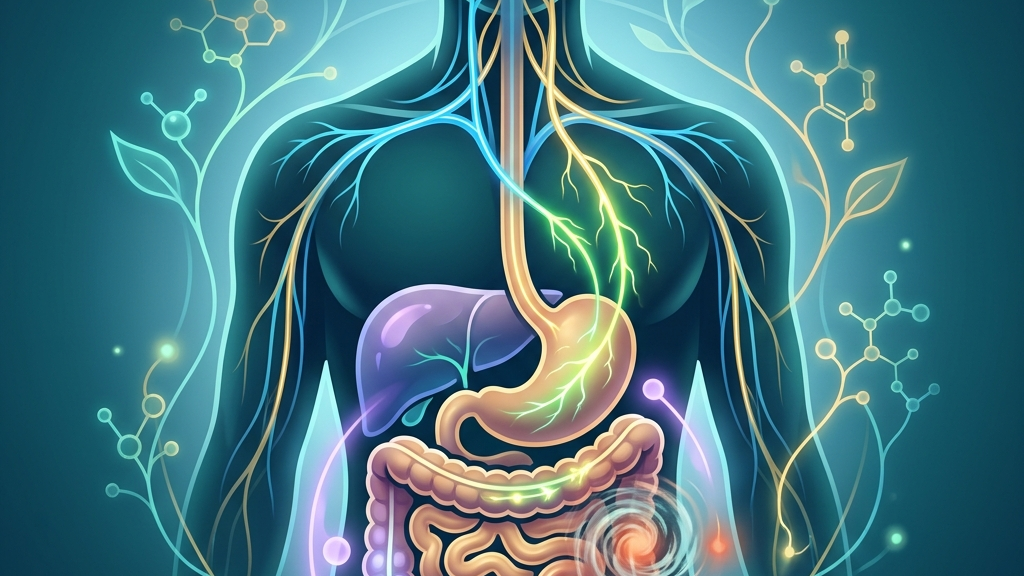
You eat what you always eat. You don’t feel particularly stressed. And yet, by mid-afternoon, your belly is distended, your gut is loud, and you’re looking for the bathroom or wishing you were near one. IBS is one of the most common gut conditions in the world — and one of the most frustrating, because the standard testing usually comes back "normal."
That normal isn’t actually wrong. IBS, bloating, and many functional gut conditions don’t show up on traditional tests because they’re not structural problems. They’re communication problems — specifically, between your gut and the vagus nerve that connects it to your brain.
The Gut-Vagus Conversation
Your gut and brain are connected by what is essentially a fiber-optic cable: the vagus nerve. Roughly 80% of its fibers carry information from the gut to the brain, not the other way around. Every minute, your gut is sending the brain massive amounts of data about what’s in it, how it’s moving, what the microbiome is doing, and what the immune system is sensing.
When this conversation works, your gut behavior is smooth. Food moves at the right pace. Bloating resolves. Sensation is appropriate — you notice fullness when you should, and you don’t notice ordinary digestion at all.
When the vagal conversation breaks down, the gut becomes hypersensitive (small pressures register as pain), motility becomes erratic (too fast, too slow, both at different times), and the brain gets distorted information that triggers more autonomic activation, which makes the gut worse. The loop tightens.
What Breaks the Conversation
- Chronic stress — the single biggest driver of IBS in most patients
- A bout of food poisoning or viral gastroenteritis (post-infectious IBS is well-documented)
- Antibiotic courses that disrupt the microbiome
- Restrictive eating patterns that thin the microbiome
- Trauma, especially in childhood
- Long stretches of poor sleep
- Hormonal shifts (many women notice IBS pattern changes around their cycle, pregnancy, perimenopause)
Each of these does damage to the same pathway: vagal communication between the enteric nervous system (your gut’s "second brain") and the central nervous system.
IBS isn’t a sick gut. It’s a gut that has stopped trusting its conversation with the brain — and a brain that has stopped trusting its conversation with the gut.
Why Diet Alone Often Falls Short
Most IBS treatment starts with food — low-FODMAP, gluten elimination, dairy elimination, low-histamine. These approaches help many people. But they often hit a ceiling, because food isn’t the only input the system is reacting to.
Two people can eat the exact same meal. One has no symptoms; the other bloats badly. The difference isn’t the food — it’s the nervous system the food is landing in. A gut connected to a calm vagal system processes food differently from a gut connected to an activated, sympathetically dominant system.
This is why IBS often improves dramatically with vagal training even without dietary changes — and why people who do both tend to recover faster than those who do either alone.
Daily Practices That Calm the Gut
Pre-Meal Pause
Five slow breaths before each meal, with a long exhale. This signals to your nervous system that food is coming, activates the cephalic phase of digestion, and shifts the gut into parasympathetic mode. People who do this consistently often see meaningful symptom reduction within two weeks.
Eat Without Multitasking
Sympathetic dominance during meals — phone, email, news, driving — directly worsens digestion. The brain interprets multitasking as low-grade threat. Even small steps toward attentive eating help.
Slow Breathing Daily
Ten minutes of resonance breathing (four in, six out, or five in, five out) raises baseline vagal tone. Over four to eight weeks, this measurably changes gut motility and sensitivity.
Belly Breathing
Diaphragmatic breathing massages the gut from above with each breath. Many people with IBS have shifted to chest breathing without realizing it. Returning to belly breathing can produce immediate relief, especially during a flare.
Humming, Singing, Gargling
Stimulates the vagus nerve at the throat, with downstream effects on gut motility. Three to five minutes daily.
Microbiome Support
Fermented foods (yogurt, kimchi, sauerkraut, kefir) and fiber feed the bacteria that produce short-chain fatty acids, which the vagus nerve uses as part of its signal. This isn’t supplements — it’s real food, consistently.
Sleep Architecture
The gut does most of its repair and motility cycling during deep sleep. Fragmented sleep produces fragmented digestion. Consistent bedtimes, cool dark rooms, no late alcohol.
What’s Worth Asking About Medically
- Ruling out conditions that mimic IBS: celiac, IBD, SIBO, microscopic colitis
- Hormonal evaluation if symptoms cluster around your cycle
- Whether a low-dose neuromodulator (used in some refractory IBS) is appropriate — some work specifically on gut-brain signaling
- Pelvic floor physical therapy if you have constipation patterns or pain with bowel movements
- Vagal stimulation: emerging research is exploring transcutaneous VNS for IBS, with promising early results
What to Expect Over Time
IBS rarely resolves overnight. With consistent vagal practice, dietary attention, sleep, and stress reduction, most people see meaningful improvement over three to six months. The gut isn’t damaged — it’s just out of practice trusting its environment. Trust comes back when the inputs are steady.
Start Before Your Next Meal
Take five slow breaths with a long exhale before you eat next. That’s the smallest possible starting point, and it’s already changing the conversation between your gut and your brain. Over a week of meals, the cumulative effect is real. Your gut wants to talk to your nervous system. Give it a calm partner to talk to.
Have a question?
Have a question about something specific? Send us a message.
Visit VagusSkool.com/contact — we'll try to get back to you within 24 hours.