The Lump That Won't Swallow: Globus, Difficulty Swallowing, and the Vagus Nerve
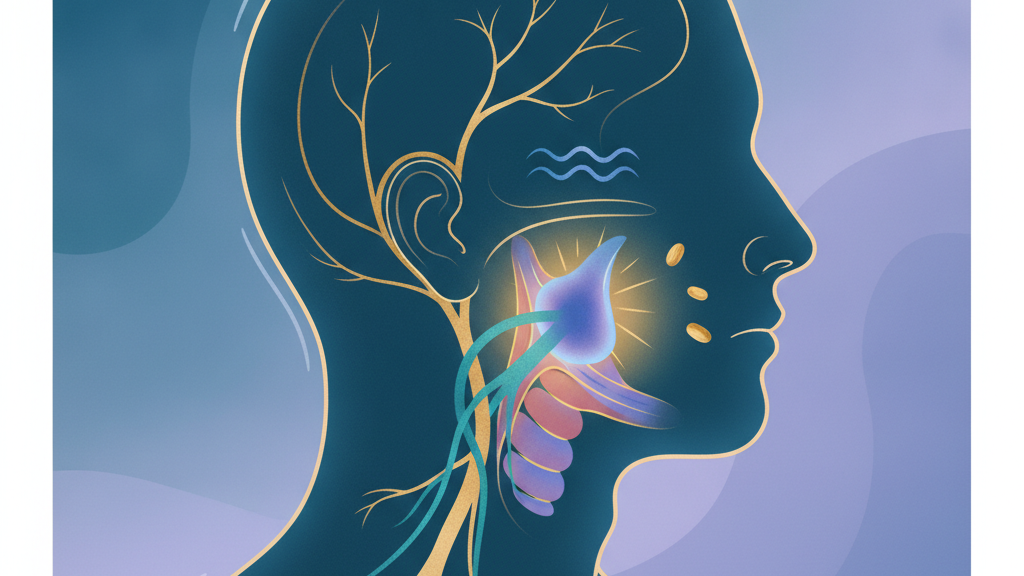
"It feels like something is stuck in my throat, but nothing is there." "I have to think about swallowing now, and sometimes food catches." These two complaints show up again and again in our intake, and they frighten people — understandably. In a large share of cases the throat is structurally fine. What has changed is the nerve that runs the swallow: the vagus.
Swallowing Is a Vagal Reflex
Swallowing feels automatic because it is. It is a finely sequenced reflex, and the vagus nerve is its master conductor. Two of its branches do the work: the pharyngeal branch drives the muscles that move food from the mouth to the esophagus, and the recurrent laryngeal nerve coordinates the larynx and the upper esophageal sphincter (Anatomy, Vagus Nerve — StatPearls). The vagus also carries the sensory information that tells your brain where the food is and when to trigger the next phase. When that signaling is off, timing and coordination suffer even when every muscle is intact.
Two Different Sensations
Globus is the persistent feeling of a lump or tightness in the throat when nothing is physically there, and importantly, it is present between swallows rather than during them. It is common, usually benign, and strongly linked to heightened throat sensitivity and tension (Globus Sensation — StatPearls).
Dysphagia is genuine difficulty moving food or liquid — food catching, coughing, or the sense that a swallow is not completing. Dysphagia is a symptom that always deserves medical evaluation, because it has a wider range of possible causes.
The Autonomic Connection
Here is why these land on a vagus-focused site. The upper esophageal sphincter and throat muscles are exquisitely tension-sensitive, and their tension tracks with your autonomic state. In sympathetic overdrive — the chronic fight-or-flight pattern — the throat braces, saliva drops, and sensory nerves become hypervigilant, amplifying normal sensations into a "lump." Many people notice their globus is worst during stressful weeks and eases when they are calm. That is not imagination; it is autonomic tone changing the sensitivity and muscle tone of a vagally controlled region.
Reflux plays a supporting role too. Low vagal tone weakens the sphincters that keep stomach contents down, and even small amounts of reflux can irritate the throat and produce a persistent lump sensation and throat clearing — so-called laryngopharyngeal reflux.
What Tends to Help
- Down-shift the nervous system first. Slow, extended-exhale breathing before meals lowers throat bracing and lets the swallow reflex run without interference.
- Stimulate the vagus through the throat. Humming, gentle singing, and gargling engage exactly the muscles the vagus controls and can reduce tension and hypersensitivity over time.
- Eat in a regulated state. Sit down, slow down, and chew thoroughly. Eating on the move keeps the sympathetic system in charge, which is the opposite of what swallowing needs.
- Address reflux upstream. Smaller evening meals, not lying down after eating, and reducing triggers ease the throat irritation that feeds globus.
- Reduce throat clearing. The habit of clearing an irritated throat re-irritates it, deepening the loop. A small sip of water breaks the cycle better than clearing does.
Red Flags — See a Doctor Promptly
Globus that comes and goes with stress is usually benign. But certain features need timely, in-person evaluation:
- Genuine difficulty swallowing solids or liquids, or food actually getting stuck
- Painful swallowing, unintended weight loss, or coughing/choking with meals
- A one-sided lump, a neck mass, hoarseness lasting more than a few weeks, or symptoms that are steadily worsening
These do not fit the benign autonomic pattern and warrant a proper examination to rule out structural or neurological causes.
The takeaway: Swallowing is a vagus-run reflex, and the throat is one of the most tension-sensitive regions in the body. When the nervous system is stuck in overdrive, the throat braces and its sensory nerves turn up the volume — producing a very real lump where nothing is stuck. Calming the autonomic state and gently training the vagus through the throat addresses the mechanism, but true swallowing difficulty always earns a medical evaluation.
Have a question?
Have a question about something specific? Send us a message.
Visit VagusSkool.com/contact — we'll try to get back to you within 24 hours.