Eagle Syndrome: When a Bone Spike in Your Neck Presses on the Vagus
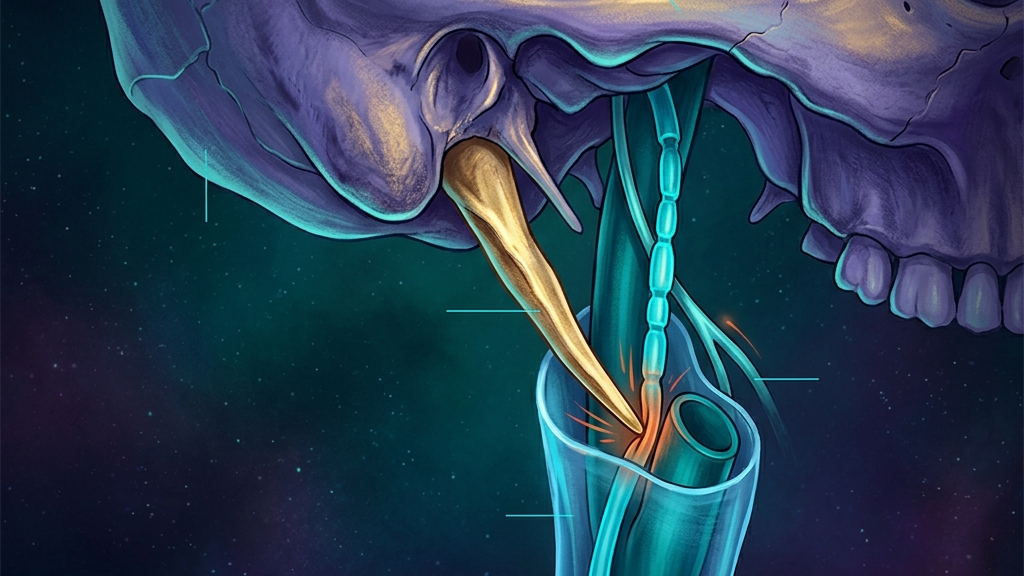
"There is a bone spike in my neck" sounds like something a doctor would gently talk you out of believing. And yet, for a real subset of people, it is literally true. A slender projection of bone at the base of the skull — normally short and harmless — can grow too long, or its attached ligament can turn to bone, until it becomes a rigid spike pressing on some of the most important nerves in the neck. The condition has a name: Eagle syndrome (symptoms caused by an abnormally elongated styloid process or a calcified stylohyoid ligament irritating nearby nerves and vessels). It is one of the clearest examples of a structural problem hiding behind symptoms that get filed under "stress."
The Bone in Question
The styloid process (a thin, pointed projection of bone extending downward and forward from the underside of the skull, just in front of the ear) is normal equipment. Everyone has one on each side. It serves as an anchor for several muscles and ligaments of the tongue and throat. In most people it is modest in length and causes no trouble at all. But in some people it is unusually long, or the stylohyoid ligament (the ligament connecting the tip of the styloid process to a small bone in the throat) gradually calcifies — turns to bone — effectively extending the spike. Either way, the result is a stiff, pointed structure reaching down into a very crowded and delicate part of the neck.
What the Spike Runs Into
Just deep to the styloid process lies the carotid sheath (a tube of connective tissue bundling together the carotid artery, the internal jugular vein, and the vagus nerve as they run through the neck). Nearby runs the glossopharyngeal nerve as well. An elongated styloid can jut toward this bundle and mechanically irritate its contents. That single fact explains the confusing spread of Eagle syndrome symptoms — the spike is not touching one thing, it is intruding on a nerve-and-vessel highway.
The Two Faces of Eagle Syndrome
Clinicians describe two overlapping patterns, depending on what the styloid is irritating.
- The classic (nerve) form tends to follow throat surgery or develop over time, and centers on the glossopharyngeal nerve. It produces throat pain, ear pain, pain on swallowing, and the maddening sensation of something stuck in the throat that will not clear. When the pain is sharp and stabbing along the back of the throat and ear, it can amount to glossopharyngeal neuralgia (severe, shock-like nerve pain in the throat and ear region).
- The vascular / nerve form comes from the styloid pressing toward the carotid sheath and the vagus running within it. This is where the alarming symptoms live: dizziness, palpitations, a feeling of impending faint, or even actual fainting — classically provoked by turning or tilting the head, because head movement changes how the spike contacts the sheath.
That last detail — symptoms that flare when you turn your head — is a genuinely useful clue. Anxiety does not usually switch on and off with neck rotation. A bone pressing on a nerve does.
Why This Gets Dismissed — and Why It Shouldn't Be
Every symptom on that list is a symptom that gets attributed to stress: throat tightness, palpitations, lightheadedness, a lump in the throat, unexplained pain. Taken one at a time, and with normal routine tests, the picture is easy to wave away. But Eagle syndrome is not diagnosed by routine tests. It is diagnosed by looking directly at the bone — typically a CT scan with 3D reconstruction, which lets a radiologist measure the styloid process and see whether the stylohyoid ligament has calcified. A styloid that is dramatically longer than normal, on the side matching the symptoms, changes the whole conversation.
The point is not that everyone with throat pain and palpitations has a bone spike — the condition is uncommon. The point is that a structural, imageable, sometimes treatable cause exists for a symptom cluster that is routinely psychologized. If your symptoms are one-sided, provoked by head position, and centered on the throat, ear, and autonomic system together, that combination has an anatomy — and it is worth asking whether anyone has actually looked at it.
Have a question?
Have a question about something specific? Send us a message.
Visit VagusSkool.com/contact — we'll try to get back to you within 24 hours.