Cold Exposure and Vagus Nerve Activation — The Dive Reflex Revisited
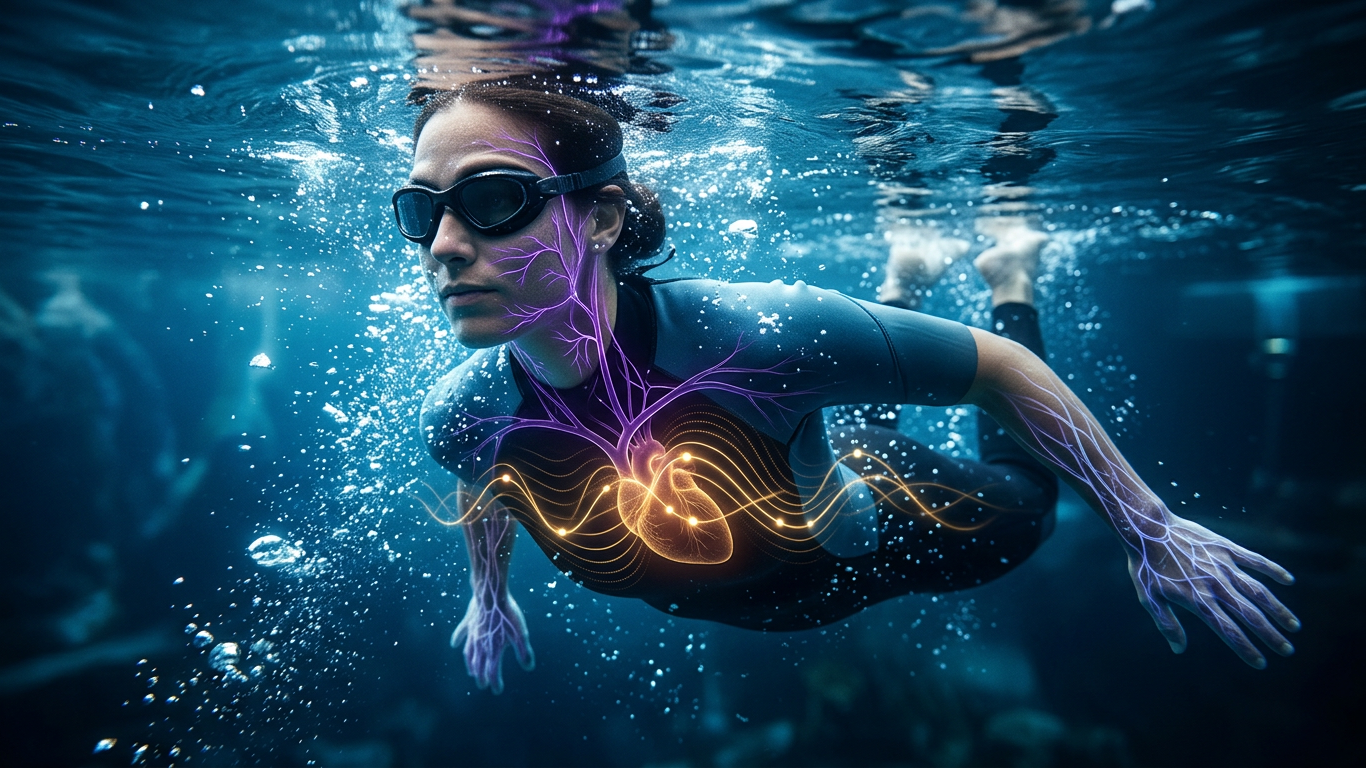
Cold Exposure and Vagus Nerve Activation — The Dive Reflex Revisited
Thesis
Cold water on the face triggers a mammalian survival reflex that directly stimulates the vagus nerve, producing immediate bradycardia and parasympathetic activation. This isn't wellness hype — it's the trigemino-cardiac reflex, hard-wired into your brainstem, and it's been scientifically measured to dramatically accelerate post-exercise autonomic recovery. Understanding the dive reflex explains why cold exposure works, and why face immersion is more effective than whole-body cold plunges for vagal activation.
Key Questions
- What is the diving reflex and how does it activate the vagus nerve?
- Why does cold face immersion work without breath-holding?
- How does cold exposure accelerate post-exercise parasympathetic recovery?
- What are the practical implications for health and performance?
Supporting Research
Al Haddad, H. et al. (2010). Influence of cold water face immersion on post-exercise parasympathetic reactivation. European Journal of Applied Physiology, 108(3), 599–606.
DOI: 10.1007/s00421-009-1253-9 | PubMed
Tipton, M.J. et al. (2017). Cold water immersion: kill or cure? Experimental Physiology, 102(11), 1335–1355.
The Trigemino-Cardiac Reflex
When cold water contacts the face — particularly the forehead, eyes, and cheeks — cold receptors in the trigeminal nerve (cranial nerve V) fire signals to the brainstem. The brainstem immediately activates the vagus nerve, producing bradycardia (slowed heart rate) and peripheral vasoconstriction. This is the diving reflex, evolved in all air-breathing vertebrates to conserve oxygen during submersion.
The critical insight from Al Haddad's 2010 study: this reflex works independently of breath-holding. Participants used a snorkel and nose clip — they breathed normally throughout. Cold face immersion alone was sufficient to trigger vagal activation.
Measurable Effects
The study compared cold water face immersion (10–12°C) vs. control (seated with snorkel) after intense intermittent exercise. The results were dramatic:
- Heart rate recovery (HRR₆₀ₛ): 30 ± 8 beats/min (control) vs. 3 ± 13 beats/min (cold immersion) — P = 0.002
- lnHF (high-frequency HRV): 2.84 ± 1.40 ln(ms²) (control) vs. 4.34 ± 1.69 (cold) — P = 0.004
- ln rMSSD: 1.87 ± 0.60 ln(ms) (control) vs. 2.36 ± 0.89 (cold) — P = 0.026
All measures of parasympathetic reactivation improved significantly. The cold immersion didn't boost sympathetic activity — it selectively enhanced vagal recovery.
Why Face vs. Whole Body?
The trigeminal nerve innervates the face with far greater density of cold receptors than the body. Whole-body cold immersion triggers a competing sympathetic response (fight-or-flight from the cold shock), which can overwhelm the vagal effect. Face immersion is surgically precise: it activates the diving reflex without triggering the full-body sympathetic defense cascade.
Practical Applications
- Post-exercise recovery: Cold face immersion for 5 minutes dramatically accelerates parasympathetic reactivation, reducing cardiac workload and potential arrhythmia risk
- Acute stress reduction: Splashing cold water on the face during panic attacks or acute anxiety can immediately trigger vagal braking
- Athletic performance: Faster autonomic recovery between training bouts or competitions
- Safety: Potentially reduces risk of sudden cardiac events during exercise recovery
Why This Matters
The dive reflex is one of the most accessible, immediate methods for vagal activation. Unlike meditation or breathing exercises, which require practice and time, cold face immersion works in seconds. It's free, requires no equipment, and produces measurable physiological changes within minutes. Understanding it as a trigemino-vagal reflex — rather than "cold exposure" broadly — explains why Wim Hof's face dunks work better than his cold showers for parasympathetic activation.
Experimental Predictions
- Trigeminal nerve density in the face should correlate with dive reflex strength
- Chronic cold face immersion training should improve baseline vagal tone over time
- Combining cold face immersion with slow breathing should produce synergistic vagal activation
- Patients with vagal dysfunction (e.g., autonomic neuropathy) should show attenuated dive reflex
Have a question?
Have a question about something specific? Send us a message.
Visit VagusSkool.com/contact — we'll try to get back to you within 24 hours.