Biofeedback Beyond HRV: The Full Toolkit for Autonomic Training
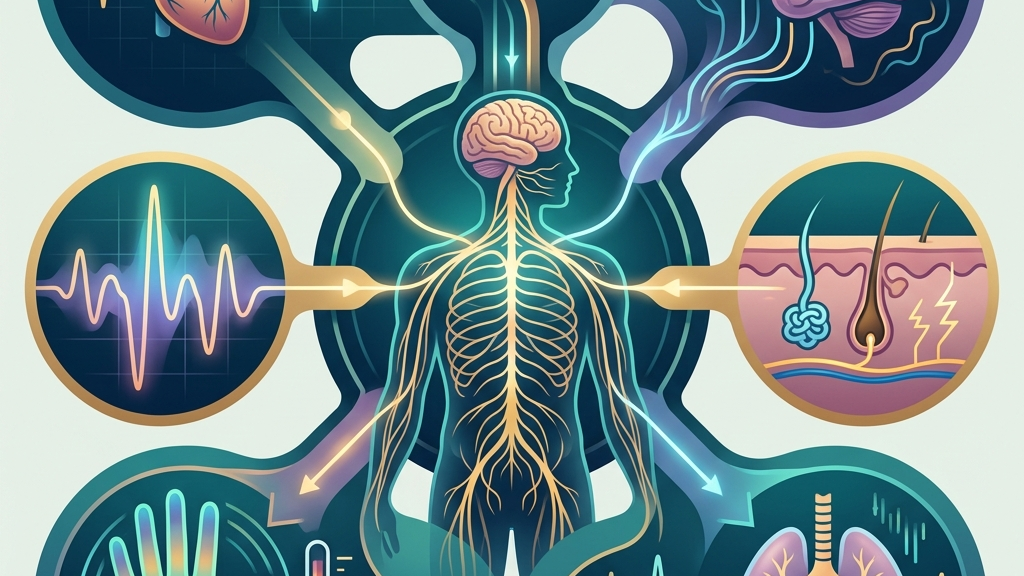
Most people who hear "biofeedback" today think of HRV — a wearable that shows your heart rate variability while you breathe. That’s a great starting point. But HRV is just one of several biofeedback modalities, and depending on what you’re trying to do, other tools may be a better fit.
Biofeedback is the broader category: any technology that takes a hidden body signal, makes it visible, and lets you train it. Done well, it’s one of the most efficient ways to influence your nervous system, because you skip years of guessing about what works for your body.
What Biofeedback Actually Is
Your body produces dozens of signals you can’t consciously feel: heart rate variability, brain waves, skin conductance, muscle tension, breath rate, body temperature, blood pressure. Each of these reflects some aspect of your autonomic state, your emotional state, or both.
Biofeedback uses sensors to measure one of these signals and display it back to you in real time — a graph, a tone, a number, a color shift. As you watch it move, you naturally start noticing what shifts it. Over time, you build the ability to influence that signal on command, without the device.
This is fundamentally different from passive practices. You’re not just hoping the breathing helps. You’re seeing exactly what helps, instantly.
The Main Tools
HRV Biofeedback
The most accessible. Sensors range from a finger clip to a chest strap to a wearable ring. The graph shows the variation in time between heartbeats, mostly governed by the vagus nerve. As you slow your breathing to your resonance frequency (around six breaths per minute), the graph rises and smooths out.
Best for: Stress resilience, anxiety, blood pressure, athletic recovery, post-traumatic regulation.
EEG Neurofeedback
Sensors on the scalp measure the electrical activity of your brain. Different frequency bands correspond to different states: alpha (relaxed alertness), beta (focus), theta (light meditation, drowsiness), gamma (high-level processing). The display rewards you for producing more of one band and less of another.
Best for: ADHD, attention training, post-concussion recovery, peak performance, deep meditation. Done well, it can produce changes that other modalities can’t. Done poorly, it can be a waste of money. Practitioner quality matters enormously.
Galvanic Skin Response (GSR / EDA)
Sensors on the fingers measure tiny changes in skin conductance, which rise with sympathetic activation. The signal moves within seconds of a stress shift — even before you consciously notice it.
Best for: Real-time stress awareness, recognizing emotional triggers, learning to release sympathetic spikes quickly. The fastest feedback signal of all biofeedback modalities.
Temperature Biofeedback
A small thermistor on your fingertip. As your nervous system shifts toward parasympathetic dominance, peripheral blood flow increases and your fingers warm up. As you stress, blood flow constricts and they cool.
Best for: Migraine prevention, Raynaud’s, anxiety. Cheap, low-tech, unexpectedly powerful. The Mayo Clinic has used it for decades in headache training.
Capnometry / Breath Biofeedback
Measures end-tidal CO2, which reflects how efficiently you’re breathing. Many people with chronic anxiety or panic chronically over-breathe, blowing off too much CO2 — which itself worsens symptoms. Capnometry shows this in real time and lets you correct it.
Best for: Panic, hyperventilation, asthma, performance breathing.
Surface Electromyography (sEMG)
Sensors on muscles measure tension. You learn to recognize tension you weren’t aware of, and to release it.
Best for: Tension headaches, jaw and neck pain, pelvic floor dysfunction, rehabilitation after injury.
Biofeedback works because it skips the guessing. Instead of hoping something is helping, you see, in real time, exactly what shifts your nervous system.
How to Choose
The best biofeedback tool depends on what you’re trying to address:
- General stress, anxiety, anxiety-driven sleep problems: Start with HRV biofeedback
- Migraines, especially with cold hands: Temperature biofeedback
- Attention, focus, ADHD, post-concussion: EEG neurofeedback (with a qualified practitioner)
- Panic attacks: Capnometry plus HRV biofeedback
- Tension headaches, jaw clenching, pelvic floor issues: sEMG, often through a pelvic floor or PT specialist
- Real-time stress awareness: GSR / EDA
Many people benefit from combining two modalities — for example, HRV plus temperature, or HRV plus GSR. The combination provides a fuller picture of your autonomic state.
Where to Start at Home
Affordable Options
- HRV: A chest strap (Polar H10) plus a free or low-cost app (Elite HRV, HRV4Training). Around $90.
- Temperature: A simple stress thermometer (around $20) on a fingertip during practice. Surprisingly effective.
- HeartMath Inner Balance: A clip-on sensor with a coherence-focused app. Friendly entry point for beginners. Around $130.
- Capnometry: Once expensive, now available in some consumer devices. Particularly useful for people who suspect they over-breathe under stress.
When to Work With a Professional
Some modalities are best learned with a clinician:
- EEG neurofeedback — practitioner skill matters enormously
- sEMG for pelvic floor — needs hands-on expertise
- Multimodal biofeedback for complex conditions (PTSD, chronic pain) — a trained therapist can integrate the data into a coherent treatment plan
Common Mistakes
- Chasing the score: Trying to "win" your HRV reading creates effort, which raises sympathetic tone and lowers the score. Soft attention works better than hard focus.
- Inconsistent practice: Biofeedback works through repetition. Five minutes daily for a month produces more change than an hour once.
- Wrong tool: HRV biofeedback won’t fix migraine as well as temperature biofeedback. Match the tool to the goal.
- Ignoring lifestyle: No biofeedback compensates for chronic poor sleep, alcohol, or untreated apnea.
The Bigger Picture
Biofeedback is the bridge between intention and physiology. It turns the abstract idea of "calming down" into a real-time skill you can train. For some people, HRV is enough. For others, the right second tool unlocks results that one alone never produced.
Pick the tool that matches your specific issue. Use it five to ten minutes daily for a month. Then decide whether to add another. The body responds quickly when you stop guessing and start seeing.
Have a question?
Have a question about something specific? Send us a message.
Visit VagusSkool.com/contact — we'll try to get back to you within 24 hours.