Your Autonomic Nervous System, Explained: A Plain-English Map of Sympathetic, Parasympathetic, and Vagal Tone
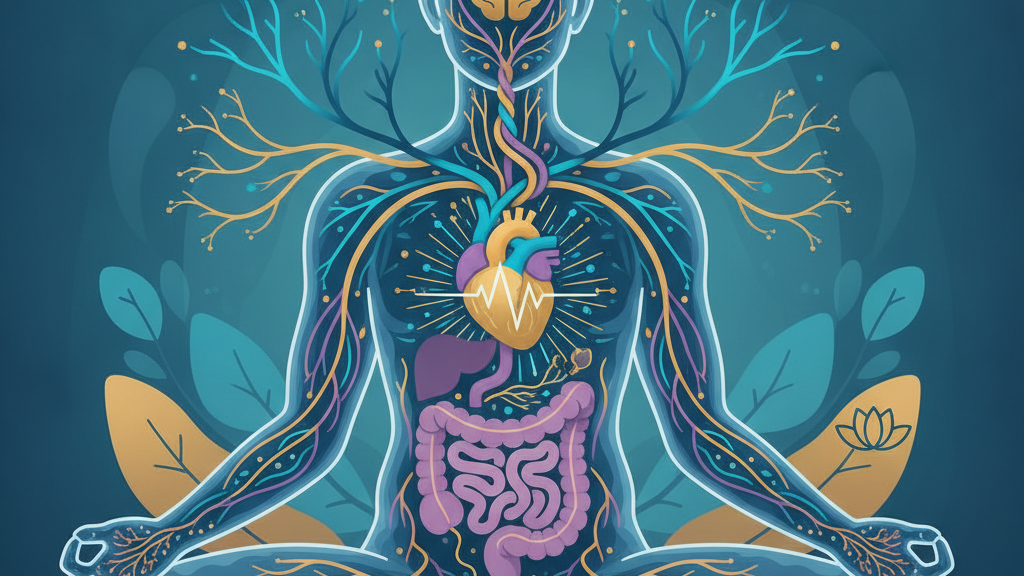
Almost every symptom people write to us about — the racing heart, the exhaustion that sleep does not fix, the gut that will not settle, the sense of being switched permanently "on" — traces back to one system most of us were never taught about: the autonomic nervous system. If you understand how it works, the symptoms stop looking random and start looking like a system doing exactly what it was told to do. This is the map.
The System That Runs You Without Asking
The autonomic nervous system (ANS) is the part of your nervous system that runs the body automatically — heart rate, breathing rate, blood pressure, digestion, temperature, pupil size, sweating, and immune signaling — without conscious effort (StatPearls: Physiology, Autonomic Nervous System). You do not decide to digest lunch or slow your heart after a scare. The ANS does it for you, thousands of times a day.
It has two main branches that work like the accelerator and the brake in a car: the sympathetic branch and the parasympathetic branch. Health is not one branch winning. Health is the flexibility to move between them at the right moments.
The Accelerator: The Sympathetic Branch
The sympathetic branch mobilizes you for action — the classic "fight-or-flight" response. When it fires, it raises heart rate, redirects blood to the large muscles, dilates the pupils, releases adrenaline and cortisol, sharpens focus, and pauses non-urgent housekeeping like digestion. This is not a malfunction. It is a survival gift. The problem is not that it turns on; the problem is when it will not turn off.
The Brake: The Parasympathetic Branch
The parasympathetic branch governs "rest, digest, and repair." It slows the heart, deepens breathing, restarts digestion, supports immune balance, and allows the body to recover. The main highway carrying parasympathetic signals is the vagus nerve — the longest cranial nerve, running from the brainstem down through the throat, heart, lungs, and gut. Roughly 80% of its fibers are sensory, meaning it is mostly a reporting line carrying information from your organs up to the brain, not just commands going down (Breit et al., Vagus nerve as modulator of the brain–gut axis).
Vagal Tone: Your Recovery Score
"Vagal tone" describes how strong and responsive that parasympathetic brake is. Higher vagal tone means the body can down-shift efficiently after stress. Lower vagal tone means it stays revved. You cannot feel vagal tone directly, but you can measure a close proxy: heart rate variability (HRV), the tiny beat-to-beat variation in your pulse. Counter-intuitively, more variability is healthier — it signals a nervous system that is flexible rather than locked (Shaffer & Ginsberg, An Overview of Heart Rate Variability Metrics).
The Three States, Not Two
Stephen Porges' polyvagal framework adds useful nuance by describing three states rather than a simple on/off (Polyvagal Institute):
- Ventral vagal (safe and social): calm, connected, able to think clearly and engage with others.
- Sympathetic (mobilized): anxious, driven, on guard — fight-or-flight.
- Dorsal vagal (shutdown): numb, flat, exhausted, checked-out — the body conserving energy when it perceives threat it cannot escape.
Many people cycle between the bottom two — wired, then crashed — without ever landing in the calm ventral state. That pattern, not any single symptom, is what "dysregulation" really means.
When the Map Explains Your Symptoms
Once you see the ANS, a scattered symptom list resolves into one story. A stuck accelerator produces a predictable phenotype: elevated resting heart rate, low HRV, shallow breathing, cold hands and feet, poor sleep, tight or reactive digestion, jaw clenching, and the "tired but wired" feeling. A collapsed state produces the opposite: heavy fatigue, low mood, brain fog, and a body that feels offline. Neither is a character flaw. Both are autonomic states.
The Good News: The System Is Trainable
Autonomic tone behaves like physical fitness — it responds to consistent, specific training. The most reliable levers are unglamorous and free:
- Slow breathing at roughly six breaths per minute, with a longer exhale than inhale, is the single most direct way to activate the vagal brake.
- Humming, singing, and gargling stimulate the vagus through the muscles of the throat.
- Cold water on the face triggers the dive reflex, a strong built-in vagal activator.
- Regular movement, sleep, and co-regulation with calm people rebuild baseline capacity over weeks.
None of these works in a single session. Like any conditioning, the effect comes from the repetition.
The takeaway: You are not broken, and your symptoms are not random. You have a two-branch control system that has lost some of its flexibility — usually stuck too far toward the accelerator. The path back is not forcing relaxation; it is patiently retraining the brake. Every article on this site is, in one way or another, about that single project.
References & Further Reading
- Waxenbaum JA, et al. Physiology, Autonomic Nervous System. StatPearls. Read
- Breit S, et al. Vagus Nerve as Modulator of the Brain–Gut Axis. Front Psychiatry. Read
- Shaffer F, Ginsberg JP. An Overview of Heart Rate Variability Metrics and Norms. Front Public Health. Read
- Polyvagal Institute — What is Polyvagal Theory. Read
Have a question?
Have a question about something specific? Send us a message.
Visit VagusSkool.com/contact — we'll try to get back to you within 24 hours.