Autoimmune Disease and the Vagus Nerve: The Inflammatory Reflex Frontier
If you’ve ever sat in a doctor’s office while they explained that your immune system is attacking your own body, you know how unsatisfying the conversation usually is. The drug menu lists immunosuppressants — helpful, often necessary, but with significant trade-offs. The lifestyle advice is vague. The mechanism is named ("autoimmune") but rarely explained at the level you can actually do something about.
That’s starting to change. A discovery from a New York lab at the turn of the century has slowly rewritten what we know about autoimmunity — and it points to a single nerve as one of the most important regulators of immune balance in the human body.
The Discovery That Changed the Field
In 2000, a researcher named Kevin Tracey and his team at the Feinstein Institute discovered something unexpected: the vagus nerve directly controls inflammation, through a circuit they called the inflammatory reflex.
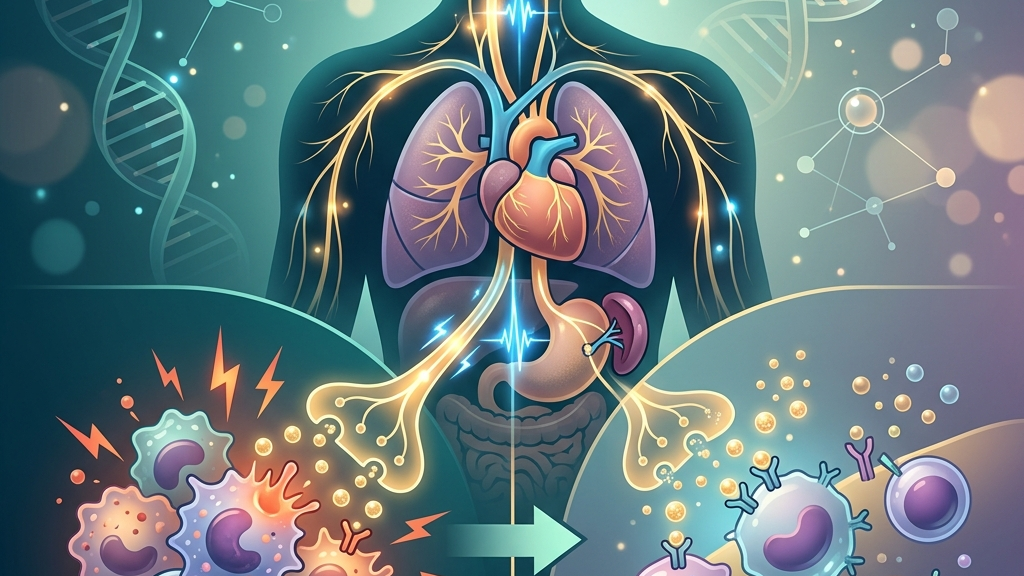
The mechanism is elegant. When the body detects inflammatory signals, the vagus nerve’s sensory fibers carry that information to the brainstem. The brainstem then triggers the vagus nerve’s motor fibers, which release acetylcholine at the spleen. The acetylcholine binds to specific receptors on immune cells, telling them to dial down inflammatory cytokine production.
Within seconds. Faster than any drug.
This was the first demonstration that the nervous system has direct, real-time control over the immune system. It launched an entire new field: bioelectronic medicine.
Why This Matters for Autoimmunity
Autoimmune diseases — rheumatoid arthritis, lupus, Crohn’s, ulcerative colitis, multiple sclerosis, Hashimoto’s, type 1 diabetes — share a common feature: an immune system that has lost its ability to distinguish self from non-self, and is producing inflammation it shouldn’t.
The cholinergic anti-inflammatory pathway is the body’s built-in brake on this kind of overreach. When vagal tone is healthy, the brake works — inflammation rises and falls appropriately. When vagal tone is low, the brake fails. Inflammation runs longer than it should. Over months and years, this contributes to the chronic-inflammatory state autoimmune diseases live in.
For decades, autoimmunity was a chemistry problem with no electrical answer. The discovery that a nerve could brake inflammation in seconds has rewritten what’s possible.
From Theory to Treatment
The clinical evidence has been remarkable. Implanted vagus nerve stimulators have been tested in patients with rheumatoid arthritis whose disease hadn’t responded to multiple drugs. Many achieved remission. Trials in Crohn’s disease have shown similar results. The same is being studied in lupus, psoriatic arthritis, and other autoimmune conditions.
Crucially, this isn’t a substitute for existing treatments — it’s an addition, sometimes a powerful one. Patients who couldn’t tolerate biologics, or who had run out of options, gained new ones. The era of treating autoimmunity with drugs alone is closing. The era of treating it as a neural-immune partnership is just beginning.
What This Means for Daily Life
Most people with autoimmune disease aren’t candidates for an implanted device. But the same biology runs every day at a smaller scale: every time you breathe slowly, expose yourself briefly to cold, get a real night of sleep, or laugh with someone you love, you’re activating the same anti-inflammatory pathway.
Daily vagal practice doesn’t replace medication. It improves the platform medication is working on. People with autoimmune conditions who consistently work with their nervous system often see improvements in:
- Symptom severity and flare frequency
- Inflammatory markers on bloodwork (hs-CRP, ESR)
- Energy and brain fog between flares
- Tolerance of medication side effects
- Mood and quality of life independent of disease activity
What Damages the Pathway
- Chronic stress — the single biggest depressor of the inflammatory reflex
- Poor sleep, especially less than six hours
- Sedentary behavior
- Smoking
- Excessive alcohol
- Highly processed diets that disrupt the gut microbiome (which talks to the vagus nerve)
- Untreated sleep apnea
- Loneliness and social isolation
None of these alone cause autoimmune disease, but each one chips away at the brake the body has on inflammation.
What Strengthens It
Slow Breathing
Five to ten minutes daily of resonance breathing (around six breaths per minute). Cumulatively raises baseline vagal tone, which raises the activity of the cholinergic anti-inflammatory pathway. Studies have measured cytokine reductions in people who do this consistently.
Cold Exposure
Brief cold — a 30-second cold shower finish, or face immersion — activates the dive reflex and surges vagal output. The Wim Hof method has been tested in inflammatory contexts with measurable acute effects.
Movement Without Overtraining
Regular moderate exercise improves vagal tone and reduces inflammation. Excessive training does the opposite. For autoimmune patients especially, the dose matters.
Gut Care
The microbiome influences immune behavior through the vagus nerve. Fermented foods, fiber, and reducing constant snacking all support cleaner vagal signaling. There’s also growing evidence that specific probiotic strains may help in autoimmunity, though the science is still evolving.
Sleep Architecture
Vagal repair and immune balance both happen during deep sleep. The single biggest leverage point for inflammation control is solid, consistent sleep.
Real Connection
The ventral vagal complex is the social engagement system. Loneliness elevates inflammation; meaningful connection lowers it. This isn’t poetic — it’s measurable in cytokine levels.
What to Ask Your Doctor
- Whether transcutaneous vagal stimulation could be added to your treatment plan — several FDA-cleared devices are now on the consumer market
- Bloodwork that includes inflammatory markers (hs-CRP, ESR) so you can track changes over time
- Vitamin D, B12, iron, and selenium levels — deficiencies in these all worsen autoimmune patterns
- A thoughtful conversation about gut health, sleep, stress, and lifestyle, not just medications
The Bigger Picture
Autoimmune disease is rarely cured. But the trajectory can shift dramatically when you treat the nervous system the immune system lives inside. The vagus nerve isn’t a workaround for medication — it’s the platform that lets medication do its real work, while reducing the underlying overreach the medication is trying to suppress.
Pick one practice for this week: ten minutes of slow breathing, daily. Most people with autoimmune disease notice subtle changes within two to four weeks. The brake is responsive. It just needs you to keep using it.
Have a question?
Have a question about something specific? Send us a message.
Visit VagusSkool.com/contact — we'll try to get back to you within 24 hours.