Air Hunger: Why You Can't Get a Full Breath When Your Oxygen Is Perfectly Fine
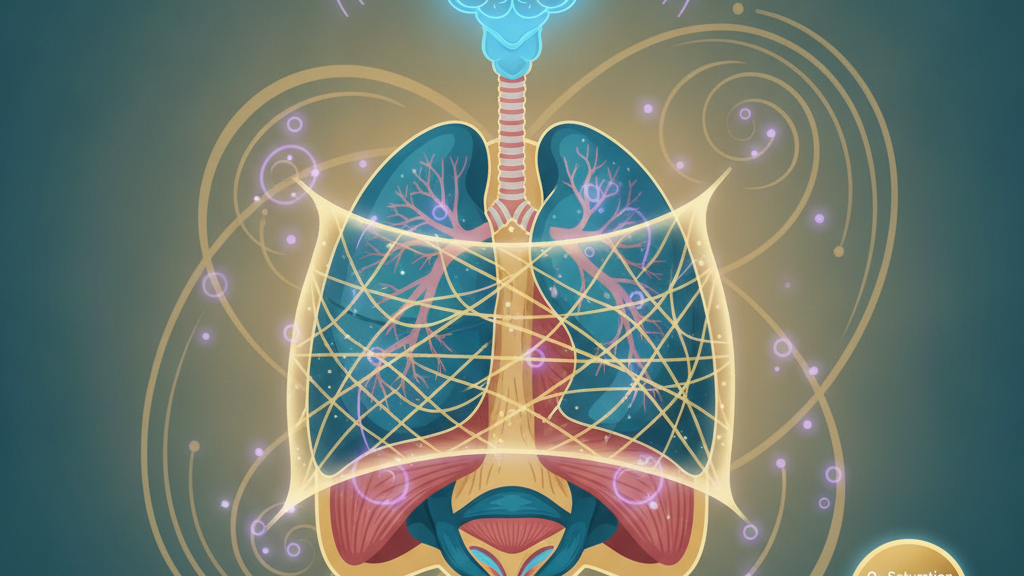
"I keep trying to take a deep breath, but it never feels like it lands." "I feel like I'm not getting enough air, so I yawn and sigh constantly — but my oxygen is normal." This symptom is deeply unsettling, precisely because breathing is supposed to be automatic. The good news, in the vast majority of cases, is that the lungs are working fine. The problem is in the control system — and the vagus nerve sits at its center.
The Paradox of Air Hunger
Air hunger — the sensation of not being able to get a satisfying breath despite normal oxygen levels — is one of the most common and most confusing symptoms in anxiety and dysautonomia. Pulse oximetry reads 98–99%. The chest X-ray is clear. Yet the feeling of suffocation is real. The explanation is that the sensation of breathing and the adequacy of breathing are governed by different systems, and they can disagree.
What's Actually Happening: Over-Breathing
Counter-intuitively, air hunger is often driven by breathing too much, not too little. In chronic stress, many people quietly over-breathe — shallow, upper-chest breaths, frequent sighs — which blows off carbon dioxide and lowers blood CO2 (a state called hypocapnia). Low CO2 is what actually triggers the urge to yawn and sigh, along with tingling, lightheadedness, and chest tightness (Dysfunctional breathing and hyperventilation — review). The harder you try to "get a full breath," the more you over-breathe, and the worse the sensation gets. It is a self-reinforcing loop.
The Vagal and Autonomic Layer
Breathing is one of the only autonomic functions you can also control consciously, which makes it the main doorway into the nervous system. The vagus nerve carries stretch signals from the lungs and information from CO2 sensors up to the brainstem, and vagal output modulates the airways and the diaphragm's rhythm. In a sympathetically dominant state, breathing shifts high into the chest and fast — exactly the pattern that produces hypocapnia and air hunger (brain–gut and vagal regulation review). The sensation of breathlessness then feeds anxiety, which drives more over-breathing. The vagus is both a reporter in this loop and the lever to interrupt it.
Breaking the Loop
The fix is almost always the opposite of the instinct. Instead of chasing a bigger breath, the goal is to breathe less and slower, letting CO2 normalize:
- Breathe low and slow. Soft belly breaths through the nose, with a longer exhale than inhale, roughly five to six breaths per minute. The exhale is where the vagal brake engages.
- Stop chasing the deep breath. Resist the urge to force a maximal inhale or repeatedly sigh. Let breaths be smaller and quieter than feels natural at first.
- Nose, not mouth. Nasal breathing slows the rate and improves the mechanics that keep CO2 in a healthy range.
- Practice when calm. Train the pattern for a few minutes daily so it is available when air hunger strikes, rather than trying to learn it mid-episode.
- Address the driver underneath. Because air hunger rides on sympathetic overdrive, the broader work of raising vagal tone reduces how often it appears at all.
When It Is Not Just the Nervous System
Air hunger is usually benign, but breathlessness can have serious causes. Seek prompt medical care if shortness of breath is:
- Sudden and severe, or with chest pain, a racing or irregular heartbeat, or fainting
- Accompanied by low oxygen readings, blue lips, wheezing, or a cough with fever
- Triggered by exertion in a new way, or steadily worsening
These patterns point to the heart or lungs and need to be ruled out before attributing air hunger to breathing pattern and autonomic tone.
The takeaway: Air hunger with normal oxygen is usually a breathing-pattern and autonomic problem, not a lung problem — often driven by subtle over-breathing that lowers CO2 and creates the very suffocation feeling you are trying to fix with bigger breaths. The remedy is to breathe slower and less, engaging the vagal brake on the exhale, while ruling out cardiac and pulmonary causes when the red flags above are present.
Have a question?
Have a question about something specific? Send us a message.
Visit VagusSkool.com/contact — we'll try to get back to you within 24 hours.