Acid Reflux Is a Vagus Nerve Story: GERD Through the Autonomic Lens
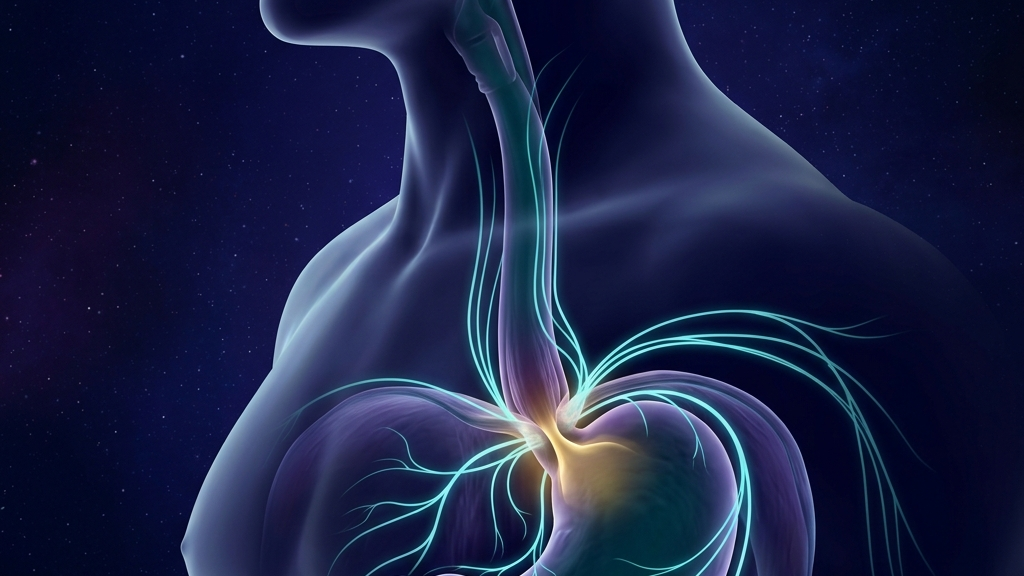
Acid reflux is one of the most over-prescribed and under-understood conditions in modern medicine. Patients are routinely placed on long-term proton pump inhibitors without anyone asking why the acid is in the wrong place. The honest answer in most cases is not "too much acid" — it is parasympathetic dysfunction. The vagus nerve controls the lower esophageal sphincter, the diaphragm, and gastric motility. When vagal tone fails, reflux follows.
What Actually Causes Reflux
GERD is driven by three primary mechanisms: low tone of the lower esophageal sphincter (LES), abnormal esophageal motility, and delayed gastric emptying. All three are under autonomic control, and the upper GI tract from esophagus to proximal colon is entirely innervated by the vagus nerve (ScienceDirect 2024).
The LES is not a structure that simply opens and closes mechanically. Its tone is maintained by parasympathetic vagal input. Transient lower esophageal sphincter relaxations — the primary cause of reflux events — are mediated through a vago-vagal reflex with the sensory limb in the stomach (PubMed 10718459). Disruption of vagal regulation produces a sphincter that opens when it should stay closed.
The Autonomic Dysfunction in GERD Patients
Parasympathetic dysfunction is highly prevalent in GERD populations. In one study, 59 of 83 patients with reflux esophagitis showed subnormal sphincter responses, with the abnormality independent of hiatal hernia status (PubMed 3883388). Multiple studies have found cardiac autonomic dysfunction in GERD patients — meaning the vagal deficit affects both the heart and the gut at the same time (PMC 4462740).
This is why reflux so often travels with low HRV, palpitations, anxiety, sleep disturbance, and GI dysmotility. It is not coincidence — it is the same vagal lesion expressing in different organs.
The Patient Profile
The autonomically driven reflux patient typically describes: nighttime symptoms worse when lying down, reflux that flares during periods of high stress or poor sleep, partial response to PPIs but recurrence on tapering, and other markers of vagal compromise — palpitations, brain fog, fatigue, slow gastric emptying.
The Emerging taVNS Evidence
Transcutaneous auricular vagus nerve stimulation has begun to demonstrate measurable benefit in reflux populations. A 2024 study in laryngopharyngeal reflux disease showed integrative improvements in esophageal motility and pharyngeal symptoms through vagal mechanisms (Frontiers 2024). A separate trial of transcutaneous electrical acustimulation in GERD patients produced parallel improvements in gastroesophageal motility (PubMed 34183577).
This is early evidence, but the mechanism is sound and the clinical signal is real.
A Vagus-First Reflux Protocol
- Rebuild the vagal brake. Six-per-minute breathing twice daily. Cold-water face immersion. Humming. The same fundamentals as any vagal-tone program, applied to the gut.
- Eat in a parasympathetic state. Three slow exhales before any meal. The body cannot digest in fight-or-flight; LES tone falls when sympathetic dominance is high.
- Reduce mechanical contributors. Smaller meals, finish eating at least three hours before lying down, raise the head of the bed, lose weight where indicated.
- Mind the comorbidities. SIBO, gastroparesis, hiatal hernia, and Helicobacter pylori all worsen reflux when present. Each treated lowers the symptom baseline.
- Use PPIs carefully. They have a role — particularly in erosive disease — but long-term use is not benign. The aim is to use them as a bridge while the underlying autonomic issue is addressed.
- Consider taVNS. Early evidence is encouraging; protocols vary by device and clinic.
Clinical takeaway: Chronic reflux is, for most patients, the gut's expression of low vagal tone. Suppressing acid does not fix the sphincter — it masks the symptom of a deeper autonomic problem. Restoring vagal tone restores the reflux barrier.
References & Further Reading
- Autonomic dysfunction in GERD — consequences for the cardiovascular system. ScienceDirect, 2024. Read
- Cardiac autonomic dysfunction in GERD. PMC 4462740. Read
- taVNS for laryngopharyngeal reflux disease. Frontiers, 2024. Read
- Transcutaneous electrical acustimulation in GERD. PubMed 34183577. Read
- Central control of LES relaxation. PubMed 10718459. Read
Have a question?
Have a question about something specific? Send us a message.
Visit VagusSkool.com/contact — we'll try to get back to you within 24 hours.