The 3 A.M. Wake-Up: Why You Jolt Awake Wired at the Same Hour Every Night
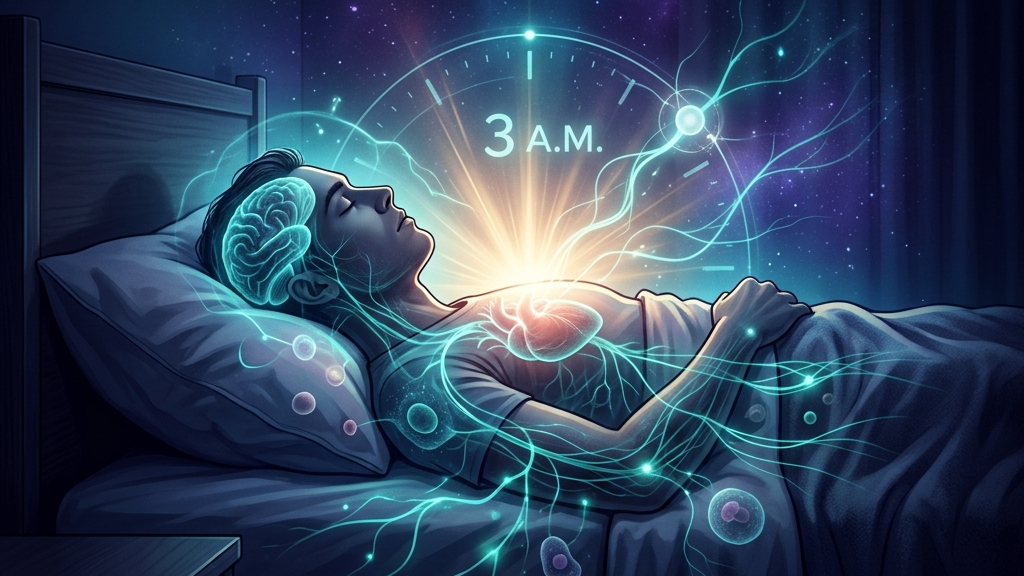
"I fall asleep fine. Then at 3 a.m. — almost the same time every night — I'm suddenly wide awake, heart thudding, mind racing, wired but bone-tired, and there is no getting back to sleep." If that is you, and you have been told it is "just stress" or "just anxiety," here is a more accurate story. The predawn wake-up is often a genuine physiological event: a collision between a dip in your metabolism and a surge in your stress chemistry, playing out on a schedule your body keeps whether you like it or not.
What Should Be Happening Overnight
During healthy deep sleep, your nervous system is supposed to be in parasympathetic dominance (the state in which the calming, vagal branch of the autonomic nervous system is in charge). In this state the heart slows, digestion idles, and the body does its repair work. A good marker of it is HRV (heart rate variability — the natural beat-to-beat variation in the timing of your heartbeat, which rises when the vagus is well in control). Overnight, HRV should be high and the body calm. That is the baseline the 3 a.m. wake-up interrupts.
The Metabolic Trigger: A Predawn Dip
You have not eaten for hours by the middle of the night, and blood glucose can drift downward in the early morning. In some people it dips low enough to matter — a mild nocturnal hypoglycemia (a drop in blood sugar during sleep). The brain will not tolerate low fuel quietly. Its rescue plan is chemical: release adrenaline and cortisol to prod the liver into dumping stored glucose back into the blood.
That rescue is a sympathetic surge (activation of the fight-or-flight branch of the nervous system). And a sympathetic surge is, by design, the opposite of sleep. Adrenaline speeds the heart, sharpens the mind, and floods you with alertness — exactly the "wired but tired" sensation of a 3 a.m. jolt. The pounding heart is not imaginary; it is the body doing precisely what it is built to do when it senses a fuel problem, just at the worst possible hour.
The Clock Trigger: An Early, Steep Cortisol Rise
Layered on top is a daily rhythm. In the hours before waking, the body naturally begins ramping up cortisol to prepare you for the day — a pattern called the cortisol awakening response (the sharp, normal rise in cortisol around the time of waking). In a well-regulated system this rise crests right as you get up. But if it arrives too early or climbs too steeply, that same wake-you-up signal lands at 3 a.m. instead of 6:30 — and cortisol nudges alertness and blood sugar upward in the same direction the adrenaline rescue already pushed. The two can reinforce each other into full wakefulness.
Why This Is Not "Just Anxiety"
The reason this reframe matters: when you wake up flooded with adrenaline, the mind does what minds do with a body in alarm — it goes looking for something to worry about, and finds it. So the racing thoughts feel like the cause. Directionally, they are often the consequence. The autonomic and metabolic event came first; the anxious thinking is your brain interpreting an already-activated body. That does not make the distress less real — it makes it more explainable, and more addressable at the source.
- Wired-but-tired is a signature. Genuine exhaustion combined with racing alertness points to a stress-chemistry surge, not simple insomnia.
- The same-time pattern is a clue. A body event on a schedule — the predawn metabolic dip and cortisol ramp — tends to strike at a consistent hour, unlike random worry.
- The body came first. The adrenaline arrives, then the anxious thoughts arrive to explain it — which is why calming the body often settles the mind faster than arguing with the thoughts.
What Some People Find Helps
None of this is medical advice, and recurrent night waking is worth raising with your clinician — but a few cautious, physiology-aligned ideas are widely reported. Many people find that a small, balanced snack with some protein or fat before bed blunts the overnight glucose dip that can trigger the adrenaline rescue. On waking, slow breathing with a long, unhurried exhale directly recruits the vagus and can pull you back toward parasympathetic dominance rather than fighting the surge head-on. And because the whole cascade is downstream of the body, treating it as a body event — steady the breath, steady the fuel — is often more effective than treating it as a thought problem.
References & Further Reading
- Clow A, Hucklebridge F, Stalder T, et al. The cortisol awakening response: More than a measure of HPA axis function. Neuroscience & Biobehavioral Reviews, 2010. PubMed
- StatPearls. Physiology, Cortisol. NCBI Bookshelf. NCBI
- StatPearls. Hypoglycemia. NCBI Bookshelf. NCBI
- Shaffer F, Ginsberg JP. An Overview of Heart Rate Variability Metrics and Norms. Frontiers in Public Health, 2017. PubMed
Have a question?
Have a question about something specific? Send us a message.
Visit VagusSkool.com/contact — we'll try to get back to you within 24 hours.