Vagus Nerve Stimulation in Stroke Recovery and Rehabilitation
For most of medical history, recovery after a stroke has been a long, often disappointing process. Patients regain some function in the first weeks, then progress slows. The "plateau" is one of the most discouraging facts of rehabilitation.
That story is changing. In 2021, the FDA approved the first device that combines physical therapy with electrical stimulation of the vagus nerve. Patients who had stopped progressing began progressing again. Some regained movement they had lost years earlier. The technology is called paired vagus nerve stimulation, and it’s one of the most exciting developments in stroke care in decades.
What Happens to the Brain After a Stroke
A stroke kills brain tissue — either from a blocked vessel (ischemic stroke) or a burst one (hemorrhagic). The lost tissue doesn’t come back. But the brain is more flexible than its anatomy implies. Surrounding regions can take over functions that were lost, a process called neuroplasticity.
This rewiring depends on a specific kind of learning. The brain learns when it sees a pattern repeated in a meaningful context, with reward signals telling it the pattern matters. After a stroke, repetition is the foundation of recovery — but the reward signaling, which depends on neurotransmitters like acetylcholine and norepinephrine, is often weakened.
This is exactly where vagus nerve stimulation comes in.
How Paired VNS Works
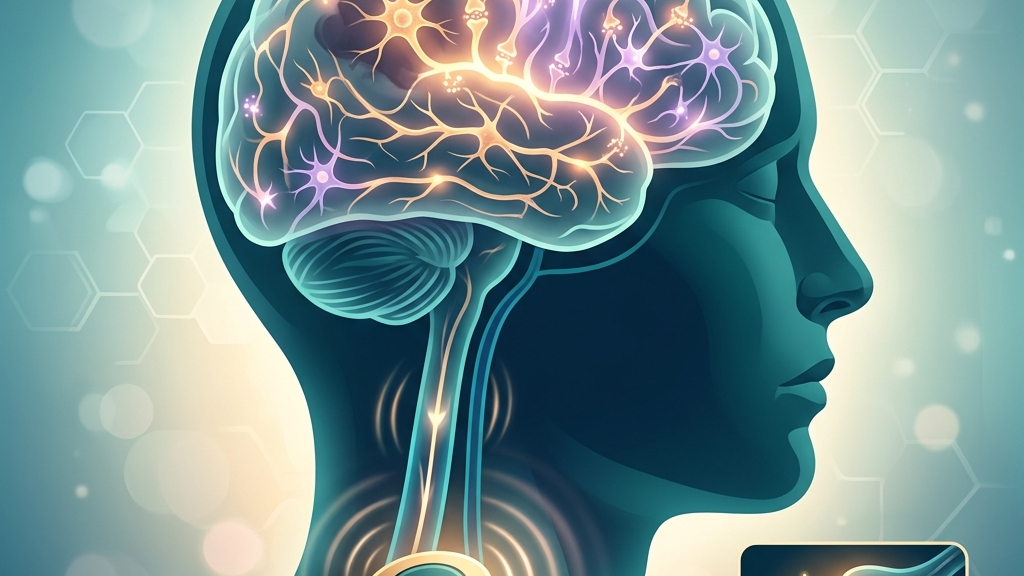
The device, called Vivistim, is a small implant placed in the chest, with a thin wire connecting to the vagus nerve in the neck. During physical therapy sessions, when the patient performs a desired movement — reaching, gripping, lifting — the device delivers a brief, mild electrical pulse to the vagus nerve.
That pulse triggers the release of brain neurotransmitters that mark the moment as important. The brain effectively gets a "remember this" signal at exactly the moment the right movement happens. Over many repetitions, this accelerates the rewiring that creates lasting recovery.
For decades, stroke recovery plateaued because the brain stopped marking new movements as important. Paired vagus nerve stimulation gives that signal back — mid-movement, in real time.
What the Studies Show
The pivotal trial that led to FDA approval (VNS-REHAB) showed that patients receiving paired VNS during therapy had roughly two to three times the improvement of patients receiving therapy alone. Critically, this was in patients whose strokes had occurred years earlier — long after the conventional "recovery window" was supposed to be closed.
The improvements weren’t just statistical. Patients reported being able to use their hands for everyday tasks they’d lost — buttoning shirts, holding utensils, opening jars. Independence increased. Quality of life improved.
Why the Vagus Nerve Specifically
The vagus nerve has a unique connection to the brain’s learning systems. When stimulated, it activates two brainstem regions:
- Locus coeruleus: Releases norepinephrine, which heightens attention and learning
- Nucleus basalis: Releases acetylcholine, which strengthens synaptic connections being used at that moment
- Together: the brain receives a "this moment matters, encode it strongly" signal
This is, in essence, hijacking the brain’s own reward and learning circuitry to focus it on the rehab movement. The principle goes far beyond stroke — paired VNS is being studied in spinal cord injury, traumatic brain injury, tinnitus, PTSD, and motor recovery in many other conditions.
Who It’s For — And Who It Isn’t
The current FDA indication is for moderate-to-severe upper-limb impairment after ischemic stroke. The device is implanted, paired with a structured physical therapy protocol, and used over months.
It isn’t a substitute for early rehabilitation, and it doesn’t replace acute stroke care. What it offers is something rehab medicine has never had before: a way to break through chronic plateaus and accelerate recovery long after conventional approaches have stopped helping.
What This Tells Us About the Vagus Nerve in General
The success of paired VNS reinforces a broader principle: the vagus nerve is a learning amplifier. Its activation enhances how strongly the brain encodes whatever is happening in that moment.
This has implications well beyond stroke recovery. It suggests that periods of high vagal tone — during meditation, slow breathing, or moments of true presence — may also be moments of accelerated learning, emotional integration, and memory consolidation. People who work with the nervous system deliberately have always intuited this. The neuroscience is now catching up.
What’s Coming Next
- Non-invasive paired stimulation through the ear (transcutaneous auricular VNS) is being studied as an alternative to implanted devices
- Spinal cord injury rehab using similar paired-stimulation principles is in active trials
- Tinnitus protocols pairing VNS with sound therapy are under investigation
- Application to traumatic brain injury and post-concussion syndrome is being explored
- Memory enhancement and learning research is examining whether VNS could improve outcomes in cognitive rehabilitation
What This Means for the Rest of Us
Most people reading this aren’t recovering from a stroke. But the principle still matters: how strongly your brain encodes any moment depends partly on your autonomic state. A brain in a calm, vagally-active state learns better, remembers better, and integrates emotional experience more cleanly than a brain in chronic sympathetic activation.
Daily vagal practice isn’t a substitute for medical-grade neurostimulation — but it works on the same biology, at a smaller scale, every day. That small scale, multiplied over years, becomes how your brain learns and adapts to your life.
If you or someone you love is in stroke recovery, ask the rehab team specifically about paired vagus nerve stimulation. The technology exists. The evidence is solid. The recovery window has been pried open in ways that weren’t possible just a few years ago.
Have a question?
Have a question about something specific? Send us a message.
Visit VagusSkool.com/contact — we'll try to get back to you within 24 hours.