The Physiological Sigh: The Double-Inhale Reset Built Into Your Brainstem
You have done it thousands of times without noticing: a full breath in, then a second short sip of air stacked on top, then a long slow exhale. It happens when you are winding down, when you have been crying, sometimes in your sleep. It looks like a glitch. It is the opposite — it is one of the most precisely engineered reflexes in your body, and once you understand what it does, you can use it on purpose to change your state in about ten seconds.
Why Your Lungs Need a Reset in the First Place
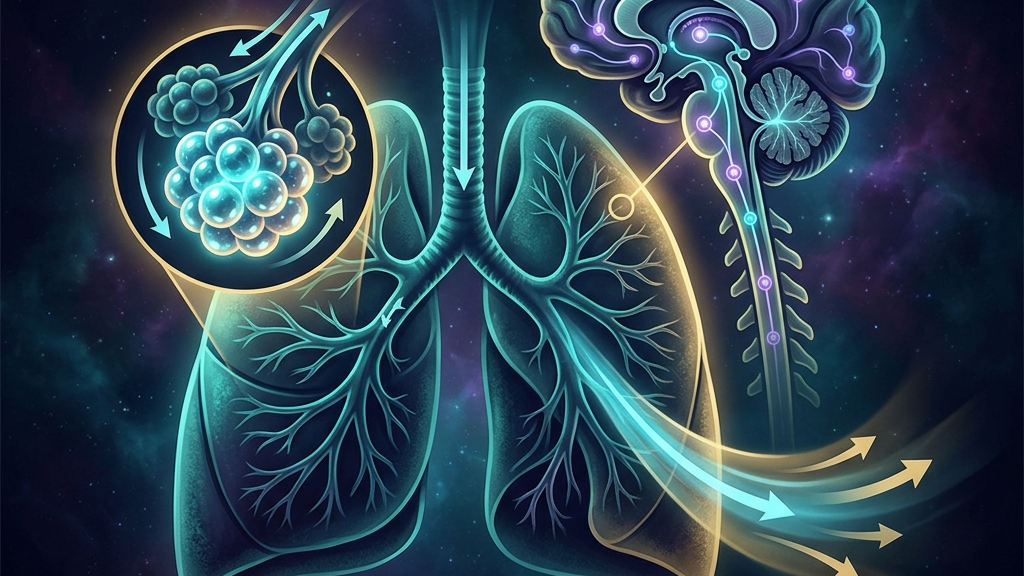
Your lungs are not simple balloons. They are packed with hundreds of millions of tiny air sacs called alveoli (microscopic sacs in the lungs where oxygen and carbon dioxide are exchanged with the blood). These sacs are where the actual work of breathing happens. But over time, especially during long stretches of shallow breathing — stress, illness, sitting hunched at a desk — some alveoli quietly collapse and stick shut. Fewer open sacs means less efficient gas exchange, which means carbon dioxide starts to build up in the blood.
A single normal inhale often cannot pop those collapsed sacs back open. They need an extra burst of pressure. That is exactly what the second inhale of a sigh delivers: a top-up of air that re-inflates the collapsed alveoli and restores the lung's surface area.
The Circuit That Fires It
This reflex is not improvised by your lungs. It is generated in the brainstem by a small cluster of neurons called the preBötzinger complex (a tiny group of cells in the medulla that generates the basic rhythm of breathing). This circuit is the metronome of respiration — it sets the pace of every breath you take, awake or asleep — and it also produces the periodic sigh on a schedule, roughly every few minutes, to keep the lungs open. Landmark work by Jack Feldman and colleagues traced the breathing rhythm to this region and showed the sigh is a distinct, built-in pattern, not noise.
The important consequence for you is that this is a hybrid system. It runs automatically, but it also accepts voluntary override. You cannot consciously command your heart to slow, but you can reach into the breathing circuit and fire a sigh whenever you choose.
The Exhale Is Where the Nervous System Shifts
Re-inflating alveoli and dumping carbon dioxide is only half the story. The reason a deliberate sigh calms you so fast is the long exhalation (the breathing-out phase) that follows. During a slow exhale, the vagus nerve becomes more active and applies its brake to the heart, so the heart rate drops with every breath out. This is vagal activation (increased parasympathetic signaling that shifts the body toward rest), and it is directly tied to the exhale. The longer and slower you breathe out relative to breathing in, the more you tip the balance toward calm.
So the physiological sigh does two useful things at once: the double inhale fixes the lungs, and the extended exhale shifts the nervous system.
How to Do It Deliberately
- Inhale once through the nose, filling the lungs to roughly comfortable.
- Take a second short sip of air through the nose on top of that first breath — this is the move that re-inflates the collapsed alveoli. It should feel like topping off an already-full glass.
- Exhale slowly and completely through the mouth, letting it run longer than the inhale. This is the part that engages the vagal brake.
- Repeat one to three times. Research on cyclic sighing has found even a few minutes practiced daily can measurably lower stress and improve mood — but a single sigh works in the moment.
The elegance is that you are not fighting your body or forcing a foreign technique. You are manually triggering a reset your brainstem already runs on its own — just at the moment you need it.
References & Further Reading
- Feldman JL, Del Negro CA. Looking for inspiration: new perspectives on respiratory rhythm. Nature Reviews Neuroscience, 2006. PubMed
- Balban MY et al. Brief structured respiration practices enhance mood and reduce physiological arousal. Cell Reports Medicine, 2023. PubMed
- Li P et al. The peptidergic control circuit for sighing. Nature, 2016. PubMed
- preBötzinger complex — overview. Reference overview
Have a question?
Have a question about something specific? Send us a message.
Visit VagusSkool.com/contact — we'll try to get back to you within 24 hours.