Ultrasound Vagus Nerve Therapy
Ultrasound Vagus Nerve Therapy
For decades, stimulating the vagus nerve required either a surgically implanted device or surface-level electrical stimulation through the skin. Both approaches have limitations: surgery carries risks and costs, while transcutaneous stimulation can only reach superficial nerve fibers. Focused ultrasound changes the equation entirely.
How Focused Ultrasound Works
Unlike the therapeutic ultrasound used in physical therapy (which heats tissue), focused ultrasound for neuromodulation uses low-intensity, pulsed acoustic energy to mechanically stimulate nerve fibers. The sound waves create tiny oscillations in cell membranes — including the ion channels that control nerve firing — without heating or damaging tissue.
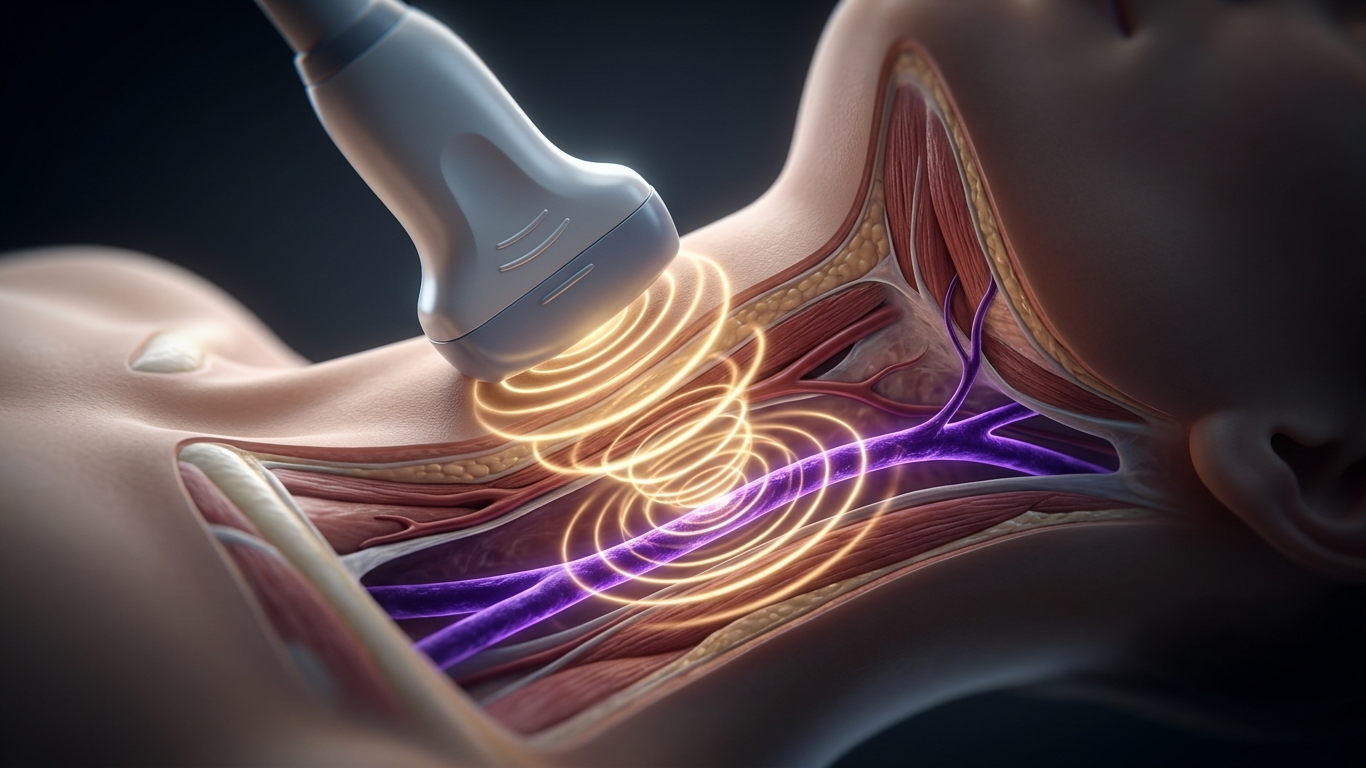
The key advantage is penetration depth. Electrical stimulation on the skin surface struggles to reach nerve fibers more than a few millimeters below the surface. Ultrasound can be focused precisely on structures several centimeters deep, reaching the cervical vagus nerve where it sits alongside the carotid artery — a location previously accessible only through surgery.
The Physics of Acoustic Neuromodulation
When an ultrasound wave encounters a nerve fiber, it creates mechanical pressure that modulates the behavior of mechanosensitive ion channels on the nerve cell membrane. These channels — particularly TREK-1 and TRAAK potassium channels — respond to mechanical stress by opening or closing, altering the membrane potential and influencing whether the nerve fires.
Research suggests that low-intensity pulsed ultrasound (LIPUS) at specific frequencies (typically 0.5–5 MHz) can either excite or inhibit neural activity, depending on the pulse parameters. This bidirectional control is a significant advantage over electrical stimulation, which tends to be primarily excitatory.
Clinical Evidence
Several pilot studies have demonstrated the feasibility and safety of transcutaneous focused ultrasound vagus nerve stimulation (tFUS-VNS):
- Epilepsy — Early trials show reduction in seizure frequency comparable to implanted VNS devices
- Depression — Preliminary evidence suggests mood improvement after sustained tFUS-VNS protocols
- Inflammation — Animal studies demonstrate reduced inflammatory markers following ultrasound VNS
- Heart rate variability — Acute studies show increased HRV during and after stimulation sessions
Device Landscape
Several companies are developing focused ultrasound devices for vagus nerve stimulation. These range from handheld consumer devices for home use to clinical-grade systems for medical settings. The technology is advancing rapidly, with device miniaturization making home-based therapy increasingly feasible.
Current devices typically deliver stimulation sessions of 10–30 minutes, one to three times daily. The treatment is painless — most users report only a mild warmth or tingling sensation at the application site.
Advantages Over Traditional VNS
- Non-invasive — No surgery, no implanted device, no lead wires
- Deeper access — Can reach vagal fibers inaccessible to surface electrodes
- Precise targeting — Focal beam can selectively activate specific fiber populations
- Bidirectional control — Can excite or inhibit depending on parameters
- Lower cost — No surgical fees, no device replacement surgeries
- Adjustable — Parameters can be modified without additional procedures
The Future
As focused ultrasound technology matures, we're moving toward a world where vagus nerve therapy is as accessible as taking a daily supplement. The combination of non-invasive delivery, deep tissue access, and precise neural control makes tFUS-VNS one of the most promising developments in neuromodulation.
Research is expanding into applications for autoimmune disease, chronic pain, cognitive enhancement, and longevity — areas where vagus nerve modulation shows therapeutic potential but where surgical intervention has been impractical. The vagus nerve's role as a master regulator of inflammation, metabolism, and autonomic function makes it an ideal target for non-invasive therapies, and focused ultrasound is the technology that makes it possible.
Have a question?
Have a question about something specific? Send us a message.
Visit VagusSkool.com/contact — we'll try to get back to you within 24 hours.