The Vagus Nerve’s Quiet Role in Sleep Architecture, Digestive Rhythm, and Resting Cardiac Stability
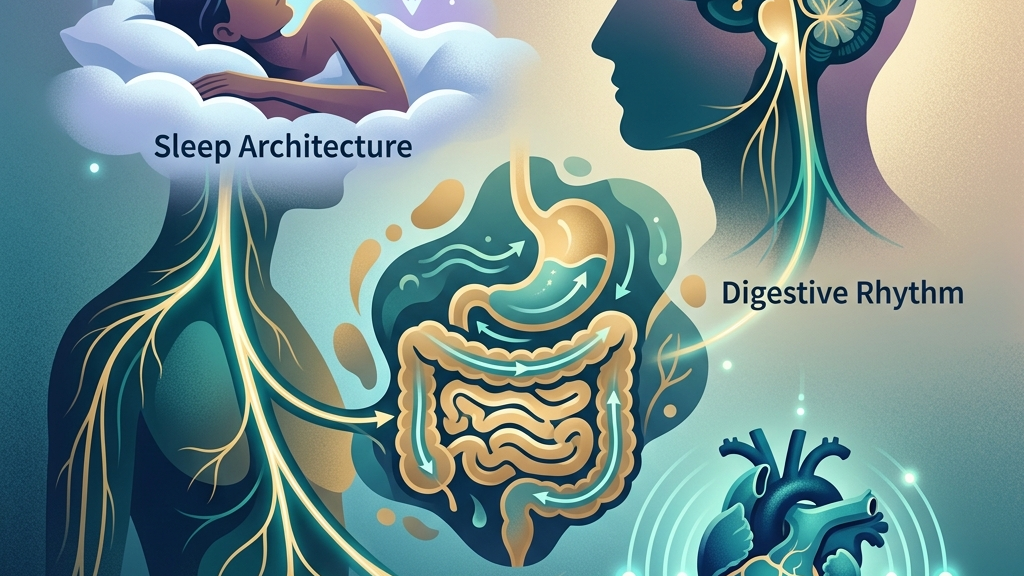
How the vagus nerve works
The vagus nerve is the tenth cranial nerve and the longest in the parasympathetic division of the autonomic nervous system. It originates in the medulla oblongata and travels through the neck, chest, and abdomen, sending and receiving signals to and from the heart, lungs, esophagus, stomach, intestines, and other organs. Its bidirectional traffic allows the brain to receive continuous updates about visceral conditions while also issuing commands that promote conservation of energy and restoration. In its parasympathetic capacity, the vagus nerve helps counterbalance sympathetic arousal. When vagal outflow increases, heart rate tends to slow, digestive secretions and motility are supported, and inflammatory signaling is dampened. This regulatory function is often described in terms of the nerve’s contribution to heart-rate variability, the natural beat-to-beat fluctuations that reflect flexible autonomic control rather than rigid sympathetic dominance. The gut-brain axis illustrates another dimension of vagal activity. Roughly 80 percent of vagal fibers carry information from the viscera to the brainstem, transmitting mechanical stretch, nutrient presence, and microbial metabolites. These ascending signals influence brainstem nuclei that then adjust descending output, creating a feedback loop between intestinal state and central autonomic tone. Research on vagal sensory neurons underscores how this loop participates in both satiety signaling and the modulation of mood-related circuits. Heart-rate variability serves as a practical window into vagal tone because respiratory sinus arrhythmia—the acceleration of heart rate during inhalation and deceleration during exhalation—is largely mediated by vagal efferents. Higher baseline variability is generally associated with greater capacity to move between arousal and recovery states, whereas reduced variability can accompany persistent sympathetic activation or vagal withdrawal. These patterns are not diagnostic on their own but provide measurable correlates of autonomic balance. To appreciate the underlying circuitry, consider the two main brainstem origins of vagal motor fibers: the dorsal motor nucleus, which supplies most abdominal organs with steady background tone, and the nucleus ambiguus, which provides more phasic, myelinated fibers to the heart and larynx. These distinct populations allow the nerve to deliver both tonic restraint and rapid, moment-to-moment adjustments. For instance, when a person stands up quickly after sitting for an hour, the nucleus ambiguus fibers briefly withdraw their brake on the sinoatrial node so heart rate can rise just enough to maintain blood pressure, then re-engage once baroreceptors confirm stability. Everyday experiences such as feeling the pulse quicken during a stressful phone call and then settle during a quiet walk reflect this same push-pull dynamic. Sensory fibers traveling in the opposite direction are equally specialized. Some endings respond to gentle stretch in the stomach wall after a moderate meal, while others detect changes in blood-gas levels or the presence of short-chain fatty acids produced by gut bacteria. Because these signals converge in the nucleus tractus solitarius, a single meal containing both protein and fermentable fiber can simultaneously update digestive motor output and nudge overall autonomic tone toward greater calm. This integration explains why a balanced lunch often leaves a person feeling both physically settled and mentally clearer, whereas a large, rapidly eaten meal may produce sluggishness accompanied by mild brain fog until vagal feedback recalibrates.The Vagus Nerve and Sleep Regulation
During the transition into non-REM sleep, parasympathetic dominance becomes more pronounced, and vagal activity contributes to the slowing of heart rate and respiratory rate that characterize deeper stages. The nerve’s influence on the sinoatrial node helps stabilize cardiac rhythm so that brief arousals are less likely to escalate into prolonged wakefulness. When vagal tone is adequate, the body can sustain the prolonged periods of restorative slow-wave sleep that support memory consolidation and cellular repair. Vagal afferents from the gastrointestinal tract also participate in sleep regulation indirectly. Signals related to nutrient absorption and gut distension reach brainstem nuclei that project to hypothalamic sleep centers. This pathway helps align sleep pressure with metabolic state; after a balanced meal, for instance, increased vagal traffic can reinforce the drive toward rest rather than continued activity. Conversely, disruptions in vagal signaling may coincide with fragmented sleep architecture, although many factors interact in any given night’s rest. Respiratory control offers a further link. The vagus nerve carries sensory information from pulmonary stretch receptors that help fine-tune breathing depth and rate. Slow, rhythmic breathing patterns that engage these receptors tend to increase vagal outflow, which in turn supports the physiological conditions for sleep onset. People often notice that evenings marked by rapid, shallow breathing are followed by lighter or more interrupted sleep, illustrating the practical interplay between respiratory vagal afferents and sleep continuity. In addition, vagal modulation of inflammatory cytokines may affect sleep quality. Elevated systemic inflammation can increase nighttime awakenings and reduce slow-wave sleep; the vagus nerve’s cholinergic anti-inflammatory pathway provides one route by which the nervous system can limit such signaling. This mechanism operates alongside hormonal and circadian factors, underscoring that vagal contributions to sleep are part of a larger regulatory network rather than a single switch. A concrete illustration arises when someone finishes a workday with elevated shoulder tension and shallow breathing. The resulting drop in vagal cardiac modulation keeps heart-rate variability low into the evening. As bedtime approaches, the same low tone means that a minor environmental sound is more likely to trigger an arousal that lengthens into full wakefulness. In contrast, a person who spends ten minutes performing extended exhales before brushing teeth often experiences a measurable rise in respiratory sinus arrhythmia; this elevated tone helps the transition into stage N2 sleep occur more smoothly and lengthens the first slow-wave period, during which growth-hormone release and synaptic downscaling are most active. The same vagal pathways also interact with thermoregulation. Core body temperature must fall approximately one degree Celsius for optimal sleep onset. Vagal stimulation of cutaneous blood vessels in the extremities promotes heat dissipation, and individuals who take a warm shower followed by cool air exposure frequently report faster sleep initiation. This effect is partly mediated by vagal afferents that sense the post-shower cooling and reinforce parasympathetic outflow, creating a feed-forward loop that aligns cardiovascular, respiratory, and thermal systems for deeper rest.Vagal Pathways in Digestive Function
The vagus nerve supplies parasympathetic innervation to most of the gastrointestinal tract proximal to the splenic flexure, influencing both motility and secretory functions. Efferent fibers stimulate gastric acid production, pancreatic enzyme release, and peristaltic contractions that move contents through the stomach and small intestine. When vagal tone is balanced, these processes proceed at a pace that supports efficient nutrient absorption without excessive urgency or stasis. Vagal afferents also convey mechanical and chemical information from the gut wall back to the brainstem. Stretch receptors signal the degree of gastric filling, while chemosensors detect the presence of specific macronutrients and microbial metabolites. These ascending signals help calibrate subsequent efferent output, creating moment-to-moment adjustments in digestive activity. This feedback is one reason that eating in a calm state often feels more comfortable than eating under acute stress, when sympathetic override can temporarily suppress vagal digestive support. The same afferent traffic participates in the gut-brain axis dialogue that influences appetite and satiety. Vagal signals reach the nucleus tractus solitarius and are relayed to hypothalamic and limbic structures involved in hunger perception. Research on the vagus nerve as modulator of the brain–gut axis highlights how these pathways integrate metabolic information with motivational states, allowing the brain to adjust feeding behavior according to visceral conditions. Beyond motility and secretion, vagal activity helps regulate local immune tone within the gut mucosa. The cholinergic anti-inflammatory pathway can attenuate excessive cytokine release triggered by luminal challenges, supporting an environment in which digestion and barrier function remain stable. This immunomodulatory role operates continuously and interacts with the enteric nervous system, illustrating the layered control the vagus nerve exerts over gastrointestinal homeostasis. Consider the ordinary experience of eating lunch at a desk while answering emails. Sympathetic activation reduces vagal efferent traffic to the stomach, so gastric mixing slows and acid secretion is blunted. Food remains in the fundus longer, producing a sensation of heaviness. Later, when the same person steps away for a short walk, vagal tone rebounds, peristalsis resumes, and the previously delayed chyme moves forward. Over repeated days, this pattern can shift microbial fermentation profiles because transit time influences which bacteria have more time to metabolize particular substrates. Another nuance appears in the coordination between the vagus and the migrating motor complex. During fasting periods between meals, brief clusters of strong contractions sweep residual material through the small intestine. Vagal sensory fibers detect the resulting distension and help time the next hunger signal. Individuals who space meals at least four hours apart often notice clearer hunger cues in the late morning; this timing reflects intact vagal feedback rather than an arbitrary schedule.Resting Heart Rate and the Vagal Brake
At rest, the vagus nerve exerts a tonic inhibitory influence on the sinoatrial node, often referred to as the vagal brake. This continuous restraint keeps heart rate below the intrinsic firing rate of pacemaker cells and allows rapid adjustments when metabolic demand changes. Withdrawal of vagal tone produces quick acceleration, while renewed vagal outflow produces prompt deceleration, giving the cardiovascular system its characteristic responsiveness. Heart-rate variability metrics capture this dynamic balance. Respiratory sinus arrhythmia, driven largely by vagal efferents that wax and wane with each breath, accounts for a substantial portion of short-term variability. Higher resting variability generally reflects stronger vagal modulation and is associated with greater adaptability to postural shifts, emotional demands, and recovery after exertion. Lower variability can occur when vagal outflow is reduced or when sympathetic drive remains elevated. Baroreflex function provides another window into vagal cardiac control. Pressure-sensitive receptors in the carotid sinus and aortic arch send afferents via the glossopharyngeal and vagus nerves to the brainstem, which then adjusts vagal outflow to maintain blood-pressure stability. Efficient baroreflex-mediated vagal responses help prevent excessive fluctuations in heart rate and pressure during ordinary daily activities such as standing or mild exertion. The same vagal pathways that modulate heart rate also intersect with respiratory and inflammatory regulation. Because vagal fibers innervate both cardiac and pulmonary structures, changes in breathing depth directly affect cardiac vagal tone. This coupling explains why extended exhalations reliably increase instantaneous heart-rate variability and why conditions that impair vagal signaling can simultaneously affect cardiac rhythm and respiratory comfort at rest. A practical example occurs when a person moves from sitting to standing. The initial small drop in blood pressure unloads baroreceptors, briefly reducing vagal outflow so heart rate rises by five to ten beats per minute. Within seconds, renewed vagal activity restores equilibrium. In someone with lower baseline vagal tone, this adjustment is slower, producing a longer period of light-headedness before stabilization. Over months, consistent slow-breathing practice can strengthen the baroreflex gain, shortening the recovery window after each postural change.What the research shows
Multiple lines of investigation have examined vagal contributions to the domains discussed above. Studies using vagus nerve stimulation have reported associations with improved sleep continuity and reduced sleep-disordered breathing events in selected populations, consistent with the nerve’s role in parasympathetic stabilization during non-REM stages. Vagus Nerve Stimulation, Sleep-Disordered Breathing & Sleep Quality reviews these findings and notes the need for further controlled trials. Cardiac vagal tone has been quantified through heart-rate variability measures in both healthy and clinical cohorts. Heart Rate Variability and Cardiac Vagal Tone summarizes evidence that higher vagally mediated variability correlates with better autonomic flexibility and recovery capacity, while lower values often accompany states of sustained sympathetic activation. The gut-brain axis has been mapped through anatomical tracing and functional studies demonstrating that vagal sensory neurons relay nutrient and microbial signals to brainstem and forebrain targets. Vagus Nerve as Modulator of the Brain–Gut Axis and Vagal Sensory Neurons and Gut–Brain Signaling together outline how these pathways participate in both digestive regulation and interoceptive awareness. Anatomical and physiological reviews from major clinical sources confirm the nerve’s extensive distribution and its dual sensory-motor character. Vagus Nerve: Function, Location & Conditions and Neuroanatomy, Cranial Nerve 10 (Vagus Nerve) provide foundational descriptions of the pathways relevant to sleep, digestion, and cardiac control.Practical ways to support your vagus nerve
- Slow, extended exhales performed for several minutes can increase vagal outflow to the heart by enhancing respiratory sinus arrhythmia, offering a readily accessible entry point for many people.
- Humming or gentle gargling engages laryngeal and pharyngeal branches of the vagus, providing mechanical stimulation that some individuals incorporate into brief daily routines.
- Brief, tolerable cold exposure such as cool water on the face or hands may activate vagal afferents through trigeminal and cervical pathways, though individual tolerance varies widely.
- Paced breathing at approximately six breaths per minute aligns with resonance frequencies that amplify heart-rate variability and vagal modulation in many adults.
- Light, rhythmic movement such as walking or gentle stretching can support overall autonomic flexibility without requiring intense effort that might temporarily shift toward sympathetic dominance.
- Consistent morning light exposure combined with stable sleep timing helps entrain circadian rhythms that interact with vagal regulation of both cardiac and digestive functions across the 24-hour cycle.
When to talk to a professional
Certain symptoms warrant prompt medical evaluation regardless of any interest in vagal support practices. These include sudden or severe changes in heart rhythm, unexplained fainting, persistent difficulty swallowing, significant unexplained weight loss, or gastrointestinal bleeding. Sleep disturbances that involve witnessed breathing pauses, severe daytime sleepiness, or sudden onset of intense symptoms should also be assessed by a qualified clinician. Professional guidance ensures that any underlying conditions are identified and managed appropriately.Common questions
Can vagal tone be measured directly at home?
Direct measurement of vagal nerve traffic requires specialized clinical equipment. Heart-rate variability derived from consumer devices offers an indirect estimate of cardiac vagal modulation but should not be interpreted as a clinical diagnosis.
How quickly might someone notice changes from breathing practices?
Acute shifts in heart-rate variability can appear within minutes of slow breathing, yet sustained changes in baseline tone generally develop over weeks of consistent practice and interact with many other lifestyle and health factors.
Does posture affect vagal activity?
Yes, upright versus supine positions alter baroreflex loading and therefore vagal outflow to the heart. Lying down typically increases vagal cardiac tone, which is one reason resting measurements are often taken in a standardized posture.
Are there differences in vagal function across age groups?
Vagal tone tends to decline gradually with advancing age, although the rate of change varies considerably among individuals and is influenced by overall fitness, chronic health conditions, and daily movement patterns.
Can digestive discomfort be solely attributed to vagal function?
No single pathway accounts for digestive symptoms; vagal signaling interacts with enteric nervous system activity, hormonal signals, microbial composition, and central stress responses, so comprehensive evaluation is necessary when symptoms persist.
The vagus nerve does not operate in isolation but participates in an integrated network that links cardiac rhythm, gastrointestinal function, and sleep continuity. Attention to the conditions that support balanced autonomic tone—through steady daily rhythms, measured breathing, and appropriate professional care when needed—offers a grounded approach to understanding these relationships.Have a question?
Have a question about something specific? Send us a message.
Visit VagusSkool.com/contact — we'll try to get back to you within 24 hours.