The Vagus Nerve’s Influence on Sleep Quality and Stress Recovery
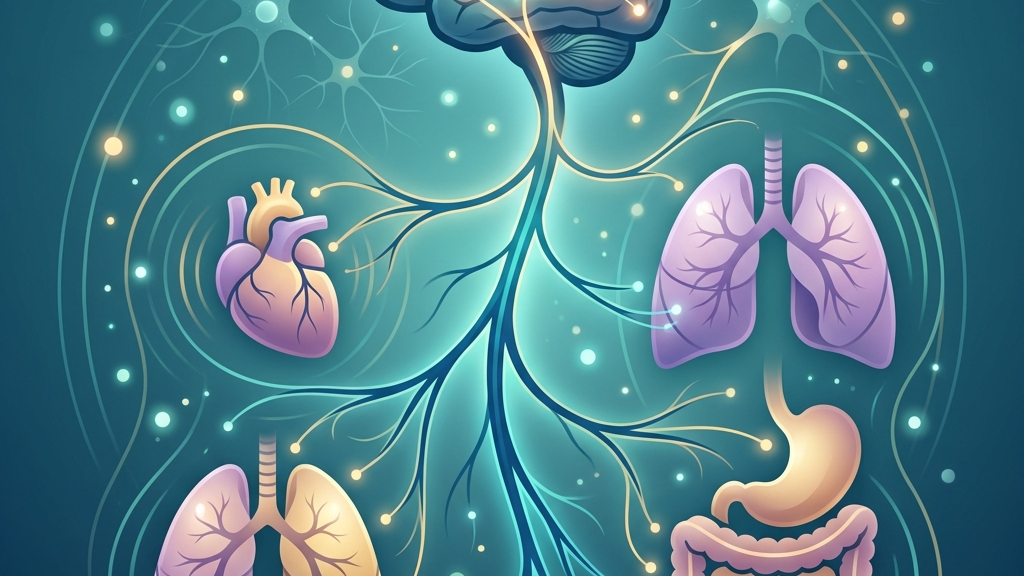
How the vagus nerve works
The vagus nerve, designated cranial nerve X, emerges from the medulla oblongata and extends through the neck, thorax, and abdomen, innervating the heart, lungs, esophagus, and much of the gastrointestinal tract. Its longest branches carry both efferent signals that slow heart rate and promote digestion and afferent signals that relay visceral status back to the brainstem. This bidirectional traffic places the nerve at the center of parasympathetic regulation, the branch of the autonomic nervous system that favors conservation and repair over mobilization. In practical terms, after finishing a large meal, efferent vagal signals help coordinate the release of digestive enzymes and gentle contractions that move food along the tract, while afferent fibers report back on nutrient absorption rates so the brain can adjust overall energy allocation for the evening ahead. In the cardiovascular system the vagus exerts a braking effect on sinoatrial node firing, increasing the interval between beats and thereby raising heart-rate variability. Greater variability at rest typically reflects stronger vagal modulation, whereas reduced variability often coincides with sustained sympathetic dominance. The same nerve fibers also reach the gut wall, where they modulate motility, secretion, and local immune activity while simultaneously conveying nutrient and inflammatory signals upward to influence mood and arousal centers. A person who feels their pulse quicken during a tense conversation may later notice the gradual lengthening of intervals between heartbeats once the discussion ends; that lengthening arises largely from renewed vagal influence on the pacemaker cells of the heart. Because the vagus participates in both descending control and ascending feedback, it forms a core component of the gut-brain axis. Sensory neurons embedded in the nerve detect mechanical stretch, chemical composition, and microbial metabolites within the intestine, then transmit this information via the nucleus tractus solitarius to higher regulatory networks. This loop allows digestive state to shape sleep propensity and stress responsiveness without requiring conscious awareness. For example, eating a fiber-rich dinner can trigger stretch receptors that send calming afferent signals, subtly increasing the likelihood of feeling drowsy within an hour or two, whereas a meal high in refined sugars may produce less coherent feedback and leave the nervous system less primed for nighttime restoration.Sleep and Vagal Tone
During the descent into non-rapid-eye-movement sleep, vagal outflow increases while sympathetic tone declines, producing the characteristic slowing of heart rate and rise in heart-rate variability observed in healthy sleepers. This shift supports the nightly drop in core body temperature and the reduction in cortisol that together facilitate growth-hormone release and tissue repair. When vagal withdrawal is incomplete, transitions between sleep stages become less stable and micro-arousals increase. Someone who checks work emails late into the evening may experience a delayed rise in vagal tone, resulting in lighter slow-wave sleep and more frequent shifts into lighter stages even though total time in bed appears sufficient. Respiratory sinus arrhythmia, a direct marker of vagal cardiac influence, strengthens during slow-wave sleep and weakens during rapid-eye-movement periods. Individuals who display robust respiratory sinus arrhythmia across the night commonly report fewer awakenings and a greater sense of refreshment upon rising. Conversely, persistently low variability through the sleep period frequently accompanies complaints of unrefreshing rest even when total sleep time appears adequate by conventional measures. In everyday life this can appear as the difference between waking naturally a few minutes before an alarm versus repeatedly hitting snooze because the body has not completed its full cycle of restorative processes. The vagus also links gastrointestinal activity to sleep regulation. Evening surges in vagally mediated gut motility and hormone release, such as those involving cholecystokinin and melatonin precursors, can promote drowsiness, whereas low vagal tone may leave digestive signals less synchronized with circadian cues. Over time this desynchrony can contribute to the pattern in which people feel both fatigued and wired at bedtime. A concrete illustration is the contrast between finishing dinner three hours before bed versus eating a heavy snack close to bedtime; the earlier meal allows vagal afferents to convey satiety and metabolic information that aligns with the evening decline in alertness. Because vagal afferents reach brainstem nuclei that project to the thalamus and cortex, the nerve participates in gating sensory throughput during sleep. Stronger vagal signaling tends to dampen transmission of minor visceral or environmental stimuli, allowing deeper continuity of sleep. When this gating is less effective, otherwise innocuous sensations more readily produce brief arousals that fragment the night without the sleeper’s full recollection. This mechanism explains why some individuals remain undisturbed by a partner’s quiet movements while others register every shift in bedding texture or distant street noise.Stress Recovery and Vagal Regulation
After an acute stressor, the vagus nerve supplies the primary mechanism for cardiac deceleration and restoration of digestive function. Rapid re-engagement of vagal tone lowers heart rate, reduces blood pressure, and reinstates peristalsis, shortening the physiological tail of the stress response. When this re-engagement is delayed or incomplete, heart-rate variability remains suppressed and subjective tension lingers long after the original challenge has passed. A commuter stuck in traffic may notice that even after reaching home and sitting down, their breathing stays shallow and digestion feels sluggish until vagal pathways gradually reassert control over the cardiovascular and enteric systems. Vagal afferents also convey information about peripheral inflammatory mediators back to the brain, influencing the duration of sickness behavior and emotional reactivity. Efficient vagal signaling appears to limit excessive cytokine-driven arousal, allowing the organism to return to exploratory rather than avoidant states more quickly. Reduced signaling capacity, by contrast, can extend the window during which the nervous system remains biased toward threat detection. After a minor illness such as a seasonal cold, people with stronger baseline vagal function often resume normal social and work activities sooner because the feedback loop that signals resolution of inflammation operates more smoothly. The nerve’s connections with the prefrontal cortex support the cognitive reappraisal that often accompanies successful stress recovery. Stronger vagal tone correlates with greater capacity to maintain attentional flexibility once sympathetic activation has subsided. Individuals who exhibit this pattern commonly describe an ability to shift focus away from ruminative thoughts within minutes to hours rather than days. In practice this might look like reviewing a difficult meeting in the evening yet still being able to read a book or prepare lunch for the next day without the event dominating mental space. Because the vagus participates in both the afferent and efferent arms of the baroreflex, it helps calibrate blood-pressure responses to postural change and emotional cues. Efficient baroreflex function, mediated in part by vagal pathways, prevents prolonged elevations in heart rate after standing or after emotionally charged conversations. When this calibration falters, orthostatic or emotional triggers more readily produce sustained sympathetic overshoot. Everyday examples include feeling momentarily light-headed upon rising from a desk after a long call, followed by a slower return to steady cardiovascular rhythm when vagal baroreflex contributions are robust.What the research shows
Studies of heart-rate variability consistently link higher resting vagal tone to more stable sleep architecture and faster autonomic recovery after laboratory stressors. Heart Rate Variability and Cardiac Vagal Tone reviews the physiological basis for these associations and underscores the utility of variability metrics as non-invasive indices of vagal modulation. Parallel work examining sleep-disordered breathing demonstrates that vagal stimulation can alter upper-airway muscle tone and sleep continuity in selected populations, as summarized in Vagus Nerve Stimulation, Sleep-Disordered Breathing & Sleep Quality. Anatomical tracing and functional imaging have clarified how vagal sensory neurons convey gut-derived signals that influence brainstem and forebrain circuits involved in arousal and affect. Vagal Sensory Neurons and Gut–Brain Signaling details the molecular identities of these neurons and their projection targets, while Vagus Nerve as Modulator of the Brain–Gut Axis integrates these findings into a systems-level account of bidirectional communication. Clinical overviews from Vagus Nerve: Function, Location & Conditions and Neuroanatomy, Cranial Nerve 10 (Vagus Nerve) provide the foundational descriptions of innervation patterns that underpin the physiological observations. Collectively these sources indicate that vagal activity occupies a central position in the physiology of both sleep maintenance and post-stress restoration, although individual responses vary with age, fitness, and concurrent health conditions. The literature emphasizes measurement of heart-rate variability and respiratory patterns rather than direct nerve recordings in humans, leaving room for continued refinement of mechanistic models. Researchers continue to explore how factors such as regular physical activity or dietary fiber intake may interact with these pathways across different age groups, providing additional context for interpreting variability metrics in daily life.Practical ways to support your vagus nerve
- Slow, extended exhales performed for several minutes can increase respiratory sinus arrhythmia and transiently elevate heart-rate variability by enhancing vagal outflow to the heart.
- Humming or gentle gargling engages the laryngeal and pharyngeal branches of the vagus, producing noticeable vibration that some people experience as a rapid calming of throat tension.
- Brief, tolerable cold exposure to the face or neck activates vagal afferents that contribute to the mammalian dive reflex and subsequent heart-rate slowing.
- Paced breathing at approximately six breaths per minute aligns with the natural resonance frequency of the baroreflex and often yields measurable increases in vagally mediated variability.
- Light movement such as walking after meals stimulates vagal motor fibers to the gut and supports postprandial parasympathetic dominance without requiring intense exertion.
- Consistent morning light exposure combined with a stable sleep schedule helps align circadian signals that in turn facilitate nocturnal rises in vagal tone during sleep.
When to talk to a professional
Persistent difficulty falling or staying asleep that does not improve with basic schedule adjustments warrants evaluation by a clinician experienced in sleep medicine. Sudden changes in resting heart rate, frequent dizziness upon standing, or unexplained gastrointestinal symptoms that coincide with profound fatigue also merit prompt assessment. Individuals who notice chest pain, severe shortness of breath, or rapid changes in consciousness should seek immediate medical attention rather than attempting self-directed practices. These recommendations reflect general patterns observed across populations and underscore the importance of professional guidance when symptoms persist or intensify.Common questions
Does everyone have the same degree of vagal influence on sleep?
Baseline vagal tone varies with age, physical fitness, and health status, so the magnitude of its contribution to sleep continuity differs across individuals even when external conditions appear similar. Older adults, for instance, often show a gradual reduction in vagal modulation that can lengthen the time required to reach stable slow-wave sleep, while trained endurance athletes may exhibit pronounced respiratory sinus arrhythmia that supports deeper continuity even after late-day physical exertion.
Can breathing exercises produce lasting changes in vagal function?
Regular practice of slow breathing has been shown in controlled studies to increase heart-rate variability during the session itself; whether these acute shifts accumulate into durable trait-like changes remains under investigation. Longitudinal observations suggest that consistency over months may strengthen baroreflex sensitivity in some practitioners, yet outcomes depend on factors such as concurrent aerobic fitness and overall daily stress load.
Is heart-rate variability the only way to gauge vagal activity?
While heart-rate variability provides a convenient non-invasive index, it reflects multiple autonomic influences; complementary measures such as baroreflex sensitivity and respiratory patterns add context but still do not capture every vagal pathway. Researchers sometimes combine these indices with assessments of gastrointestinal motility or inflammatory markers to build a more complete picture of vagal contributions across organ systems.
Do gastrointestinal symptoms always indicate low vagal tone?
Gut complaints can arise from many sources; vagal dysfunction represents only one possible contributor, and professional evaluation is required to determine relevance in any specific case. Dietary composition, microbial balance, and mechanical factors within the digestive tract can each produce overlapping symptoms, highlighting why isolated interpretation of vagal tone metrics is insufficient for understanding individual digestive patterns.
The interplay between vagal signaling, sleep architecture, and stress recovery illustrates how a single cranial nerve participates in both immediate physiological adjustments and longer-term patterns of restoration. Continued attention to measurable indicators such as heart-rate variability can inform personal experimentation while remaining anchored in the broader evidence base.Have a question?
Have a question about something specific? Send us a message.
Visit VagusSkool.com/contact — we'll try to get back to you within 24 hours.