The Vagus Nerve’s Connections to Stress Recovery, Breathing, and the Voice
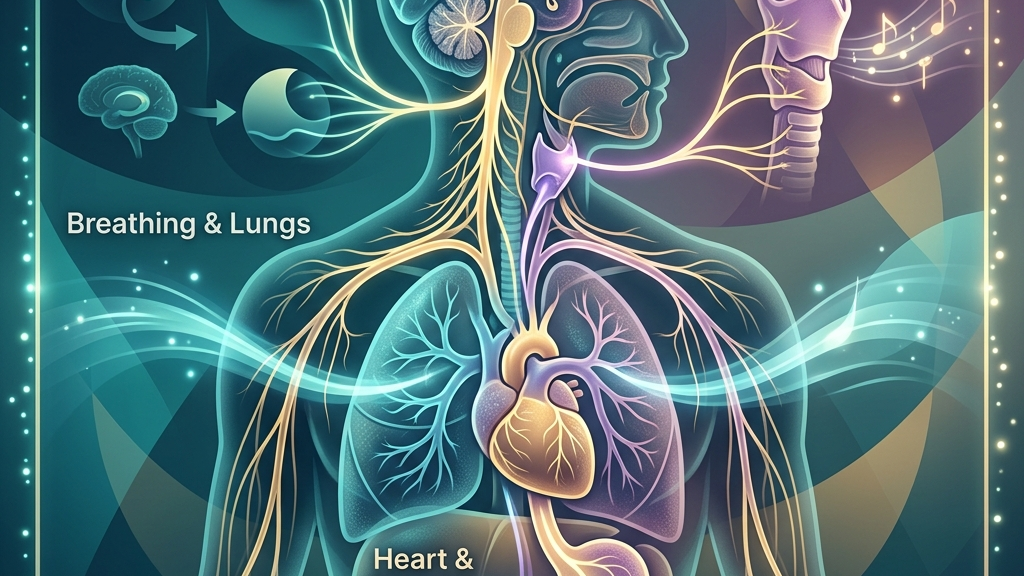
The vagus nerve serves as a primary communication highway between the brain and many internal organs, influencing how the body shifts out of heightened states and returns toward balance. Its activity is closely tied to everyday experiences of tension release, respiratory rhythm, and even the subtle sensations in the throat during speaking or swallowing. Understanding these links offers a clearer picture of why certain physiological patterns feel the way they do and how small shifts in one area can ripple through others.
Readers will encounter detailed explanations of the nerve’s anatomy and its role in the parasympathetic system, followed by focused examinations of stress recovery processes, respiratory mechanics, and laryngeal functions. Mechanisms such as heart-rate variability, afferent signaling, and brainstem integration receive attention, along with observations people commonly report when these systems operate smoothly or encounter friction. Later sections review selected research findings and outline straightforward practices that many individuals explore to support vagal function.
How the vagus nerve works
The vagus nerve, designated as cranial nerve ten, originates in the medulla oblongata and extends long branches that reach the heart, lungs, esophagus, and portions of the digestive tract. Its fibers carry both outgoing commands that slow heart rate and promote digestion and incoming sensory information that reports the state of those organs back to the brainstem. This bidirectional traffic allows the nerve to participate in moment-to-moment adjustments that favor conservation of energy once immediate demands subside. In daily life this shows up when someone finishes a brisk walk and notices their pulse settling within a minute or two rather than remaining elevated; the vagus is actively braking cardiac output while simultaneously increasing blood flow to the intestines so that nutrient absorption can resume. The same fibers also carry information from specialized receptors in the aortic arch that detect subtle pressure changes, allowing the brainstem to fine-tune vascular tone before blood pressure drifts outside a narrow window.
Within the parasympathetic division of the autonomic nervous system, vagal outflow acts as a brake on sympathetic activation. When vagal tone is robust, heart-rate variability tends to increase, reflecting flexible responsiveness rather than rigid acceleration. The nerve also contributes to the gut-brain axis by transmitting signals from enteroendocrine cells and microbiota-derived metabolites, which can influence mood-related circuits and visceral comfort. For instance, after eating a meal rich in fermentable fibers, short-chain fatty acids produced by gut bacteria stimulate vagal afferents that travel to the nucleus tractus solitarius; from there, projections reach areas involved in satiety and emotional regulation, often producing the familiar post-meal sense of calm that encourages rest rather than further activity.
Respiratory sinus arrhythmia provides one visible marker of vagal influence: heart rate rises slightly during inhalation and falls during exhalation when vagal activity is intact. This rhythm arises because vagal preganglionic neurons receive input from respiratory centers, creating a natural coupling between breathing and cardiac regulation. Disruptions in this coupling may appear as reduced variability or a sense of persistent physiological vigilance. A person sitting at a desk who begins to breathe more shallowly while concentrating may notice that their heart rate stays relatively flat across the breath cycle; restoring a slower, deeper pattern often brings the expected waxing and waning of heart rate within a few cycles, illustrating how quickly the coupling can be re-established.
Branching anatomy further explains the nerve’s reach into the throat. The superior and recurrent laryngeal nerves, both vagal derivatives, innervate muscles that control vocal-fold tension, swallowing coordination, and sensation in the pharynx and larynx. These connections mean that mechanical or sensory events in the throat can send afferent traffic that modulates brainstem nuclei involved in autonomic balance. Someone who clears their throat repeatedly during a stressful meeting may inadvertently stimulate these laryngeal afferents, sometimes triggering a brief wave of parasympathetic activity that softens overall muscle tone even while cognitive attention remains high.
Stress Recovery and Shifts in Autonomic Balance
Stress recovery depends in part on the vagus nerve’s capacity to re-engage parasympathetic dominance after sympathetic arousal has served its purpose. When a challenge passes, vagal efferents help lower heart rate, reduce inflammatory signaling, and restore gastrointestinal motility that may have been suppressed. Research on heart-rate variability indicates that higher resting vagal tone correlates with faster return to baseline cardiovascular parameters following laboratory stressors. In everyday terms this appears when a driver merges onto a busy highway, experiences a surge of alertness, and then, once safely in the correct lane, feels the chest loosen and digestion resume within minutes; the vagus is reasserting itself through baroreflex-mediated braking and reduced sympathetic drive to the gut.
Mechanistically, the nucleus tractus solitarius integrates baroreceptor and chemoreceptor input carried by the vagus, then modulates output to cardiac ganglia. This feedback loop allows blood-pressure fluctuations to trigger vagal braking, preventing prolonged elevation. In parallel, vagal afferents from the gut can dampen hypothalamic-pituitary-adrenal axis activity, limiting the duration of cortisol release once the acute phase of stress has ended. Consider the difference between finishing a heated conversation and immediately checking email versus pausing for a slow walk around the block: the latter provides additional vagal afferent traffic from both movement and respiration that more effectively quiets the stress-axis response.
Many people notice that periods of effective recovery coincide with a subjective sense of warmth in the chest, easier digestion after meals, or a gradual softening of muscle tension along the neck and shoulders. Conversely, when vagal withdrawal persists, individuals may describe lingering mental alertness, shallow breathing even at rest, or a feeling that the body remains “on alert” despite an objectively safe environment. These sensations reflect the nerve’s role in signaling safety or its absence to higher brain centers. A common example is the difficulty falling asleep after an evening argument; even though the environment is quiet, reduced vagal tone keeps heart-rate variability low and breathing patterns slightly rapid, delaying the transition into deeper sleep stages.
Chronic low-grade stressors can gradually reduce vagal tone through repeated inhibition of parasympathetic outflow. Over time, this pattern may manifest as lower heart-rate variability and slower physiological downregulation after daily demands. The vagus therefore participates both in acute recovery and in shaping longer-term autonomic set points that influence resilience. Office workers who spend most of the day seated with minimal breaks often report that evening wind-down rituals become less effective over months; introducing brief upright movement and extended exhales during the workday can gradually restore some of the lost variability, demonstrating that the set point is modifiable rather than fixed.
Breathing Patterns and Their Influence on Vagal Tone
Respiration directly engages vagal pathways through mechanical and neural routes. Stretch receptors in the lungs and airways send afferent signals via the vagus to the brainstem, where they interact with cardiac vagal neurons. Slow, extended exhalation lengthens the phase during which vagal outflow to the heart is less inhibited, often increasing heart-rate variability within a single breath cycle. A person who habitually sighs or yawns after concentrating may be unconsciously lengthening exhalation, thereby recruiting this mechanism to restore momentary balance.
The relationship is bidirectional. Elevated vagal tone supports smoother respiratory rhythms by modulating airway smooth muscle and mucus secretion, while disordered breathing can reduce vagal afferent traffic and thereby lessen parasympathetic restraint on the heart. Studies of paced breathing demonstrate that ratios favoring longer exhalation reliably shift spectral measures of heart-rate variability toward the frequency band associated with vagal activity. In practice this appears when someone switches from rapid upper-chest breathing during a deadline to a deliberate six-breath-per-minute pattern; within a few minutes the chest feels less tight and peripheral awareness widens, reflecting both mechanical lung-stretch effects and altered brainstem integration.
Individuals frequently report that deliberate slowing of the breath produces a perceptible drop in perceived urgency or a softening around the solar plexus. Conversely, rapid or shallow patterns maintained over hours may coincide with sensations of tightness in the chest or difficulty settling into rest. These subjective shifts align with objective changes in respiratory sinus arrhythmia amplitude. For example, commuters who practice extended exhales while waiting in traffic often notice that the same stretch of road feels less irritating on subsequent days, suggesting that repeated brief interventions accumulate into more stable respiratory and autonomic patterns.
During sleep, vagal respiratory coupling continues to operate; stable breathing supports nocturnal heart-rate variability, whereas apneas or irregular ventilation can interrupt vagal bursts. The resulting fragmentation may leave people feeling less restored upon waking, illustrating how breath serves as both an input to and an output of vagal regulation throughout the 24-hour cycle. Someone who wakes with a dry mouth and fragmented recall of dreams may have experienced repeated micro-arousals that reduced the cumulative duration of high-vagal states, even if total sleep time appeared adequate on a tracker.
Voice, Throat, and the Vagus Nerve
Vocal production relies on precise vagal innervation of the larynx. The recurrent laryngeal nerve supplies most intrinsic laryngeal muscles, while the superior laryngeal nerve provides sensory innervation to the supraglottic mucosa and motor supply to the cricothyroid. These branches allow the vagus to coordinate glottic closure, pitch control, and airway protection during swallowing and phonation. A speaker who notices their voice cracking under mild stress is experiencing momentary changes in laryngeal muscle tone driven by shifting autonomic input to these vagal branches.
Afferent traffic from laryngeal and pharyngeal mechanoreceptors travels back through the vagus to the nucleus tractus solitarius, where it can influence autonomic tone. Activities that gently stimulate these receptors, such as humming or gargling, increase vagal afferent load and have been observed to raise heart-rate variability in short-term recordings. Throat tension or inflammation, by contrast, may alter sensory signaling and thereby reduce the calming feedback the brainstem receives. Choir members often report a lingering sense of bodily ease after rehearsal; the sustained, low-effort vocalization provides rhythmic mechanical stimulation that augments vagal afferent traffic without requiring conscious attention to breathing.
People often notice that relaxed vocal use—such as conversational speaking or quiet singing—coincides with a calmer overall bodily state, whereas prolonged strained projection can leave residual tightness and a sense of lingering sympathetic activation. The throat thus functions as both an effector of vagal motor commands and a source of regulatory sensory information. Teachers who project loudly for several hours without adequate hydration frequently describe neck and shoulder tension that persists into the evening; the mechanical strain alters laryngeal afferent patterns, reducing the very signals that would otherwise support parasympathetic rebound.
Swallowing mechanics further illustrate the connection. Coordinated pharyngeal constriction and laryngeal elevation depend on vagal motor neurons; efficient swallowing clears the pharynx without excessive effort and sends afferent signals that support postprandial parasympathetic dominance. When these movements feel effortful or incomplete, the resulting sensory pattern may contribute to a sense that full physiological settling remains elusive. Individuals who eat quickly while distracted often experience this mismatch; slower, mindful swallowing restores both mechanical efficiency and the accompanying afferent feedback that promotes digestive calm.
What the research shows
Investigations into cardiac vagal tone have established that heart-rate variability indices partly reflect vagal modulation of the sinoatrial node, with higher values generally indicating greater parasympathetic flexibility. Heart Rate Variability and Cardiac Vagal Tone reviews the physiological basis for using these measures to track autonomic balance across different conditions.
Evidence also links vagal pathways to sleep architecture and respiratory stability. Vagus Nerve Stimulation, Sleep-Disordered Breathing & Sleep Quality examines how altered vagal signaling may intersect with breathing disruptions during sleep and subsequent daytime restoration.
Studies of the gut-brain axis highlight the vagus as a major conduit for microbial and metabolic signals that can influence central autonomic networks. Vagus Nerve as Modulator of the Brain–Gut Axis and Vagal Sensory Neurons and Gut–Brain Signaling together describe afferent routes by which intestinal information reaches brainstem nuclei involved in stress and recovery responses.
Basic anatomical and functional descriptions appear in clinical resources such as Vagus Nerve: Function, Location & Conditions and Neuroanatomy, Cranial Nerve 10 (Vagus Nerve), which outline the nerve’s extensive distribution and its contributions to parasympathetic regulation of thoracic and abdominal viscera.
Practical ways to support your vagus nerve
- Slow, extended exhales performed for several minutes can lengthen the phase of respiratory sinus arrhythmia, allowing greater vagal influence on heart rate during ordinary daily pauses.
- Humming or gentle gargling creates rhythmic vibration in the larynx and pharynx, increasing afferent traffic along vagal branches that project to the nucleus tractus solitarius.
- Brief, tolerable cold exposure such as cool water on the face may activate vagal reflexes via trigeminal and glossopharyngeal pathways that interact with brainstem autonomic centers.
- Paced breathing at approximately six breaths per minute often aligns with the frequency of maximal heart-rate variability, providing a simple rhythm that many people can sustain without equipment.
- Light movement such as walking integrates vestibular and proprioceptive input with respiration, supporting the natural coupling between posture, breath, and vagal outflow.
- Consistent morning light exposure combined with a stable sleep schedule helps anchor circadian rhythms that in turn influence nocturnal vagal activity and daytime recovery capacity.
When to talk to a professional
Sudden changes in swallowing, persistent hoarseness, or unexplained throat pain warrant prompt medical evaluation to rule out structural or neurological issues affecting vagal branches. Likewise, chest pain, severe dizziness, or fainting episodes require immediate attention regardless of any suspected autonomic component. These symptoms can arise from multiple overlapping causes, and professional assessment distinguishes between transient autonomic fluctuations and conditions requiring targeted intervention.
Individuals experiencing prolonged sleep-disordered breathing, significant digestive distress that interferes with daily function, or cardiovascular symptoms that do not resolve with rest should consult a qualified clinician. These presentations may involve multiple systems and benefit from comprehensive assessment rather than isolated self-directed approaches. Early evaluation often clarifies whether vagal-supportive practices can be safely incorporated alongside other treatments.
Common questions
How quickly can vagal tone change?
Short-term shifts in heart-rate variability can occur within minutes of altered breathing or posture, yet sustained changes in baseline tone generally develop over weeks to months through repeated practice and lifestyle consistency. The speed of change depends on factors such as prior autonomic flexibility, sleep quality, and the regularity with which new patterns are introduced.
Does posture affect the vagus nerve?
Spinal alignment and head position influence vagal branches in the neck and can alter mechanical tension around the laryngeal nerves, which many people experience as easier breathing or vocal effort when alignment improves. Forward head posture maintained for hours, for example, can increase tension on the recurrent laryngeal nerve pathway, subtly reducing the afferent feedback that supports parasympathetic tone.
Can digestive symptoms relate to vagal function?
The vagus supplies parasympathetic innervation to much of the gastrointestinal tract; altered motility or sensation may therefore coincide with changes in overall autonomic balance, though many other factors also contribute. When meals are followed by prolonged bloating or sluggish transit, reduced vagal outflow is one possible contributor among dietary, microbial, and mechanical influences.
Is heart-rate variability the only marker of vagal activity?
While HRV provides a convenient window, vagal function also appears in respiratory patterns, gastrointestinal motility, and laryngeal coordination; no single metric captures the full range of its influence. Clinicians therefore consider multiple signs together when evaluating autonomic status rather than relying on any isolated measurement.
Are there age-related changes in vagal tone?
Resting heart-rate variability tends to decline gradually with advancing age, yet individual differences remain large and modifiable factors such as physical activity and sleep continuity continue to play roles. Older adults who maintain regular movement and consistent sleep schedules often retain higher variability than sedentary peers of the same age, illustrating that age-related trends are not uniform.
The vagus nerve weaves together cardiovascular flexibility, respiratory rhythm, and laryngeal coordination into a single regulatory fabric that supports recovery after stress. Attention to breath, vocal use, and daily rhythms offers accessible avenues for noticing how these systems interact. Over time, such observation can foster a more precise appreciation of the body’s built-in mechanisms for returning toward equilibrium.
Have a question?
Have a question about something specific? Send us a message.
Visit VagusSkool.com/contact — we'll try to get back to you within 24 hours.