The Vagus Nerve as a Bridge Between Stress Recovery, Vocal Expression, and Social Connection
How the Vagus Nerve Works
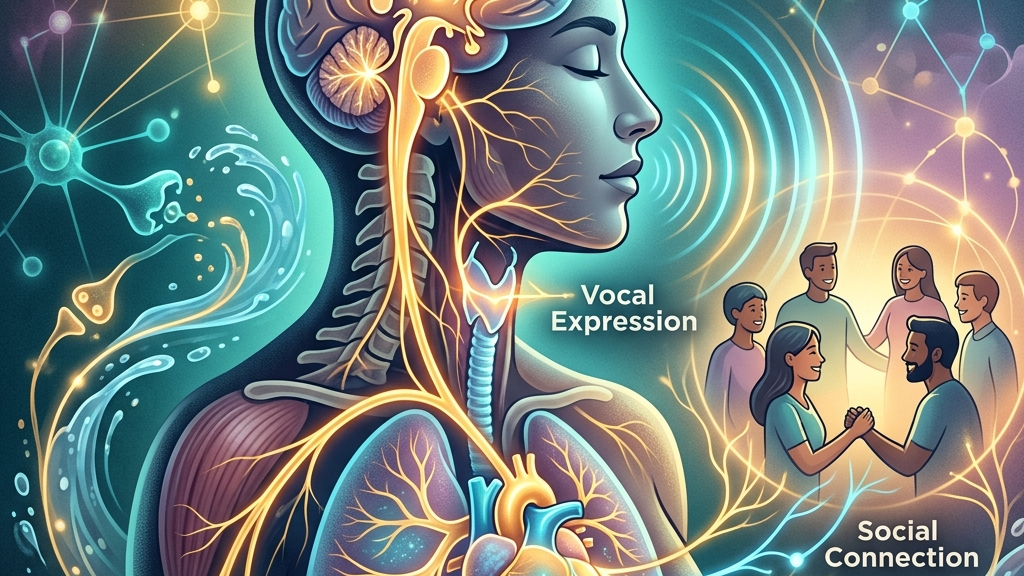
The vagus nerve is the longest cranial nerve, extending from the brainstem through the neck and into the chest and abdomen. It carries both motor and sensory fibers that form a major component of the parasympathetic nervous system, which promotes rest-and-digest functions after periods of activation. Its bidirectional signaling allows the brain to receive continuous updates from the heart, lungs, and digestive tract while also sending regulatory commands downward. One key route runs along the gut-brain axis, where vagal afferents transmit information about intestinal conditions to brainstem nuclei that influence mood and arousal. This communication helps coordinate digestive motility with emotional states, creating a feedback loop that can either support or disrupt overall equilibrium. Research on this axis highlights how vagal integrity contributes to the integration of visceral signals with higher brain centers. For instance, after a heavy meal, signals traveling upward can prompt a subtle shift toward drowsiness or reduced alertness, illustrating how gut status directly shapes momentary energy levels without conscious effort. In everyday settings, someone who eats under time pressure may notice slower gastric emptying later, as the vagus integrates the emotional context of the meal with motility patterns. Heart-rate variability serves as a practical window into vagal activity. Greater variability between heartbeats often reflects stronger parasympathetic influence, particularly through the vagus’s “brake” on the sinoatrial node. When this brake operates smoothly, the heart can decelerate efficiently after exertion or emotional challenge, supporting recovery. Lower variability may correspond to reduced vagal tone, though many factors beyond the vagus alone shape this measure. Consider a person finishing a brisk walk home from work: with intact vagal function, the interval between beats lengthens gradually during the cool-down, allowing a smooth return to baseline rather than an abrupt plateau. This same mechanism operates during quiet reading, where small fluctuations in heart rate track subtle changes in attention or posture.Vagal Tone and the Physiology of Stress Recovery
The vagus nerve participates in down-regulating sympathetic arousal once a stressor has passed. Through its connections to the nucleus tractus solitarius, it helps restore slower breathing, reduced muscle tension, and normalized digestive activity. This process relies on acetylcholine release at cardiac and visceral targets, which counters the adrenaline and cortisol surges that accompany acute stress responses. When vagal signaling remains robust, the body can shift out of defensive states more readily, though the speed and completeness of this shift differ among individuals. People frequently describe a sense of gradual settling after demanding events, such as noticing that their pulse returns to baseline or that previously tight shoulders loosen without deliberate effort. Some observe improved appetite or digestion once the immediate pressure lifts, consistent with vagal support for gastrointestinal function. Others report that sleep arrives more easily when daytime stress does not linger into the evening, reflecting the nerve’s role in promoting parasympathetic dominance during rest periods. A concrete example occurs after an unexpected work deadline: once the task ends, the vagus facilitates a return of peristalsis so that an evening meal feels satisfying rather than leaden, while respiratory rate settles enough for deeper diaphragmatic movement during the first hours of sleep. Chronic or repeated stress can influence vagal pathways over time, potentially reducing the nerve’s capacity to exert its braking effect. This may manifest as prolonged elevations in heart rate or a lingering sense of vigilance even in safe environments. The underlying mechanisms involve both central changes in brainstem regulation and peripheral adjustments in receptor sensitivity along vagal fibers, creating a nuanced picture rather than a simple on-off switch. Over months of sustained high workload, for example, an individual might notice that evening walks no longer produce the same degree of relaxation, because repeated sympathetic activation has altered the threshold at which vagal efferents re-engage. Respiratory sinus arrhythmia provides another measurable index of vagal contribution to recovery. During slow, rhythmic breathing, heart rate tends to rise on inhalation and fall on exhalation, a pattern mediated by vagal efferents. When this oscillation remains flexible, it supports efficient return to calm; rigidity in the pattern may coincide with difficulty releasing tension after stress. In practice, someone practicing this rhythm while seated at a desk may observe that the natural pause after exhalation lengthens slightly, allowing a brief window in which ambient sounds register more clearly and muscle tone in the neck decreases.The Vagus Nerve’s Influence on Voice and Throat Function
Branchial motor fibers of the vagus innervate muscles of the larynx and pharynx, enabling the fine adjustments required for speech, swallowing, and breathing. These fibers travel through the recurrent laryngeal nerve, which loops through the chest before returning to the neck, making the pathway vulnerable to mechanical or inflammatory influences. Sensory branches supply the external ear, throat lining, and upper esophagus, feeding information back to the brainstem about tissue state and movement. When vagal tone supports laryngeal muscle coordination, many people experience a voice that feels steady and resonant rather than strained or hoarse after prolonged talking. The throat itself may feel less constricted during normal activities, allowing easier swallowing or a reduced sensation of tightness when speaking under mild pressure. These observations align with the nerve’s dual motor and sensory responsibilities in the region. A teacher finishing a full day of classes, for instance, may notice that vocal projection remains consistent into the afternoon because the same vagal fibers maintain balanced tension across the vocal folds while simultaneously relaying stretch information that prevents compensatory tightening. Disruptions along vagal routes can affect vocal fold tension or pharyngeal sensation, sometimes resulting in changes in pitch range or effort required to project sound. Because the same nerve trunk carries fibers to both the heart and the larynx, shifts in cardiac vagal activity may coincide with alterations in vocal quality, illustrating the interconnected nature of these systems. Research on cranial nerve anatomy underscores how these fibers originate in shared medullary nuclei. In daily life this linkage appears when a person feels their voice rise in pitch during an anxious phone call; the same autonomic shift that elevates heart rate also increases laryngeal tension, narrowing the vocal tract slightly. Gentle stimulation of vagal afferents in the throat, such as through vibration or temperature change, can in turn influence brainstem activity that feeds back to cardiovascular regulation. This bidirectional loop suggests why throat-centered practices sometimes accompany shifts in overall arousal, though the magnitude of effect remains variable across individuals. Someone sipping a cool drink after a tense meeting may register both a subtle easing of throat sensation and a modest slowing of pulse within minutes, reflecting the shared medullary circuitry.Vagal Pathways Supporting Social Connection
The vagus nerve contributes to the neurophysiological platform for safe social engagement through its influence on facial expression, vocal prosody, and visceral calm. Myelinated fibers that developed later in mammalian evolution allow rapid adjustments in middle-ear muscles and laryngeal tension that facilitate listening to human voices and producing nuanced vocal signals. When these circuits operate without excessive interference from defensive states, people often find it easier to maintain eye contact or interpret subtle social cues. Visceral feedback via vagal afferents helps sustain a physiological environment conducive to connection. A heart rate that can decelerate in response to friendly interaction, or digestion that continues during conversation, supports the internal sense of safety required for sustained engagement. Conversely, when vagal tone is lower, the body may default more readily to protective withdrawal even in benign settings. Consider two colleagues sharing coffee: with adequate vagal tone, each person’s breathing remains relatively even, allowing the conversation to flow without frequent throat clearing or postural shifts that signal discomfort. Neuroanatomical studies trace these functions to brainstem nuclei that coordinate cranial nerves V, VII, IX, X, and XI into a social engagement system. The vagus serves as a central conduit within this network, linking autonomic state to the muscles of the face and neck. This integration helps explain why changes in breathing or posture can influence both internal calm and outward expressiveness during interactions. A parent reading aloud to a child demonstrates this when the adult’s relaxed exhalations support steady vocal inflection while the child’s attentive posture reflects reciprocal vagal signaling that keeps both parties physiologically available for continued exchange. Individual differences in baseline vagal activity may partly account for varying ease with social situations, yet environmental context, prior experience, and concurrent health factors also shape outcomes. The nerve does not act in isolation but participates in a larger web of regulatory processes that together support or hinder relational presence.What the Research Shows
Studies of heart-rate variability have established associations between higher vagal tone and more efficient cardiac recovery after stress, as detailed in research on heart rate variability and cardiac vagal tone. Complementary work on the gut-brain axis illustrates how vagal sensory neurons relay metabolic and inflammatory signals that can modulate central arousal systems, according to reviews of the vagus nerve as modulator of the brain–gut axis. Anatomical mapping confirms the vagus’s extensive distribution to laryngeal structures and its integration with other cranial nerves involved in social signaling, outlined in neuroanatomy resources on cranial nerve 10. Clinical summaries from Cleveland Clinic descriptions of vagus nerve function further note its contributions to both parasympathetic regulation and throat innervation. Additional investigations into vagal sensory neurons highlight their role in transmitting gut-derived information that influences emotional and autonomic balance, as examined in studies of vagal sensory neurons and gut–brain signaling. Separate analyses have explored vagus nerve stimulation in relation to sleep architecture and breathing patterns during rest, reported in research on vagus nerve stimulation, sleep-disordered breathing, and sleep quality. Collectively these sources portray the vagus as a multifunctional nerve whose activity intersects stress physiology, vocal motor control, and social neuroception, while emphasizing that measured effects remain correlational in many human studies and subject to individual variability.Practical Ways to Support Your Vagus Nerve
- Begin with slow, extended exhales that lengthen the out-breath relative to the in-breath; this pattern can gently increase vagal influence on heart rate through respiratory gating of parasympathetic outflow.
- Explore simple humming or soft gargling for brief periods, which may stimulate vagal afferents in the throat and pharynx while producing a mild vibratory sensation many find soothing.
- Experiment with gentle cold exposure, such as splashing cool water on the face, to engage trigeminal-vagal reflexes that can shift autonomic balance toward parasympathetic dominance.
- Practice paced breathing at a comfortable rhythm of roughly six breaths per minute, allowing natural pauses; this tempo often aligns with peak heart-rate variability responses linked to vagal activity.
- Incorporate light movement such as walking or gentle stretching, which can support vagal tone through rhythmic changes in thoracic pressure and improved circulation.
- Maintain consistent morning light exposure combined with a regular sleep schedule to help align circadian rhythms that interact with vagal regulation of cardiovascular and digestive functions.
When to Talk to a Professional
Persistent changes in swallowing, voice quality, or heart rhythm that interfere with daily function warrant evaluation by a qualified clinician. Sudden onset of dizziness, severe throat pain, or unexplained digestive distress also merits prompt medical attention rather than self-directed exploration. Individuals experiencing intense anxiety, depression, or trauma-related symptoms should consult licensed mental-health professionals who can assess the full clinical picture. The practices discussed here remain educational and are not substitutes for personalized medical care.Common Questions
How long does it take to notice shifts in vagal tone?
Responses vary widely; some people report subtle changes in breathing ease or throat comfort within days of consistent gentle practices, while measurable shifts in heart-rate variability may require weeks of observation and depend on many physiological factors.
Can vagus nerve issues cause throat tightness?
The vagus supplies motor and sensory innervation to the larynx and pharynx, so irritation or altered signaling along its branches can coincide with sensations of constriction, though many other conditions can produce similar symptoms and require professional assessment.
Is heart-rate variability the only marker of vagal health?
No single measure captures the full scope of vagal function; variability provides one accessible window, yet respiratory patterns, digestive comfort, and social engagement also reflect integrated vagal contributions.
Do breathing exercises work for everyone?
Individual responses differ based on age, fitness, concurrent health conditions, and personal preference; what feels regulating for one person may feel neutral or uncomfortable for another, underscoring the value of professional guidance when needed.
The vagus nerve offers a tangible illustration of how internal regulatory systems underpin both personal recovery and the ability to connect outwardly. By attending to its pathways through informed daily habits, individuals can cultivate a deeper appreciation for the body’s built-in capacities for balance while recognizing when professional support is the most appropriate next step.Have a question?
Have a question about something specific? Send us a message.
Visit VagusSkool.com/contact — we'll try to get back to you within 24 hours.