The Vagus Nerve and Its Interwoven Roles in Sleep Architecture, Stress Recovery, and Digestive Regulation
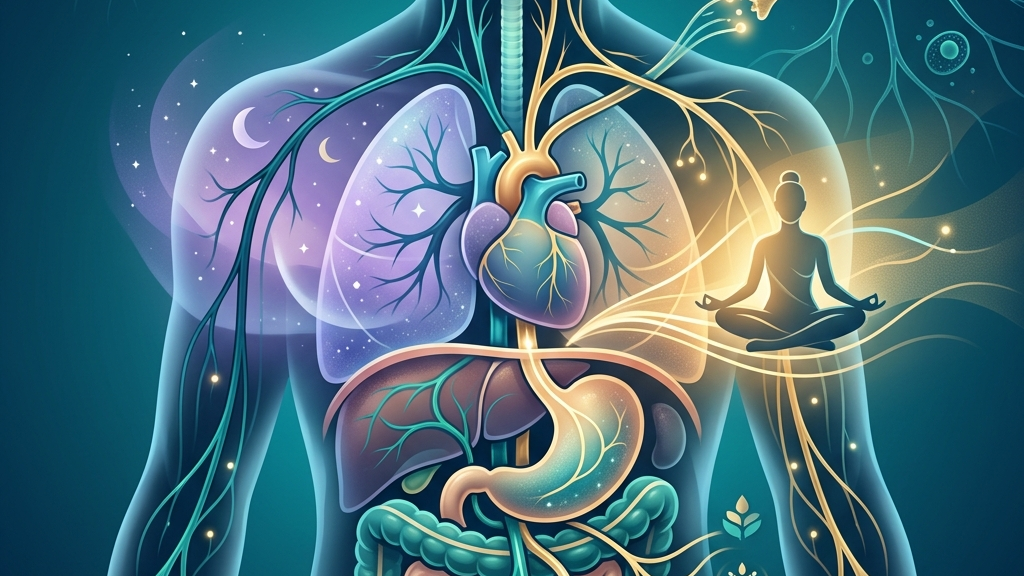
The vagus nerve serves as a primary conduit within the parasympathetic nervous system, linking brainstem centers with extensive networks throughout the body. Its influence extends across multiple physiological domains, shaping how the system transitions into restorative states, rebounds from activation, and processes nutrients. Understanding these connections offers a framework for recognizing patterns that many individuals observe in their own rhythms of rest, resilience, and gastrointestinal function.
This exploration examines the anatomical reach and signaling properties of the vagus nerve before turning to its specific intersections with sleep, stress recovery, and digestion. Mechanisms such as afferent and efferent traffic along the gut-brain axis, modulation of cardiac intervals, and sensory feedback from visceral organs receive particular attention. The discussion remains grounded in established physiology while noting areas where individual responses vary.
Readers will encounter detailed accounts of how vagal pathways contribute to heart-rate variability, enteric coordination, and brainstem regulation of arousal. Evidence summaries draw from peer-reviewed sources, and practical considerations appear in later sections without prescriptive intent. The aim is to illuminate the nerve’s integrative functions rather than to suggest targeted interventions.
How the Vagus Nerve Works
The vagus nerve, designated as cranial nerve X, originates in the medulla oblongata and extends bilaterally through the neck, thorax, and abdomen. It carries both motor and sensory fibers, with roughly eighty percent of its traffic traveling afferent signals from peripheral organs back to the brainstem. This bidirectional flow allows continuous monitoring of visceral status and enables rapid adjustments in autonomic tone. The nerve emerges from several medullary nuclei, including the dorsal motor nucleus for most efferent outflow and the nucleus ambiguus for specialized cardio-inhibitory and laryngeal fibers, then travels alongside the carotid arteries before branching extensively into thoracic and abdominal plexuses.
Within the parasympathetic division, the vagus nerve promotes conservation of energy and restoration. It slows heart rate, supports gastrointestinal motility and secretion, and dampens inflammatory signaling through the cholinergic anti-inflammatory pathway. These actions contrast with sympathetic activation, which prepares the organism for immediate mobilization; the vagus nerve therefore functions as a counterbalance that facilitates return to baseline once demands subside. In everyday terms, after finishing a large meal the vagus coordinates increased gastric contractions and pancreatic secretions while simultaneously lowering heart rate to match reduced physical demand, illustrating how one nerve integrates multiple organ systems without requiring conscious effort.
Heart-rate variability serves as one accessible window into vagal influence. Respiratory sinus arrhythmia, the natural fluctuation in interval length between heartbeats that occurs with breathing, largely reflects vagal cardio-inhibitory fibers. Higher variability at rest often corresponds to greater parasympathetic engagement, whereas reduced variability can accompany sustained sympathetic dominance or vagal withdrawal. For instance, during quiet reading the interval between heartbeats lengthens slightly on each exhale and shortens on each inhale; this subtle oscillation arises because vagal fibers inhibit the sino-atrial node more strongly during expiration, providing a real-time readout of shifting autonomic balance that can be tracked with consumer pulse sensors.
The gut-brain axis further illustrates the nerve’s integrative scope. Vagal afferents convey mechanical and chemical information from the gastrointestinal tract to the nucleus tractus solitarius, which then projects to higher centers involved in mood, appetite, and autonomic control. Efferent fibers complete the loop by modulating motility, sphincter tone, and local immune activity within the enteric nervous system. When a person consumes a fiber-rich meal, stretch receptors in the stomach walls activate vagal afferents that signal satiety to brainstem centers, while efferent traffic simultaneously enhances peristaltic waves that move contents onward; this coordinated exchange helps explain why digestive comfort can shift noticeably after periods of rushed eating versus mindful pacing.
Sleep and Vagal Tone
Transition into non-rapid-eye-movement sleep involves progressive withdrawal of sympathetic drive and a corresponding rise in vagal modulation of cardiac and respiratory rhythms. This shift supports slower heart rates and more regular breathing patterns that characterize deeper sleep stages. Vagal afferents from the lungs and heart provide feedback that helps stabilize these autonomic changes, reducing the likelihood of abrupt arousals. Consider an evening routine of dimming lights and avoiding screens: the resulting drop in sympathetic tone allows vagal afferents to reinforce slower breathing, which in turn lengthens cardiac intervals and promotes entry into stage N2 sleep within roughly twenty minutes for many adults.
During slow-wave sleep, increased vagal activity coincides with growth-hormone release and cellular repair processes. The nerve’s role in lowering metabolic demand allows resources to be redirected toward tissue maintenance and memory consolidation. Individuals sometimes notice that nights marked by greater calm upon lying down are followed by fewer awakenings, a pattern consistent with sustained parasympathetic engagement. Mechanistically, vagal efferents to the heart reduce oxygen consumption, freeing metabolic substrates for hippocampal replay of daily experiences that supports next-day recall.
Disruptions in vagal signaling can manifest as difficulty maintaining sleep continuity. When afferent traffic from visceral organs signals ongoing physiological tension, brainstem centers may remain partially alert, fragmenting sleep architecture. Research on sleep-disordered breathing highlights how altered vagal reflexes can interact with upper-airway control, though the precise causal directions remain under investigation. For example, late-evening heavy meals can increase gastric distension that sends persistent afferent signals, occasionally prompting micro-arousals even when the person feels subjectively tired.
Heart-rate-variability measurements taken across the night often show rising vagal indices as sleep deepens, followed by a gradual decline toward morning. This trajectory reflects the dynamic interplay between central autonomic networks and peripheral feedback loops. Variations in this pattern across nights can provide indirect clues about nightly recovery capacity without requiring clinical interpretation. A person who experiences an unusually stressful workday may observe that vagal rebound during the first sleep cycle is blunted, resulting in more fragmented slow-wave periods and a correspondingly earlier morning rise in sympathetic tone.
Vagus Nerve Contributions to Stress Recovery
Following an acute stressor, efficient return to baseline depends partly on rapid re-engagement of vagal cardio-inhibitory pathways. The so-called vagal brake modulates sino-atrial node activity, allowing heart rate to decelerate once the immediate demand passes. When this mechanism operates smoothly, respiratory sinus arrhythmia rebounds and subjective calm tends to follow within minutes to hours. After an unexpected work deadline, for instance, a short walk outdoors can engage pulmonary stretch receptors that increase vagal afferent traffic, accelerating the brake’s reapplication and shortening the time needed to feel settled again.
Prolonged or repeated stressors can reduce the responsiveness of these pathways, a state sometimes described as vagal withdrawal. Under such conditions, heart-rate variability remains lower even during periods of relative safety, and the system may require longer intervals to restore parasympathetic dominance. This slower recovery can influence sleep onset latency and next-day energy availability. Nuance arises because baseline fitness, sleep history, and even hydration status modulate how quickly the brake reactivates; two colleagues facing identical project pressure may therefore exhibit noticeably different evening heart-rate settling times.
The vagus nerve also participates in dampening peripheral inflammation triggered by stress-related sympathetic activation. Through the cholinergic anti-inflammatory reflex, efferent signals inhibit cytokine release in organs such as the spleen. When vagal tone is adequate, this loop helps limit the duration of low-grade inflammatory states that might otherwise prolong subjective tension. Everyday observation of this mechanism appears when someone notices lingering muscle soreness after an argument that resolves more quickly on days when prior sleep was restorative, consistent with intact vagal anti-inflammatory capacity.
Many people observe that practices involving extended exhalation or vocalization coincide with quicker settling after demanding events. These experiences align with the anatomy of vagal afferents in the larynx and lungs, which can entrain brainstem nuclei responsible for autonomic balance. Individual differences in baseline vagal capacity help explain why recovery timelines vary even when stressors appear comparable. A musician accustomed to controlled breathing during performance may therefore demonstrate faster post-meeting normalization of heart rate than a colleague without similar training.
The Vagus Nerve in Digestive Regulation
Vagal efferents stimulate gastric motility and pancreatic enzyme release while coordinating pyloric and lower-esophageal sphincter function. These motor commands support orderly progression of food through the stomach and small intestine. Concurrently, vagal afferents relay stretch and nutrient signals that inform satiety centers and modulate further digestive activity via brainstem reflexes. After eating a balanced lunch containing protein and vegetables, vagal afferents register both mechanical distension and the arrival of amino acids, prompting a measured release of pancreatic bicarbonate that prevents intestinal acidity from rising too sharply.
The enteric nervous system receives dense vagal innervation, allowing fine-tuning of peristalsis and local blood flow. When vagal tone is balanced, migrating motor complexes during fasting periods help clear residual contents and limit bacterial overgrowth. Disruptions in this traffic can correspond to sensations of bloating or irregular transit that some individuals experience during periods of heightened stress. An example occurs when a person skips breakfast because of morning meetings; the resulting delay in the first migrating motor complex can produce mid-afternoon abdominal discomfort until vagal and enteric coordination resumes with the next meal.
Communication along the gut-brain axis also influences mood and arousal states. Vagal sensory neurons convey microbial metabolites and inflammatory mediators to the nucleus tractus solitarius, which projects to limbic and cortical regions. This continuous signaling loop means that gastrointestinal status can subtly shape vigilance and emotional tone, just as central autonomic commands can alter gut function. Someone who tolerates a probiotic-rich yogurt well on relaxed weekends may notice transient shifts in perceived mental clarity during high-pressure workweeks when sympathetic override temporarily dampens vagal afferent sensitivity.
Research on vagal sensory neurons underscores their role in detecting specific nutrients and mechanical events within the lumen. These signals contribute to both short-term adjustments in motility and longer-term calibration of appetite and energy balance. Because the pathways are bidirectional, changes in central vagal tone can propagate to enteric circuits and vice versa, creating feedback that either supports or challenges digestive comfort. A concrete illustration is the difference between eating while standing versus seated: seated posture reduces abdominal compression, allowing vagal mechanoreceptors to transmit clearer signals that help calibrate portion termination.
What the Research Shows
Studies examining heart-rate variability consistently link higher resting vagal indices to more stable sleep architecture and faster post-stress recovery. Heart Rate Variability and Cardiac Vagal Tone reviews the physiological basis for these associations, emphasizing the contribution of vagal fibers to respiratory-linked fluctuations in cardiac intervals.
Investigations into sleep-disordered breathing have explored vagus-nerve stimulation as a modulator of airway patency and sleep continuity. Vagus Nerve Stimulation, Sleep-Disordered Breathing & Sleep Quality summarizes findings that suggest vagal pathways influence both respiratory control and overall sleep metrics, though outcomes vary with stimulation parameters and individual anatomy.
The gut-brain axis literature documents extensive vagal involvement in visceral signaling. Vagus Nerve as Modulator of the Brain–Gut Axis outlines how afferent fibers transmit information about microbial composition and inflammatory status, while efferent fibers regulate motility and barrier function. Complementary work in Vagal Sensory Neurons and Gut–Brain Signaling details the molecular diversity of these sensory neurons and their projections to brainstem targets.
Anatomical and functional descriptions from major medical references corroborate the nerve’s extensive distribution and parasympathetic responsibilities. Vagus Nerve: Function, Location & Conditions provides an overview of its course and clinical relevance, and Neuroanatomy, Cranial Nerve 10 (Vagus Nerve) supplies detailed mapping of nuclei and fiber types that underpin the mechanisms discussed above.
Practical Ways to Support Your Vagus Nerve
- Slow, extended exhales performed for several minutes can increase respiratory sinus arrhythmia and temporarily elevate heart-rate variability by enhancing vagal cardio-inhibitory outflow.
- Humming or gentle gargling activates laryngeal and pharyngeal vagal afferents, which project to brainstem nuclei involved in autonomic regulation and may promote a brief shift toward parasympathetic dominance.
- Brief, tolerable cold exposure such as cool water on the face engages trigeminal and vagal reflexes that can produce measurable changes in heart-rate variability within seconds to minutes.
- Paced breathing at approximately six breaths per minute aligns with the resonant frequency of the baroreflex, amplifying vagal modulation of cardiac rhythm during the practice session.
- Light rhythmic movement such as walking or rocking stimulates mechanoreceptors along the gastrointestinal tract and may indirectly support vagal afferent traffic related to digestive comfort.
- Consistent morning light exposure combined with stable sleep timing helps entrain circadian oscillators that in turn influence nightly vagal rebound and daytime autonomic flexibility.
When to Talk to a Professional
Sudden or severe changes in sleep continuity, digestive function, or the ability to recover from ordinary stressors merit evaluation by a qualified clinician. These shifts can arise from multiple physiological systems, and only a trained professional can determine whether further assessment is indicated.
Persistent symptoms such as unexplained weight change, recurrent abdominal pain, or marked alterations in heart rhythm should prompt timely medical consultation rather than self-interpretation of autonomic patterns. Early attention allows identification of treatable contributors that may intersect with vagal pathways but require targeted management.
Individuals experiencing intense anxiety, depressive symptoms, or functional impairment alongside the patterns described here benefit from professional guidance that integrates physical and psychological dimensions. Such collaboration supports comprehensive understanding without substituting for personalized care.
Common Questions
How does breathing affect the vagus nerve?
Extended exhalations stimulate pulmonary stretch receptors whose afferents travel via the vagus nerve, increasing parasympathetic outflow to the heart and temporarily raising heart-rate variability. This mechanism operates within seconds and can be observed through simple respiratory maneuvers.
Can vagal tone be measured at home?
Consumer devices that record heart-rate variability provide an indirect index of vagal influence on the sino-atrial node, though accuracy varies with recording conditions and device quality. These readings offer trends rather than diagnostic conclusions.
Does posture influence vagal signaling?
Positions that compress or stretch the neck and abdomen can alter mechanical feedback to vagal afferents, potentially affecting local motility signals and momentary autonomic balance. Such effects remain modest and context-dependent.
Is there a connection between the vagus nerve and inflammation?
The vagus nerve participates in the cholinergic anti-inflammatory pathway, whereby efferent signals inhibit cytokine production in peripheral organs. This reflex helps limit the spread of inflammatory responses initiated by stress or infection.
Why might digestive comfort change with stress levels?
Stress-related sympathetic activation can reduce vagal efferent traffic to the enteric nervous system, slowing motility and altering sphincter tone. Restoration of vagal engagement often coincides with normalization of these gastrointestinal patterns.
The vagus nerve’s distributed architecture creates multiple points of interaction among sleep regulation, stress recovery, and digestive processes. Recognizing these linkages encourages attention to the body’s integrated responses without implying that any single pathway determines outcomes. Continued observation and professional consultation remain appropriate when patterns raise concern.
Have a question?
Have a question about something specific? Send us a message.
Visit VagusSkool.com/contact — we'll try to get back to you within 24 hours.