The Second Brain: Your Gut Has 500 Million Neurons — and the Vagus Is How It Reports to HQ
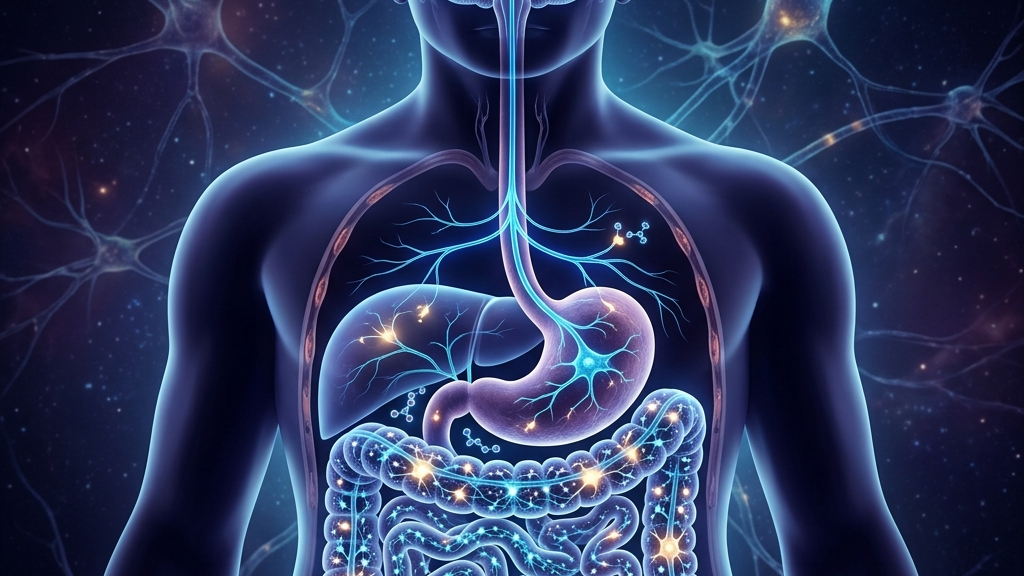
There is a brain in your gut. Not a metaphor, not a poetic flourish — an actual neural network embedded in the wall of your digestive tract, with its own reflexes, its own decisions, and enough neurons to rival the brain of a small animal. Scientists call it the enteric nervous system (the vast web of neurons lining the gastrointestinal tract), and the pioneering neuroscientist Michael Gershon named it the "second brain" for a very literal reason: it can run the whole show without any input from the brain in your head.
Half a Billion Neurons in Your Gut Wall
The numbers are what stop people cold. The enteric nervous system contains roughly 500 million neurons — more than the spinal cord, and comparable to the brain of a cat. These neurons are not scattered randomly. They are organized into two distinct layers, or plexuses, each with its own job, woven through the length of your gut from esophagus to rectum.
This is not a relay station passing orders down from headquarters. It is a genuinely local intelligence, sensing the contents of your gut, coordinating muscle and secretion, and making moment-to-moment decisions about digestion on its own authority.
Two Layers, Two Jobs
The enteric nervous system is built from two interconnected networks:
- The myenteric plexus (the outer nerve layer sitting between the gut's muscle sheets) controls motility — the rhythmic squeezing that moves food along. When you feel your gut churn and propel, that is this network firing.
- The submucosal plexus (the inner nerve layer near the gut lining) controls secretion and local blood flow — how much fluid and enzyme the gut releases, and how it manages absorption.
Together these two plexuses let the gut orchestrate digestion as a self-contained system. Remarkably, if you cut the vagus nerve entirely, the gut keeps digesting. The enteric nervous system is one of the very few parts of the body that can operate fully disconnected from the central nervous system — which is exactly why it earns the title second brain (a nervous system capable of independent reflex and control).
So What Is the Vagus For?
If the gut can run itself, why is it wired to the brain at all? Because a self-sufficient system still needs to report to the rest of the body and coordinate with it. The vagus nerve is the main communication cable between the gut-brain and the head-brain. And crucially, most of that traffic runs upward: the majority of vagal fibers are vagal afferent fibers (sensory fibers carrying signals from the organs up to the brainstem). The gut is not mostly taking orders from your head. It is mostly filing reports to it — a continuous stream of information about what is happening inside your digestive tract.
This reframes the relationship. Your head-brain is, in large part, a subscriber to your gut's newsletter.
Why the Gut Rules Your Mood
Here is the fact that ties it together. Roughly 90 to 95% of the body's serotonin — the signaling molecule most associated with mood — is made not in the brain but in the gut, largely by specialized cells in the gut lining working alongside the enteric nervous system. Gut serotonin does many jobs locally, from driving motility to shaping the signals that travel the vagal afferent line.
Combine the pieces and the picture is striking. A vast neural network in your gut, generating most of your serotonin, sending a constant upstream report through the vagus to the brainstem and on to the regions that set mood and threat level. When your gut is inflamed, irritated, or dysregulated, it is not a quiet bystander — it is broadcasting that distress upward, and the brain assembles a mood to match. This is why gut disorders and mood disorders travel together so reliably, and why calming the gut so often calms the mind.
References & Further Reading
- Gershon MD. The Second Brain. HarperCollins, 1998. Overview of the enteric nervous system
- Furness JB. The enteric nervous system and neurogastroenterology. Nature Reviews Gastroenterology & Hepatology, 2012. PubMed
- Yano JM et al. Indigenous bacteria from the gut microbiota regulate host serotonin biosynthesis. Cell, 2015. PubMed
- Enteric nervous system — overview. Reference overview
Have a question?
Have a question about something specific? Send us a message.
Visit VagusSkool.com/contact — we'll try to get back to you within 24 hours.